
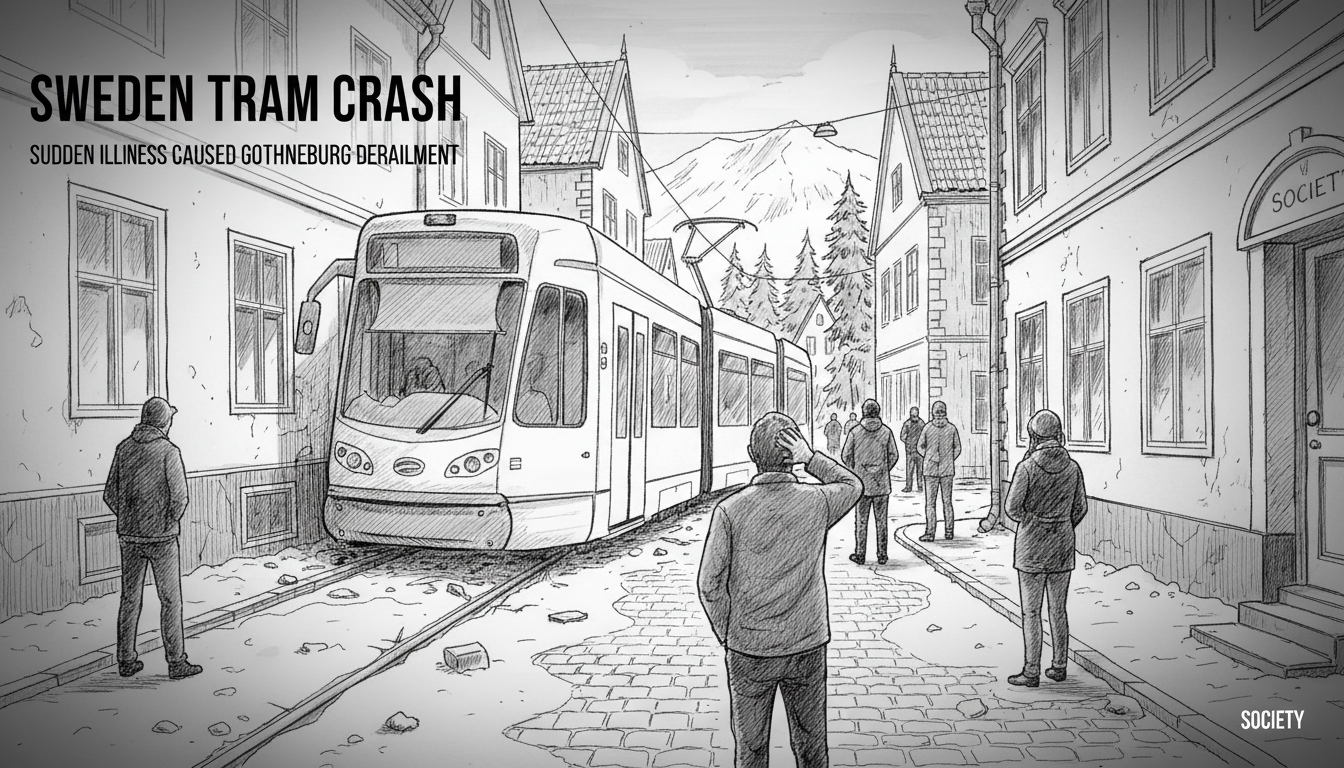
Sweden's Gothenburg tram accident in June was caused by a sudden medical emergency, police have concluded. The investigation into the derailment that sent a tram crashing into a street-side restaurant, injuring several people, has been closed. No criminal charges will be filed, as authorities found no evidence of intent or negligence, only a tragic health crisis behind the controls.
The scene at the intersection of Kungsportsavenyn and Vasagatan on that June day was one of shock and confusion. The familiar red and white tram, a symbol of the city's efficient public life, had left its tracks. It plowed into a gatukök, a classic Swedish street food kiosk, scattering tables and injuring patrons. For months, the question hanging over the city was simple: what happened? The police answer, delivered this week, points to a human vulnerability no safety protocol could fully prevent.
A City's Reliance on Rails
To understand the impact of such an event, you must understand Gothenburg's relationship with its trams. The network is the backbone of the city, carrying over 100 million passengers a year along 150 kilometers of track. It's more than transport; it's part of the civic rhythm. The clatter of wheels on rails is a constant soundtrack in neighborhoods like Linnéstaden and Majorna. An accident here doesn't just disrupt traffic; it feels like a tear in the city's social fabric.
"When something like this happens to our spårvagn, it feels personal," says Erik Lund, a lifelong Gothenburg resident I met near the site. "We trust this system every day. We trust the person driving it. To hear it was because the driver fell ill... it's tragic, but it also makes sense. We're all human."
From Suspicion to Sympathy
The police investigation began with serious potential charges: gross negligence and causing grievous bodily harm. In a society built on trust and systemic safety, the assumption was that a mechanical failure or an operational error must be to blame. Investigators combed through technical data, witness statements, and security footage.
Their conclusion shifted the narrative entirely. The evidence pointed not to a failure of the machine or the system, but to the sudden failure of the driver's health. The exact nature of the medical incident has not been disclosed, respecting the driver's privacy. This finding transforms the story from one of potential blame to one of unforeseen tragedy.
"This is a nightmare scenario for any public transport authority," says Anna Forsberg, a transportation safety analyst I spoke with. She is not connected to the investigation. "You can have the best vehicle maintenance, the most rigorous training, and strict protocols. But a sudden, acute medical event in a driver is incredibly difficult to guard against. Most systems rely on regular medical checks for drivers, but they cannot predict every acute episode."
Forsberg notes that such events, while shocking, are statistically very rare. The focus after an incident like this, she explains, often turns to emergency response protocols and whether systems like automatic braking could mitigate outcomes if a driver becomes incapacitated.
The Aftermath on Avenyn
The location of the crash is significant. Kungsportsavenyn—often just called 'Avenyn'—is Gothenburg's grand boulevard. It's a place for strolling, dining, and people-watching, lined with cafes and theaters. The gatukök, a staple of Swedish urban life serving hot dogs and burgers, represents everyday, accessible pleasure. The collision between the monumental tram and this humble kiosk created a powerful image of routine shattered.
Several people were injured in the accident. Two sustained serious injuries, a fact that underscores the potential danger of such a large vehicle moving uncontrolled, even at low speeds in a crowded area. The physical recovery for those injured continues, long after the headlines have faded.
For the driver, the psychological burden must be immense. To wake up in a hospital and learn your sudden illness caused public harm is a heavy weight. Swedish workplace culture, with its strong emphasis on employee welfare and 'lagom'—avoiding extremes—will likely focus on support and rehabilitation rather than public blame.
Safety in a Society Built on Trust
This incident touches a core Swedish value: trust. Swedes have a high level of institutional trust, extending to their public services. They trust that the water is clean, that the systems are fair, and that the trams run safely. An accident challenges that trust. The police's clear conclusion—attributing the cause to an unpredictable medical event—actually serves to restore some of that trust. It confirms the system wasn't inherently broken; it was struck by a random, human tragedy.
"We have to accept that life involves risk, even in the most well-organized societies," reflects Lars Pettersson, a sociologist at the University of Gothenburg. "The Swedish approach is to minimize systemic risk through design and regulation. But the human element is always present. The response to this event will be watched closely. Will it lead to calls for more stringent, perhaps invasive, health monitoring for drivers? Or will there be an acceptance of this as a tragic anomaly? That debate is very Swedish: it's about finding the balance between absolute safety and personal integrity."
Looking Down the Track
So, what happens now? The police case is closed. The injured continue their recovery. The tram network runs as usual, its drivers carrying the quiet knowledge of a colleague's worst-day scenario. The public transport authority, Västtrafik, will undoubtedly review its procedures. They may look at the frequency of medical check-ups or the feasibility of additional safety redundancies.
But the lasting impact may be more subtle. It's a reminder that behind every large, impersonal system—the trains, the buses, the networks that make modern city life possible—there are human beings. They are fallible, vulnerable, and subject to the same sudden twists of fate as anyone waiting at a tram stop.
The next time you board a tram in Göteborg, you might glance at the driver. You'll see a person doing a job, navigating tons of steel through crowded streets. You'll be reminded that safety is a shared contract. It relies on engineering, on rules, and on the fragile, incredible human body doing its best to get us all home. The accident on Avenyn wasn't a story of negligence. It was a story of chance. And in a city that plans for everything, that might be the hardest truth of all to accept.