
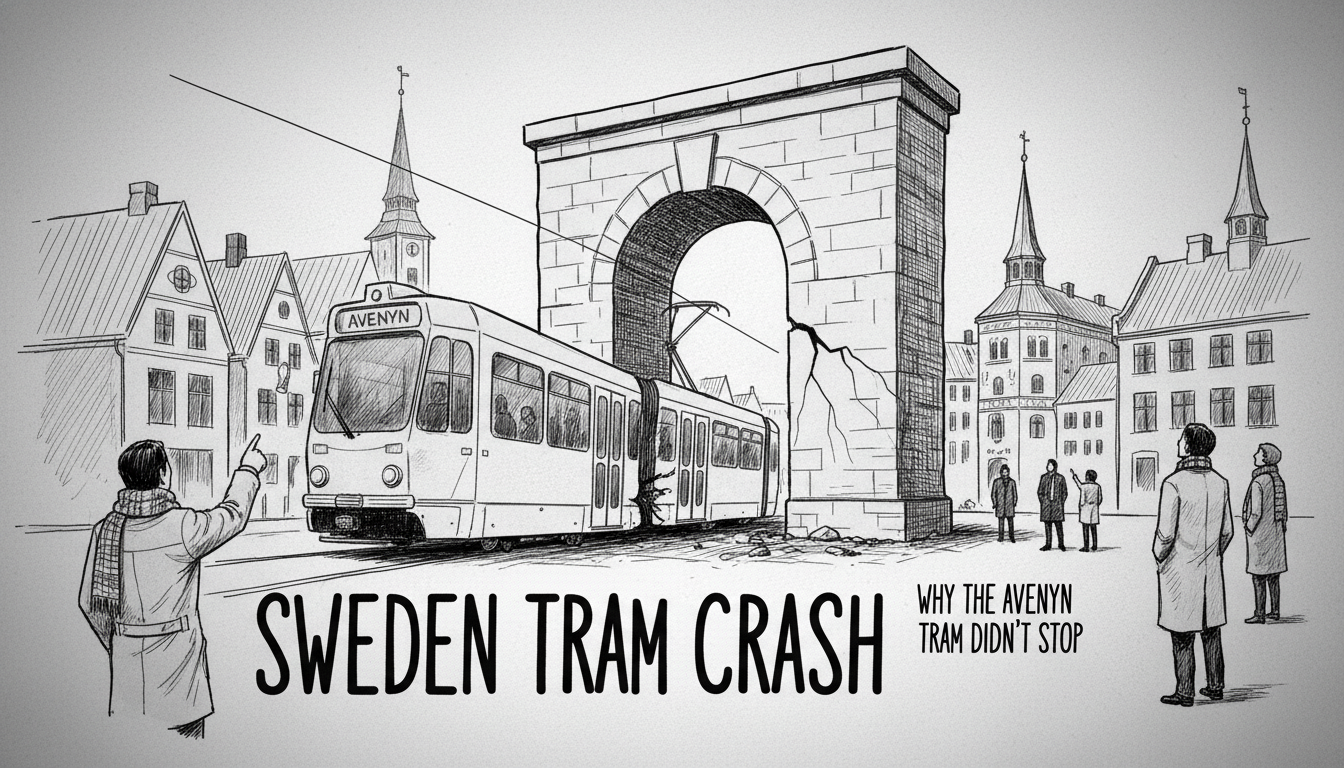
Sweden's Gothenburg tram accident last summer left several people seriously injured after the driver fell suddenly ill. The key question from investigators and the public remains: why didn't the tram stop? For months, the incident on the city's iconic Avenyn boulevard has cast a shadow over the trusted public transport system. Today, the findings of a critical investigation provide answers, revealing a complex interplay of human health and mechanical safety protocols.
It was a typical summer afternoon on Avenyn. The sun shone on the wide, tree-lined avenue, a central artery of Gothenburg life. Tourists browsed, locals enjoyed fika at outdoor cafés, and the familiar red and white trams glided along their tracks. Then, one tram's journey turned from routine to catastrophe. The driver experienced a sudden, severe medical emergency. He lost consciousness, his memory of the events wiped clean from that moment forward. With no one at the controls, the tram continued, resulting in a crash that sent shockwaves through the city.
The Investigation's Critical Findings
The official investigation, conducted by the Swedish Accident Investigation Authority, focused on two core elements: the driver's incapacitation and the tram's built-in safety systems. In Sweden, trams are equipped with a 'dead man's switch'—a safety device designed to automatically stop the vehicle if the driver becomes unresponsive. This mechanism, often a pedal or handle that must be continuously engaged, is a standard fail-safe in public transport worldwide.
So why did it fail here? The report indicates the driver's medical event was so instantaneous and severe that his body may have remained in a position that kept the safety device engaged for a critical few seconds. "The sequence of events was extremely rapid," an investigator familiar with the case explained. "The system is designed to detect a release of pressure or a conscious letting go. In this tragic scenario, the driver's physical collapse did not trigger that specific signal in time to prevent the accident." The tram's momentum on the relatively straight section of Avenyn meant those seconds were decisive.
A City's Relationship with its Trams
To understand the impact of this accident, one must understand Gothenburg's relationship with its spårvagnar. The tram network is not just transport; it's a cultural symbol. Its routes connect neighborhoods like Majorna, Haga, and Linnéstaden, weaving through the city's fabric. The gentle rumble of trams is a constant soundtrack to urban life. For many, it's the most reliable way to travel, rain or shine. This deep trust made the Avenyn incident particularly unsettling.
"We take the tram's safety for granted," said Elias Berg, a student who uses the network daily. "You hop on, you tap your card, you trust the driver and the machine. This accident made everyone stop and think. It felt like a breach of a very basic contract." The incident sparked intense public debate on forums and in local media about transportation safety, driver health screenings, and whether technology had kept pace with potential risks.
The Human Factor and Health Protocols
The investigation inevitably turned to the driver's health. In Sweden, professional transport operators undergo regular medical examinations. The driver involved had a clean bill of health and no prior history suggesting such an event was likely. This point is crucial for the investigation's conclusion: the illness was an unforeseeable, acute medical crisis.
"This highlights a difficult reality in safety engineering," said Dr. Lena Karlsson, a professor of transportation safety at Chalmers University of Technology in Gothenburg. "You can design for foreseeable human error—distraction, fatigue. But an immediate, total incapacitation from a sudden health event presents a different challenge. The systems are designed to respond to an intentional 'letting go,' not necessarily to every possible physical state following a collapse."
The report suggests reviewing the sensitivity and design parameters of these fail-safe mechanisms. Could they be adjusted to detect a wider range of unconscious states? This question is now on the agenda for transport authorities and tram manufacturers.
Safety in the Aftermath: What Changes?
In the months since the crash, operator Västtrafik and the city's transport authority have been under pressure to respond. While the investigation found no negligence, it has prompted a proactive review. Discussions are underway about potential technological augmentations. These include systems that monitor driver alertness through eye-tracking or posture sensors, which could provide an additional layer of safety beyond the physical dead man's switch.
However, implementing new technology across a large fleet is a slow and costly process. There are also concerns about privacy and creating an overly monitored work environment for drivers. Any changes will involve careful negotiation with union representatives. For now, the immediate focus has been on reinforcing support for drivers and reviewing medical check-up protocols, even within the constraints of Swedish privacy law.
A Community's Path Forward
The physical scars on Avenyn have healed. The tracks are busy again. But for those seriously injured and for the driver, whose life was also irrevocably changed, the event lingers. The investigation's closure provides answers, but not necessarily comfort. It confirms a narrative of tragic, random chance rather than systemic failure—a finding that is both reassuring and deeply unsettling.
As Gothenburg moves forward, the accident serves as a somber reminder. It highlights the immense responsibility borne by public transport operators and the complex engineering behind every seemingly simple journey. The city's trams will continue to ring their bells along Avenyn, but with a renewed, silent awareness of the delicate balance between human and machine. The ultimate question remains: in our pursuit of perfect safety, can we ever fully guard against the unpredictable nature of human health?