
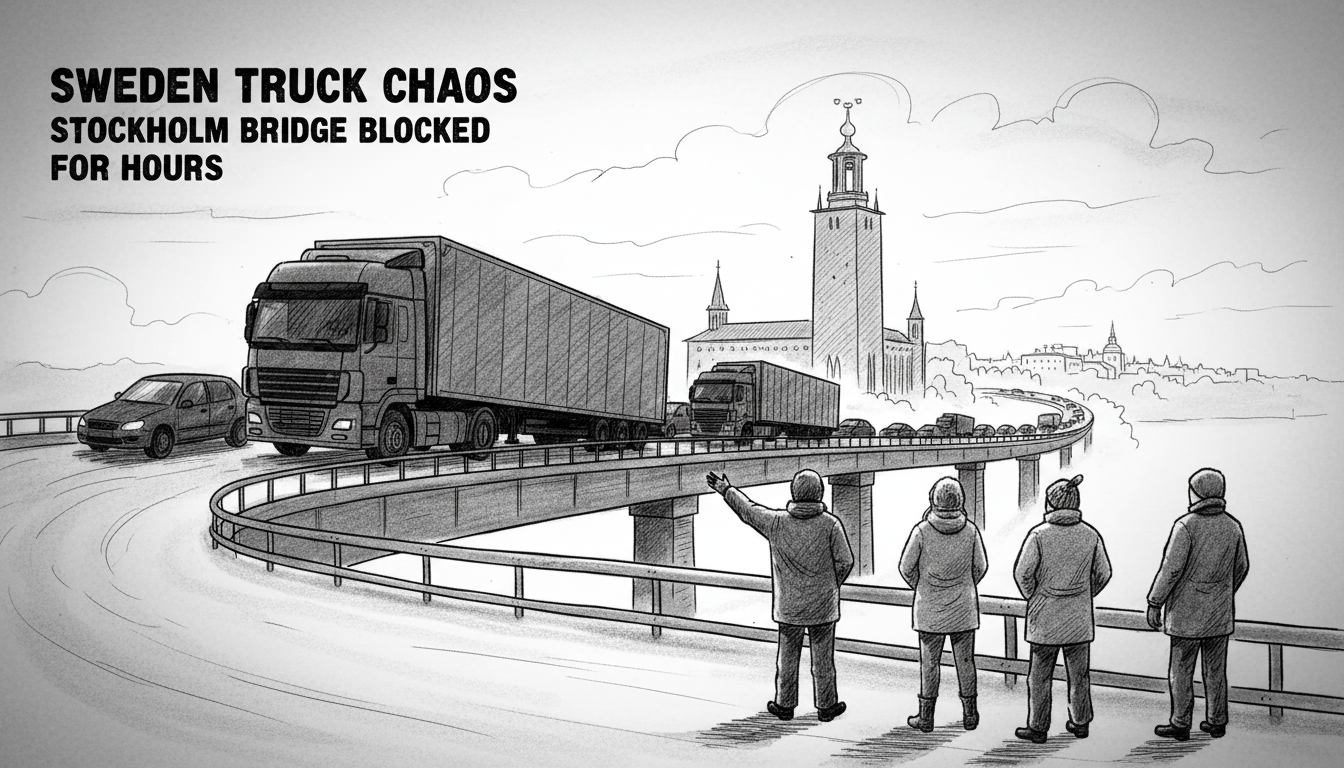
Stockholm traffic disruption hit a peak on Tuesday morning when a truck became firmly wedged under Lilla Västerbron, causing a complete standstill. The incident occurred near Rålambshovsparken on Kungsholmen, a key artery connecting the island to Södermalm. Police confirmed the truck was simply too tall for the bridge's clearance, and recovery crews were urgently called to the scene. For thousands of commuters, cyclists, and bus passengers, the morning transformed into a frustrating test of patience. The familiar hum of the city was replaced by the sound of idling engines and exasperated sighs.
I was on my bike, heading from my apartment in Vasastan to a meeting on Södermalm, when I joined the growing crowd of stranded people. The scene was almost comical in its sheer inconvenience. A single truck had managed to paralyze a major part of inner-city Stockholm. Delivery drivers leaned against their vans, scrolling on their phones. Cyclists dismounted, peering ahead to see the source of the blockage. The iconic view of Västerbron and Riddarfjärden was now framed by a tableau of urban gridlock. It was a stark reminder of how fragile our city's mobility can be.
A Recurring Stockholm Spectacle
While dramatic, this is not a unique event in Stockholm or other Swedish cities. Trucks getting stuck under low bridges is a recurring, almost seasonal, nuisance. Locals might recall the infamous ‘Bridge 9’ on the way to Arlanda Airport, a notorious trap for rental trucks. In Gothenburg, similar incidents periodically snarl traffic around the inner harbor. Each event follows a familiar pattern: a misjudgment, a loud scrape, and then a city grinding to a halt. The problem often lies with drivers unfamiliar with their vehicle's height or with specific route restrictions. International drivers, or those using rented vehicles, are frequently involved.
“You see it too often,” said Erik Lundström, a traffic planner I spoke to after the incident. “The signs are there, but in a busy urban environment, drivers can miss them or misread their maps. The consequences are disproportionate. One mistake can affect tens of thousands of people.” He pointed out that these incidents are more than just a traffic headache. They cause significant economic costs through delayed deliveries, lost work hours, and strain on public transport. Emergency services also face challenges navigating the unexpected congestion.
The Ripple Effect Across the City
The impact of the Lilla Västerbron blockage spread far beyond the immediate bridge. With a key route severed, traffic was forced onto alternative paths across Kungsholmen and into the city center. Drottningholmsvägen and other main roads became parking lots. Bus routes were diverted or severely delayed, leaving passengers waiting at stops with uncertain updates. For those relying on Stockholm's public transport, the disruption was a test of the system's resilience. While the tunnelbana (metro) ran unaffected, above-ground connections were in chaos.
The human stories emerged from the frustration. Lisa, a nurse trying to get to Karolinska University Hospital, told me she was 40 minutes late for her shift. “I left extra time, but nothing could prepare for this total stop,” she said, waiting for a diverted bus. “You feel helpless.” Meanwhile, café owners in the affected areas saw a sudden, unexpected lull in their morning rush. The usual flow of customers was stuck somewhere in the snarl. This single logistical error created a domino effect, touching small businesses, healthcare, and daily routines across central Stockholm.
The Cultural Quirk of ‘Brotthaken’
There’s even a Swedish word for these kinds of traffic snarls: ‘trafikkaos’. But more specifically, the phenomenon of a stuck truck has a certain cultural footprint. It reliably generates a mix of irritation and wry amusement. Social media quickly fills with photos of the culprit vehicle, often with witty captions. It becomes a shared, albeit annoying, experience. In a society that values efficiency and punctuality (‘tidigheten är konungens’ – punctuality is the king’s), such events are a profound nuisance. They disrupt the famous Swedish flow, the expectation that systems should work smoothly.
This incident happened near Rålambshovsparken, a beloved green space where Stockholmers sunbathe in summer and walk year-round. The contrast was striking: a peaceful park setting adjacent to a perfect storm of urban dysfunction. It highlighted the constant negotiation in Stockholm between historic infrastructure and modern traffic needs. Many of the city’s bridges and underpasses were built in an earlier era, with different vehicle dimensions in mind. Modern logistics and larger trucks constantly test these historical limits.
Prevention and the Path Forward
So, what can be done? Experts like Lundström suggest a multi-layered approach. “Better, more prominent signage is the first line of defense,” he stated. “But technology can help more. GPS systems for commercial vehicles must have updated, mandatory settings for height restrictions. We need ‘geofencing’ that alerts drivers before they enter a risky zone.” Some municipalities have installed laser-activated warning systems that flash if an over-height vehicle approaches. Others propose stricter penalties for companies whose drivers repeatedly cause such disruptions, incentivizing better training and route planning.
For the average Stockholmer, the solution feels urgent. The city is growing, and traffic pressure is increasing. While the long-term vision involves expanded public transport and congestion reduction, the immediate need is to prevent these easily avoidable crises. Every hour spent stuck in traffic is an hour lost from work, family, or the cherished Swedish work-life balance. The incident on Lilla Västerbron is a loud, concrete reminder that urban planning must account for human error. It demands smarter infrastructure, not just more of it.
A Return to Flow – Until Next Time
By late morning, the recovery crews had successfully freed the truck. The traffic, like water finding a new path, slowly began to move again. The backlog took hours to fully clear. The physical scar—perhaps some paint on the bridge girders—was minimal. The memory for commuters, however, will last longer. As the city returned to its normal rhythm, the questions lingered. Was this a simple mistake, or a symptom of a larger strain on our city's bones?
Stockholm is a city of bridges, both literal and metaphorical. They connect our islands, our communities, and our daily lives. When one fails, even temporarily, we feel the disconnect profoundly. Today’s Sweden bridge accident was a short story of miscalculation and major consequence. It served as an unplanned drill, testing our patience and our systems. As I finally cycled across a cleared Västerbron, the wind coming off Lake Mälaren felt refreshing. The city was moving again. But everyone knew: it’s only a matter of time before the next truck meets the next low bridge. The real test is whether we learn anything before it happens again.