
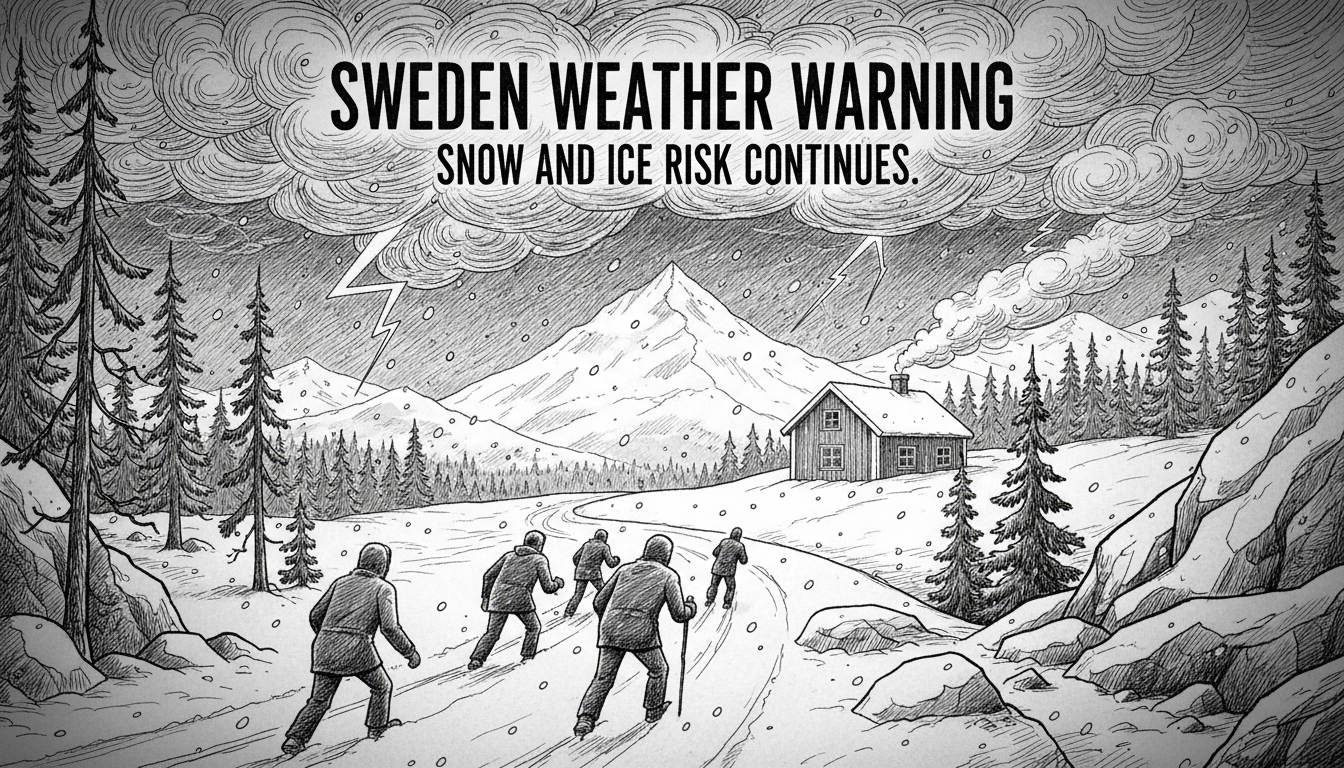
Sweden weather warnings are in effect as a persistent cold snap brings more snow and treacherous icy roads. The Swedish Meteorological and Hydrological Institute (SMHI) forecasts intermittent snowfall continuing into Monday, urging drivers across the country to exercise extreme caution. Meteorologist Moa Hallberg’s advice is simple but critical: “Keep your distance.”
For many Swedes, this is just another winter week. But for newcomers and visitors, the reality of navigating a Swedish winter can be a shock. The snow that blankets Stockholm’s Gamla Stan in picturesque white also creates a hidden hazard: black ice. This invisible danger forms when moisture freezes on road surfaces, creating a transparent, glass-like layer that is nearly impossible to see until it’s too late.
The Science of Slippery Streets
SMHI categorizes its alerts using a color-coded system. Yellow warnings suggest potential disruption, orange indicate expected impacts, and red signal severe danger requiring immediate public action. The current warnings across central and southern Sweden largely sit in the yellow to orange range. Yet even a yellow warning demands respect. “The risk isn’t just during the snowfall itself,” Hallberg explains. “It’s the cycle of melting and refreezing. Daytime temperatures might creep above zero, then plunge at night. That’s when black ice becomes a major problem on roads and sidewalks.”
This isn’t just an inconvenience. According to data from the Swedish Transport Administration, winter conditions are a contributing factor in a substantial portion of annual traffic accidents. While Sweden’s infrastructure is built for this—with a fleet of plows and a well-practiced salting regimen—the first hours of a snowfall are always the most dangerous. Road crews work tirelessly, but they can’t be everywhere at once.
A Stockholm Commuter’s Morning
To understand the human impact, you only need to ride the pendeltåg commuter train or watch the morning traffic on Essingeleden, Stockholm’s main arterial motorway. Lisa Bergman, a teacher commuting from Sollentuna into the city, describes her altered routine. “I left 25 minutes earlier today,” she says, waiting on a slippery platform. “The bus was slow, everyone is driving so carefully. You see people brushing snow off their cars in the dark, and you just know it’s going to be one of those days.” Her experience is mirrored in suburbs from Huddinge to Upplands Väsby.
The culture of preparedness is deeply ingrained. Winter tires are not just recommended; they are legally required from December 1st to March 31st. Many Swedes switch to studded tires for extra grip. Yet, as traffic safety expert Erik Lundström notes, the best equipment is useless without adjusted behavior. “The most important winter tire is the one between your ears,” he says wryly. “People get overconfident. They have four-wheel drive and studded tires, so they think they can drive normally. Physics doesn’t care. On ice, everyone has the same stopping distance: a very long one.”
Beyond the Highways: A City Adapts
The impact ripples beyond the roads. In Stockholm, city workers focus on clearing cycle paths and pedestrian walkways, but side streets in neighborhoods like Södermalm or Vasastan can remain slick for days. Older residents become hesitant to leave their homes, a quiet isolation exacerbated by winter. Delivery times for everything from food to online shopping slow down. Schoolyards are filled with children in snowsuits, but the walk to school requires careful planning by parents.
There’s a distinct societal rhythm to a Swedish winter. Weather forecasts are not small talk; they are essential planning tools. The concept of “väder” (weather) dominates coffee break conversations. Apps like SMHI’s and Trafikverket’s are checked as routinely as the time. This collective awareness is a form of social defense against the climate.
The Expert Perspective on Staying Safe
So, what does “keeping your distance” really mean in these conditions? Experts break it down. On dry asphalt at 50 km/h, a safe following distance might be two seconds. On icy roads, that needs to triple to at least six seconds. Sudden maneuvers—hard braking or sharp steering—are the most common triggers for a loss of control. The advice is to drive smoothly, as if you have a cup of hot coffee on your dashboard that you don’t want to spill.
For pedestrians, the advice is equally straightforward but often forgotten. “We see so many people, especially in cities, wearing completely inappropriate footwear,” says Lundström. “Fashion boots with smooth soles are a recipe for a fall. It sounds simple, but wear shoes with grip. Take smaller steps. Use handrails.” He points out that pedestrian injuries from slips and falls spike dramatically during these icy periods, placing a significant burden on healthcare services.
Looking Ahead: A Week of Winter
SMHI’s forecast offers little immediate relief. The cold air is entrenched over Scandinavia. While major disruptions are not currently predicted, the pattern of occasional snow showers followed by freezing temperatures is set to continue. This creates a sustained, low-level hazard rather than a single dramatic storm. For authorities, it’s a marathon, not a sprint, requiring constant salting and plowing to keep the transportation network fluid.
There is a certain stoic acceptance in the Swedish response. Winter is not an adversary; it is a condition of life. The darkness and the cold are met with candles in windows, the practice of “mys” (coziness), and a pragmatic focus on practical solutions. The weather warning is not a signal for panic, but for a collective shift in pace. It is a reminder to slow down, to pay attention, and to respect the power of the natural world that defines this part of the globe for nearly half the year.
As the streetlights come on early over Slussen, casting a glow on the icy cobblestones, the city adjusts its tempo. The snow keeps falling, softly but persistently. The warning stands. For now, the message from meteorologists, traffic experts, and seasoned commuters alike is unanimous: take it slow, plan ahead, and for heaven’s sake, keep your distance. Will this be the winter’s last major bite, or just a taste of what’s to come? Only time, and the next SMHI forecast, will tell.