
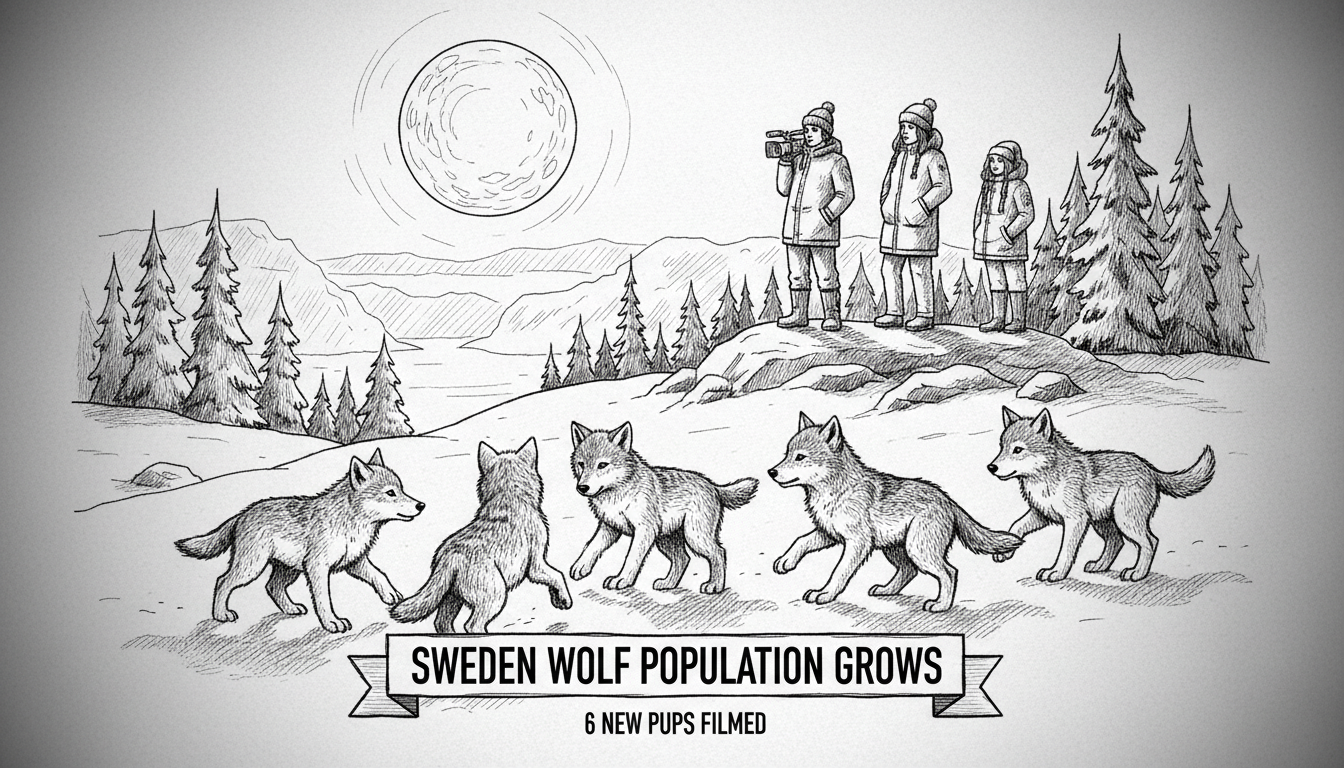
Sweden's wolf population continues its steady expansion, with new footage revealing six pups in the Brängen territory. The discovery in the forests between Mullsjö and Ulricehamn municipalities confirms successful reproduction for this pack. This development adds fresh data to the intense national debate over carnivore management. The Swedish Parliament and government face renewed pressure to define a clear, sustainable policy.
A Rare Glimpse into Pack Life
County administrative board officials confirmed the birth of six wolf pups this spring in the Brängenreviret. This territory spans the border of Jönköping and Västra Götaland counties. Autumn camera traps first captured a family group of nine wolves, which experts considered unusual for its size. The new pups, filmed playing near a den site, indicate the pack's health and stability. Their survival through the first critical months is a positive sign for local biodiversity.
"Observing a full family group with this many pups is significant," said a county wildlife officer familiar with the footage. "It tells us the territory can support them, and the pack is well-established." The footage provides invaluable behavioral data for researchers. Monitoring efforts rely on such observations, alongside genetic sampling and snow tracking, to estimate populations. This pack's success story unfolds against a backdrop of deep political division in Stockholm.
The Political Landscape of Wolf Management
The wolf's return to Sweden is a modern ecological success story with profound political complications. Wolves were functionally extinct in Sweden by the 1960s. Natural recolonization from the Finnish-Russian population began in the 1980s. Today, management is governed by a complex framework of EU directives and Swedish law. The Riksdag has delegated much authority to the Swedish Environmental Protection Agency (Naturvårdsverket).
However, major decisions on hunting quotas and population targets require political approval. The government, based at Rosenbad, must balance the EU's strict protection of the species with domestic pressures. These include livestock owners fearing attacks, hunters concerned about game populations, and conservationists advocating for robust predator numbers. Each interest group lobbies ministers and MPs, making consensus elusive. Recent Riksdag decisions have alternately authorized limited hunts and imposed stricter protections.
"The core conflict is between different visions of the Swedish countryside," explains Professor Lena Karlsson, a political scientist specializing in environmental policy. "One view sees wolves as a natural part of the ecosystem. Another views them as a direct threat to rural livelihoods and traditions. The government's policy often shifts with the parliamentary majority." This year, 345 wolf observations have been reported via the Skandobs platform, highlighting their growing presence.
The Science Behind the Population Count
Determining the exact number of wolves in Sweden is a sophisticated scientific endeavor. It is not based solely on public sightings like those logged on Skandobs. The official winter count, conducted annually, uses a combination of DNA analysis of scat and urine, radio collaring, and systematic tracking in snow. This method aims to identify individual wolves and family groups across the country.
The minimum confirmed population has fluctuated in recent years, often between 300 and 400 individuals. The discovery of new litters, like the one in Brängen, directly influences these annual figures. The goal is to maintain a "favorable conservation status" as required by the EU, while preventing inbreeding. This necessitates genetic exchange with the Finnish-Russian population, which requires functional wildlife corridors. Government policy must therefore also consider landscape connectivity and cross-border cooperation.
Regional Impacts and Local Tensions
The confirmation of a reproducing pack in central Sweden has immediate local consequences. For municipalities like Mullsjö and Ulricehamn, it means adapting coexistence strategies. The County Administrative Board (Länsstyrelsen) will likely intensify monitoring and may issue guidance to pet owners and farmers. Compensation schemes for livestock depredation, funded by the state, become more relevant.
Local hunting associations often have strong opinions on the matter. They argue that a rising wolf population impacts moose and roe deer numbers, potentially altering hunting traditions. Conversely, wildlife tourism businesses may see an opportunity. The deep-seated tension is palpable in many rural communities, where the wolf symbolizes a wider cultural clash. It pits traditional land use against modern conservation ideals, a debate frequently echoed in the Riksdag building's committee rooms.
The Path Forward for Swedish Policy
The new wolf pups are more than a wildlife story; they are a policy trigger. Their existence will be factored into the next official population assessment. That assessment will inform the Swedish Environmental Protection Agency's recommendations to the government. Ministers must then decide if, and how, to manage the population through licensed hunting or protective measures.
Any proposed policy shift will need to survive scrutiny in parliament. It must align with the EU Habitats Directive while addressing domestic concerns. The Social Democratic government, or any future administration, must navigate this minefield. The debate touches on property rights, animal welfare, biodiversity goals, and the very identity of rural Sweden. It is a quintessential example of how environmental management is deeply intertwined with governance.
Ultimately, the footage from the Brängen forest is a snapshot of a wild success. Yet it also guarantees that the wolf will remain a persistent and heated item on the Swedish political agenda. The challenge for Sweden's political leaders is to transform conflict into a durable, science-based consensus. The future of both the wolves and the communities they live near depends on it.