
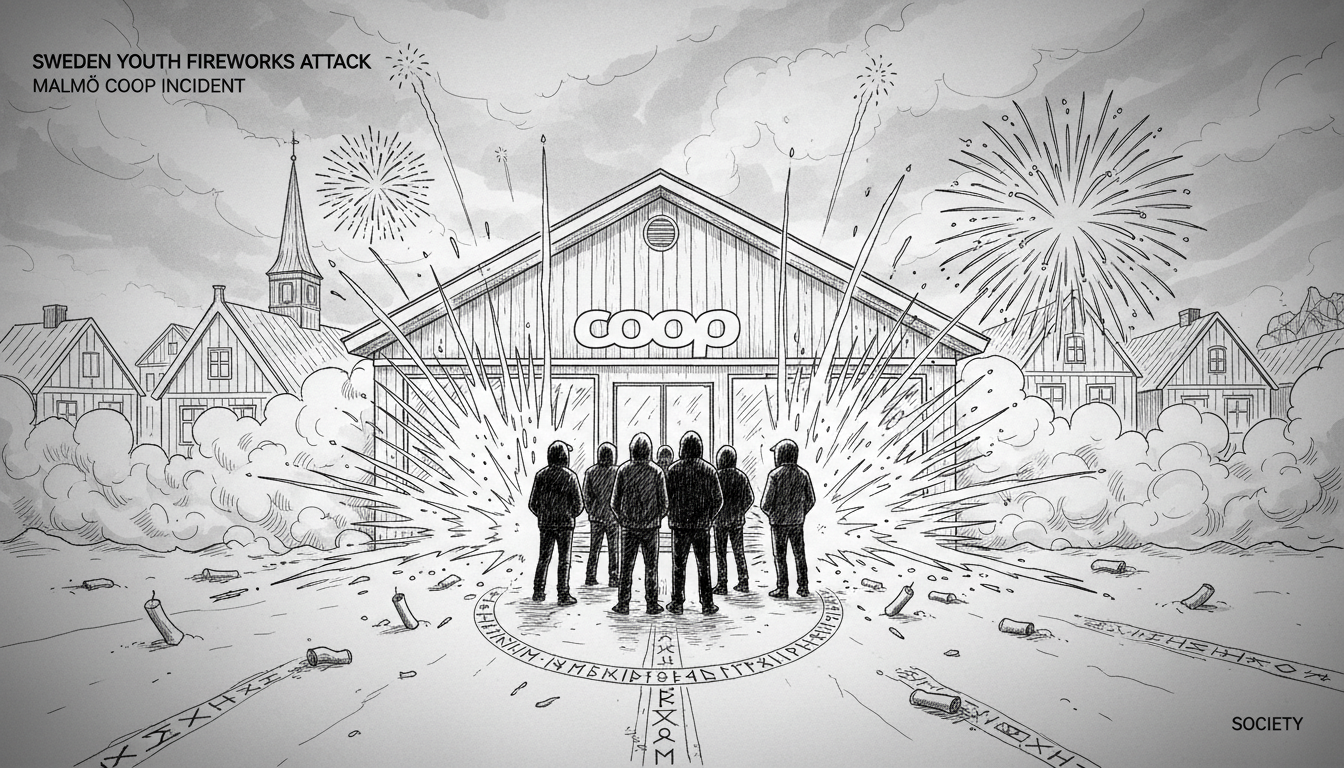
Sweden youth violence flared in Malmö on a recent evening when a group of teenagers threw firecrackers and shot fireworks inside a busy supermarket. Police were called to the Stora Coop store at 20:52, responding to what many locals describe as a terrifying disruption in a place meant for quiet, everyday shopping. The incident, which resulted in no reported injuries or property damage, has ignited a broader conversation about public safety, youth engagement, and the complex social fabric of Sweden's third-largest city.
For shoppers like Anette Lundström, a 42-year-old teacher from the nearby Rosengård district, the event was a shock. "You go to buy milk and bread," she told me, standing outside the store the next day. "You don't expect explosions and flashes. My first thought was for the elderly people and the children who might have been there. It's not just dangerous; it shows a deep disrespect for our shared spaces." The Coop, a cornerstone of local commerce, represents more than just a grocery store in many Swedish neighborhoods. It's a community hub, especially in areas like this where large retail options are vital.
A Pattern of Pyrotechnic Mischief
While this specific incident caused no physical harm, it fits into a recurring pattern of fireworks misuse that spikes around holidays like New Year's Eve and Sweden's National Day. However, random, off-season attacks in enclosed spaces mark a worrying escalation. Swedish police have long struggled with regulating fireworks, which are legal for adults to purchase during specific periods but are often obtained illegally by minors. The Malmö police press spokesperson, Patric Fors, confirmed officers spoke with the youths involved. "We were on site and talked to the teenagers," Fors said. The response highlights a common challenge: intervening in acts that cause alarm and disruption but, in this case, did not cross into clear-cut criminal damage or assault.
Security experts point to the inherent difficulty of protecting large, open retail environments. "A supermarket is designed to be welcoming and accessible," said Karl Jensen, a security consultant based in Stockholm who has worked with retail chains. "It's nearly impossible to prevent someone from walking in with items concealed in a pocket. The focus shifts to rapid response and de-escalation, which appears to be what happened here. But each event like this chips away at the public's sense of security."
Beyond the Bang: Understanding Malmö's Challenges
To view this event solely through a lens of petty crime or youthful pranks misses the deeper context of Malmö. The city is a proud symbol of modern, multicultural Sweden but also grapples with significant socioeconomic disparities. Areas with higher unemployment rates, particularly among young adults, and pockets of segregation can become breeding grounds for frustration and alienation. Social integration remains a key topic in Swedish society news, and incidents like the Coop fireworks attack often get framed within this larger, more difficult discussion.
"We must ask what these young people are signaling," said Dr. Lena Månsson, a sociologist at Malmö University who studies urban youth communities. "Is it boredom? A cry for attention? A test of boundaries? Often, it's a mix. The fireworks themselves are a potent symbol—they create light, noise, and demand to be seen, however briefly. When positive channels for recognition and engagement feel closed off, negative ones can fill the void." She emphasizes that while not excusing the behavior, effective solutions require looking at after-school programs, youth center funding, and mentorship opportunities, especially in the long, dark Scandinavian winters when outdoor activities dwindle.
The Community's Response and the Path Forward
Back at the Stora Coop, store management declined to comment on the record about specific security changes. However, the mood among staff and regular customers was one of weary resilience. "We clean up and we open again," said one employee, who asked not to be named. "What else can we do? We serve this neighborhood." This pragmatic response is quintessentially Swedish, favoring calm resolution over dramatic reaction. Yet, beneath the surface, concerns simmer.
Local politicians have called for a multi-pronged approach. Some advocate for stricter nationwide controls on fireworks sales, a perennial debate in Sweden. Others, like Malmö city councilor Amir Ali, focus on social investment. "Police intervention is necessary in the moment," Ali told me. "But the long-term work happens earlier. It happens in schools, in sports clubs, and in creating real job prospects. We need to offer a better, louder 'bang' for our youth's future than what a firecracker can provide."
The incident, brief and without physical tragedy, serves as a microcosm of larger tensions. It touches on themes of public order, the challenges of integration, and the search for belonging that defines the adolescent experience everywhere, albeit here with a pyrotechnic twist. As Swedish society trends toward becoming ever more diverse, its success will be measured not just by economic metrics but by its ability to make all its residents, especially the young, feel they have a stake in the communal peace.
As the days pass, the noise and flash in the Coop aisle will fade from direct memory. But the questions it ignited will likely smolder for much longer. Can a society famed for its consensus and calm find ways to channel the explosive energy of its disaffected youth into something constructive? The answer will determine not just the safety of grocery stores, but the health of the community itself.