
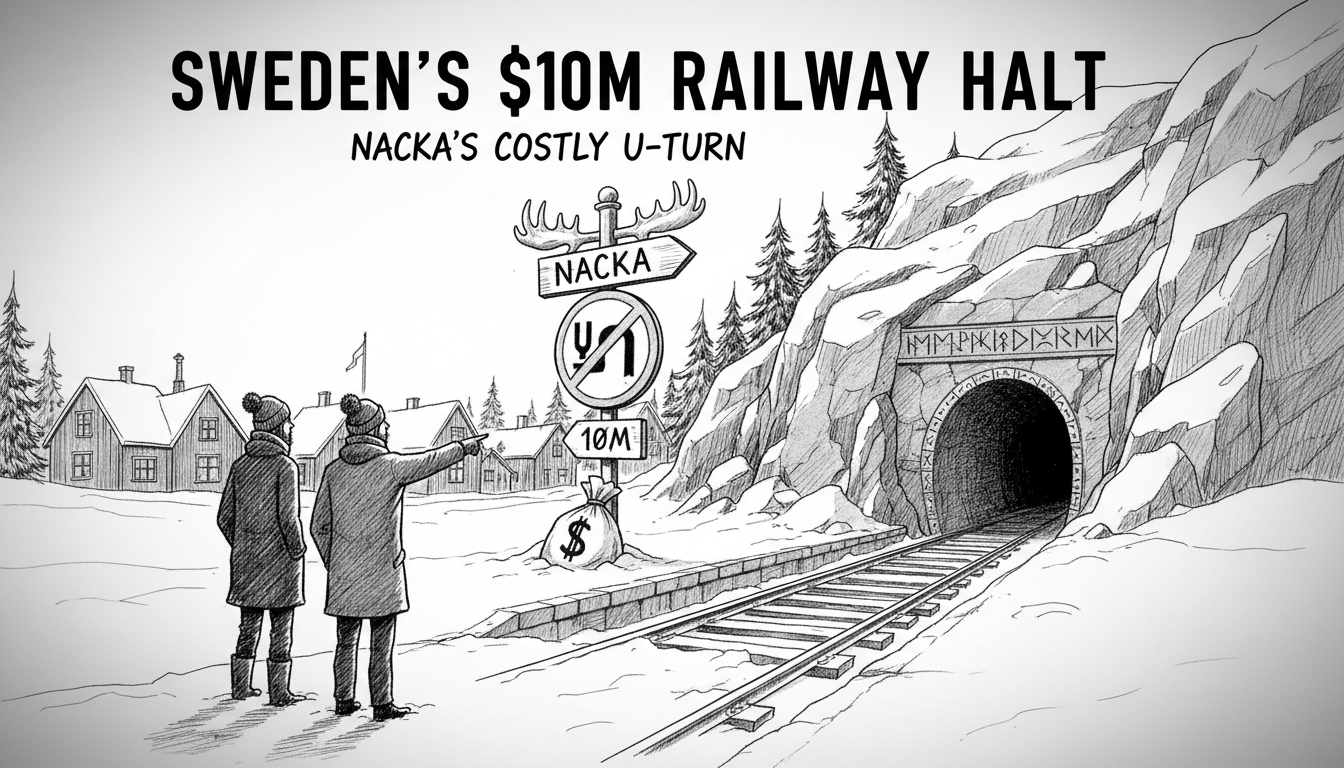
Sweden's Nacka municipality has spent over 100 million kronor on a railway project that will never be built. The plan to elevate the Saltsjöbanan commuter line, intended to unite Sickla shopping district with Alphyddan and Finntorp, was abruptly halted last March. Officials pulled the emergency brake when projected costs exploded from 280 million to a staggering 1.2 billion kronor. By that point, 59 million kronor had already vanished into planning and preparatory work. This financial saga highlights the precarious balancing act in Stockholm's booming eastern suburbs, where ambitious growth meets harsh budgetary realities.
A Vision Derailed
The Saltsjöbanan is more than just tracks and trains. For decades, this picturesque railway has connected the heart of Stockholm at Slussen to the leafy archipelago communities of Nacka. It's a vital artery for commuters and a cultural touchstone. The elevation project was born from necessity. Nacka is one of Sweden's fastest-growing municipalities, with new apartment blocks rising around stations like Nacka and Sickla. The vision was elegant: lift the railway onto a bridge, freeing the ground below for better traffic flow on Värmdövägen and creating seamless pedestrian connections between key areas. Architectural renderings showed a modern, integrated transport hub. "It was supposed to solve tomorrow's problems today," says Lars Pettersson, a urban planner familiar with the initial proposals. "The goal was to untangle the growing congestion before it strangled development."
The Numbers That Didn't Add Up
What went wrong? According to municipal documents, the cost estimates began to creep, then sprint, upwards. Initial feasibility studies reportedly failed to account for the immense complexity of building a new elevated rail bed while maintaining uninterrupted service on the existing line. The price of materials like steel and concrete surged. Labour costs in the overheated Stockholm construction market added further pressure. By early 2023, the projected 280 million SEK bill had morphed into 1.2 billion. For Nacka's politicians, the math became impossible. "We have a responsibility to our taxpayers," a municipal spokesperson said in a statement announcing the halt. "Continuing would have meant sacrificing other crucial investments in schools, elderly care, and climate adaptation for years to come." The decision, while fiscally prudent, leaves a 59 million kronor hole and a station building in limbo.
A Station in Storage
One of the most tangible symbols of this stalled project is the Nacka station house itself. The charming wooden building, a local landmark, must be moved to make way for the separate, but essential, expansion of Värmdövägen road. The municipality has allocated 3.5 million kronor to purchase, carefully dismantle, and store the structure. Its future home, however, remains a mystery. "It's a piece of our history, wrapped in plastic on a pallet," sighs Anna Bergström, a lifelong Nacka resident. "They spent millions to save it, but for what? It feels like a metaphor for the whole project—well-intentioned, expensive, and currently going nowhere." This detail captures the project's irony: spending millions to preserve the past because of a failed plan for the future.
Expert Perspective: A Systemic Challenge
Infrastructure experts see the Saltsjöbanan saga as symptomatic of a wider issue. "Major public transport projects in growing urban regions are incredibly difficult to budget," explains Dr. Elin Mårtensson, a researcher in transport economics at KTH Royal Institute of Technology. "You have volatile global material costs, a competitive labour market, and immense pressure to avoid disrupting daily commutes. The margin for error is tiny." She notes that the Saltsjöbanan's unique status—a municipally owned railway—adds another layer. Unlike state-run projects, the financial risk rests entirely on one locality's balance sheet. "Nacka is growing, but its tax base isn't infinite. The choice became: one railway bridge or multiple new schools. It's a brutal prioritization." Dr. Mårtensson suggests that better regional cooperation and more conservative initial risk assessments are needed for future projects.
What Comes Next for Nacka's Transport?
The cancellation leaves a pressing problem unsolved. Traffic congestion on Värmdövägen is a daily headache for thousands. The Saltsjöbanan, at ground level, acts as a barrier. The municipality now faces the challenge of finding cheaper, incremental solutions. Ideas being discussed include improved bus lanes, smarter traffic light systems, and incentives for cycling. Some residents wonder if a scaled-back version of the elevation could be revisited. "The need hasn't disappeared," says commuter Mikael Johansson, waiting at Sickla station. "Every morning, the queues get longer. We spent 100 million to learn it would cost 1.2 billion. Fine. But what's Plan B?" The question hangs over Nacka's future development plans, forcing a rethink of how to sustainably connect new neighbourhoods like Alphyddan to the rest of the city.
The High Cost of Saying No
This story is ultimately about the price of prudent governance. The 100+ million kronor already spent—on consultants, engineers, environmental assessments, and the station house—is a significant sum for a municipality. It represents libraries not built, playgrounds not renovated, or climate subsidies not given. Yet, officials argue that stopping was the only responsible choice, preventing a financial catastrophe ten times larger. The episode serves as a cautionary tale for other Swedish municipalities embarking on large-scale infrastructure projects. It underscores the importance of robust, pessimistic early-stage costing and transparent communication with citizens. For now, the renderings of an elevated Saltsjöbanan remain just that—digital visions of what might have been, paid for with real money that is now gone. The tracks remain at ground level, the traffic builds, and Nacka continues to grow, searching for a more affordable path forward.