
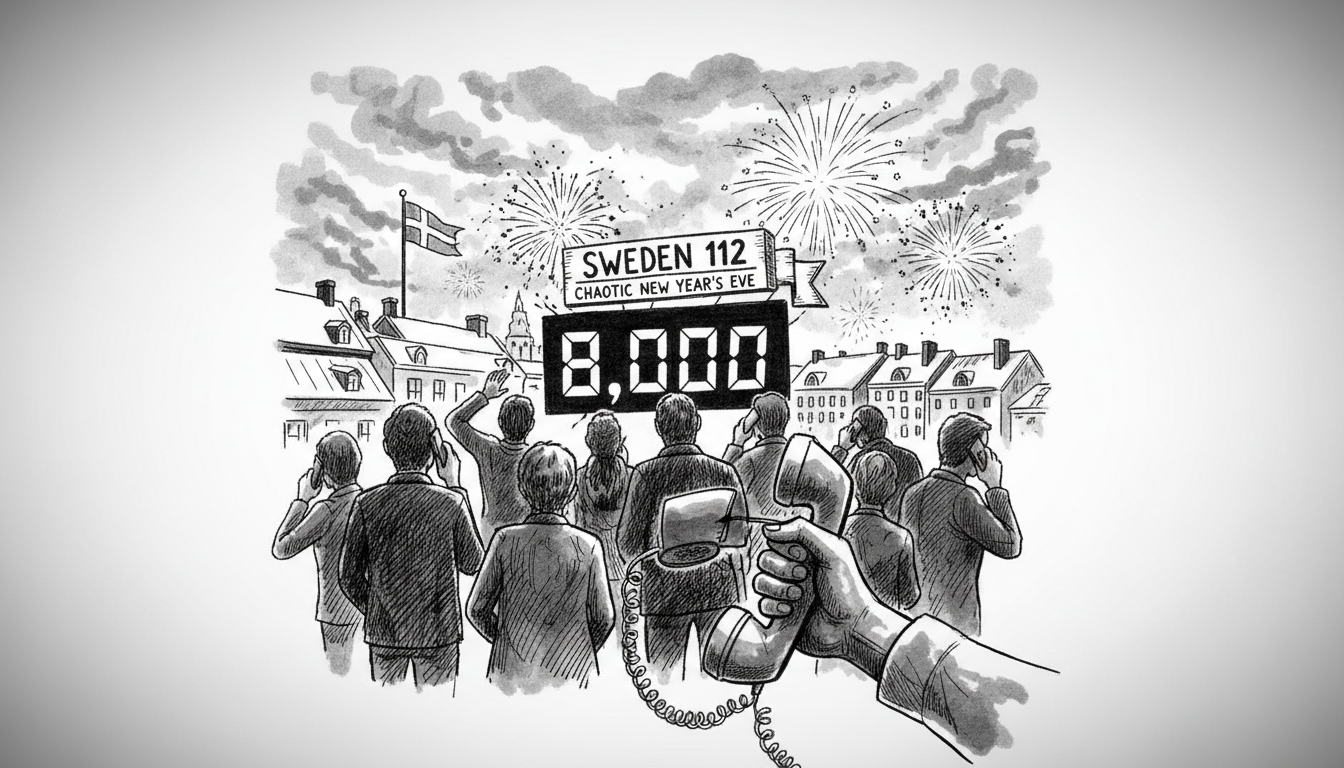
Sweden's national emergency number 112 braces for a predictable annual storm every December 31st. As fireworks light up the sky, SOS Alarm's call centers face a tidal wave of dials. The volume triples at midnight, with one in three calls being a non-emergency. This surge creates a dangerous queue where a complaint about noisy neighbors could delay help for a heart attack victim.
"It looks the same every year. About an hour before midnight, we get a doubling of the number of calls, and at midnight in parts of the country it's a tripling compared to a regular weekend," says Douglas Norström, acting press officer at SOS Alarm.
His statement lays bare a critical public safety challenge wrapped in celebration. On a regular weekend evening, operators handle around 3,200 calls. During the crucial eight-hour window from 10 PM on New Year's Eve to 6 AM, that number soars to approximately 8,000. For the men and women answering the phones, it's the most intense shift of the year.
The Midnight Surge and Its Consequences
The spike isn't just a minor increase. It's a system-straining event. The pattern is so consistent it's almost ritualistic. As the countdown to midnight begins across Sweden, from the icy streets of Luleå to the packed squares of Stockholm, the phones start ringing. They don't stop.
Norström explains the domino effect clearly. "All calls go into the same queue, which means a call about a spraying water pipe or loud neighbors can steal time from someone with a cardiac arrest." Every second counts in a genuine emergency. A delay of even a minute can mean the difference between life and death, especially for medical crises. The non-essential calls don't just waste time; they actively block a lifeline.
This creates a paradox. New Year's Eve, a night of joy and fresh starts, simultaneously becomes one of the most dangerous nights for those experiencing real crises. The very celebrations that mark the occasion—fireworks, parties, alcohol consumption—contribute to both the number of real emergencies and the flood of misguided calls.
A Nation's Celebration vs. A System's Limits
Sweden prides itself on a robust, reliable welfare state where public safety is a cornerstone. The efficiency of SOS Alarm is a key part of that social contract. The New Year's Eve phenomenon tests that efficiency to its limit. It raises uncomfortable questions about public awareness and personal responsibility.
Why do so many people call 112 for non-emergencies? Analysts point to several factors. Intoxication plays a role, blurring judgment. There's also a simple lack of knowledge. Many might not know the alternative numbers for less urgent issues, like 114 14 for police non-emergencies or their local healthcare advice line. In the moment, under the influence of alcohol or panic, 112 becomes the default.
"A third of the calls are assessed to be false calls from people who don't need help," Norström states. That's over 2,600 calls during the peak period that shouldn't be there. Imagine the collective hours of operator time consumed by reports of minor firework debris, petty disputes, or questions that a simple web search could answer. That's time not spent guiding a caller through CPR or dispatching firefighters to a real blaze.
Inside the Call Center on the Biggest Night
The human element of this story is found in the SOS Alarm centers. The operators are the unseen guardians of the night. While the nation celebrates, they sit under fluorescent lights, headsets on, managing chaos. They must remain calm, professional, and sharp amidst a cacophony of ringing lines and urgent voices.
Their training is put to the ultimate test. They must perform rapid triage over the phone, distinguishing between a life-threatening situation and a frivolous complaint within seconds. The pressure is immense. The emotional toll of hearing genuine panic and tragedy, compounded by the frustration of fielding absurd calls, is significant. Yet, their role is indispensable.
These operators are the first link in Sweden's emergency response chain. Their ability to quickly and accurately assess a situation directs the resources of police, ambulance, and fire services. When their queue is clogged, the entire system slows down. Response times for real emergencies in cities like Stockholm, Gothenburg, and Malmö can stretch longer than on any other night of the year.
The Search for Solutions and Public Duty
SOS Alarm and Swedish authorities run annual awareness campaigns before New Year's. The message is simple: think before you dial. Use 112 only for immediate threats to life, health, property, or public order. For everything else, find another number. These campaigns are crucial, but the persistent high rate of false calls suggests more is needed.
Some experts advocate for stronger public education, starting in schools. Others wonder if technology can provide a buffer, like AI-powered chatbots to filter the most obvious non-emergencies. However, any automated system risks misdirecting a genuine, confusingly reported crisis. The human operator's judgment is still the gold standard.
Ultimately, the solution lies largely with the public. It's a matter of civic duty. In a society that values lagom (moderation) and collective well-being, misusing the emergency line is profoundly anti-social. It's a breach of the trust that holds the system together. Every person who refrains from calling 112 about a loud party is actively helping their neighbor who might be having a stroke.
Beyond the Statistics: A Cultural Reflection
This annual crisis is more than a logistical problem. It holds up a mirror to Swedish society. It reflects the tension between individual celebration and collective responsibility. The night reveals how even in a highly organized, rule-following nation, communal norms can fray under the influence of alcohol and excitement.
It also highlights the incredible resilience of the public servants who keep the system running. While we toast to the new year, they are working to ensure we live to see it. Their commitment is the quiet backbone of the night's festivities.
As the clock strikes twelve and 2025 begins, the operators at SOS Alarm will be at their busiest. The fireworks will fade, the parties will wind down, but the calls will keep coming for hours. The challenge for Sweden is whether next year's celebration can be a little safer, a little more considerate. Can the public learn to celebrate without inadvertently endangering others by clogging the emergency lines? The answer will literally be a matter of life and death.
The real test of a society's cohesion isn't just how it celebrates together, but how it protects its most vulnerable members during the celebration. For Sweden, that test happens every year at midnight.