
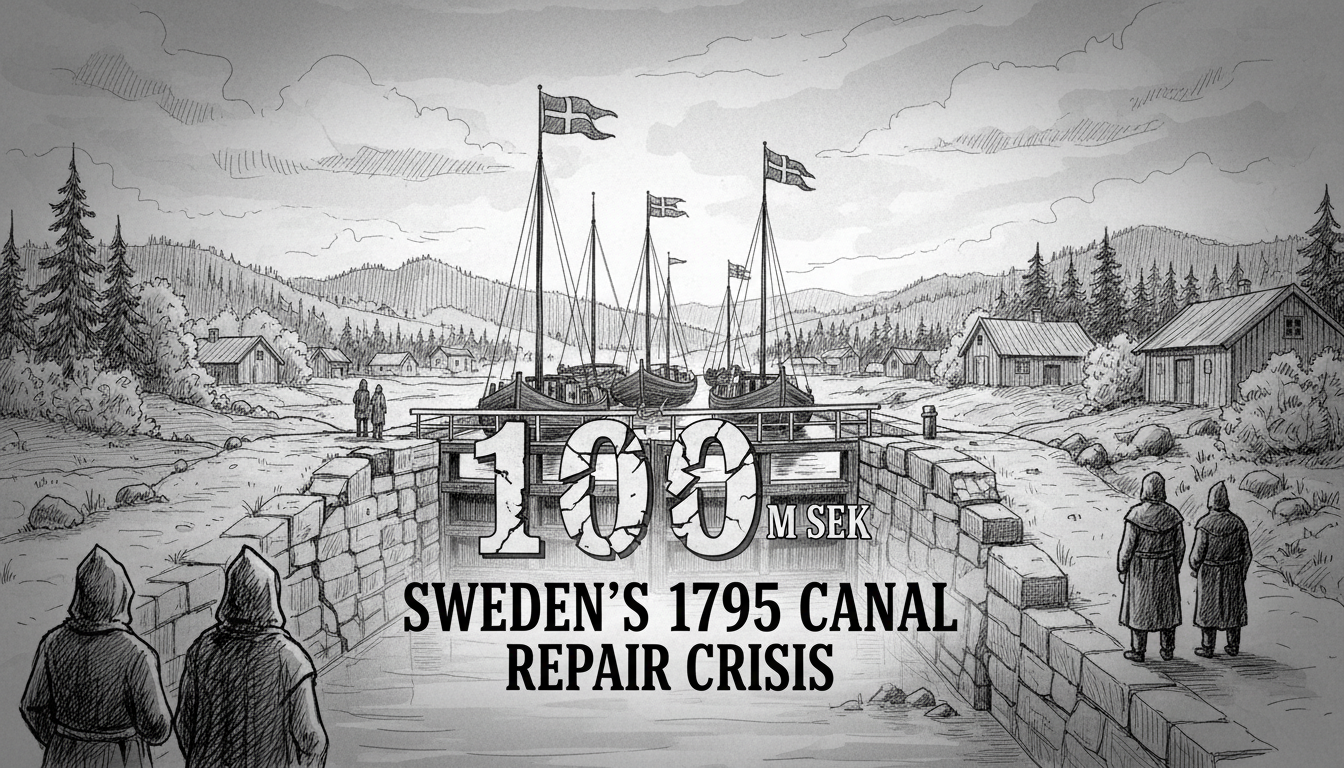
Sweden's historic Strömsholm Canal is under threat after a dangerous sinkhole forced the closure of sections around its aging locks. The discovery of ground subsidence at the Sörkvarn lock in Hallstahammar has revealed a critical infrastructure problem, with repair costs estimated at a staggering 100 million Swedish kronor. For Hans-Lennart Ohlsson, a local official involved with the canal, the issue is both urgent and deeply personal. "It's not that you'd fall in and not get out," he says, describing the risk near the compromised lock. "But it's enough for you to sprain your ankle or break your leg if you walk there."
The 100 million kronor price tag represents a monumental challenge for the four small municipalities responsible for the canal's upkeep. Hallstahammar, Surahammar, Fagersta, and Smedjebacken currently provide a combined 5 million kronor annually for maintenance. The canal company argues that 10 million per year for a decade is needed to properly address the structural issues. This funding gap has sparked a desperate search for financial help, with appeals now directed at the regional council, the state, and neighboring Västerås municipality. "Sure, it would be great if someone in the State said: 'Of course we'll help you,' that would be a relief," Ohlsson remarks, highlighting the local frustration.
A Waterway Steeped in History
Completed in 1795, the Strömsholm Canal is a living monument to Sweden's industrial age. It was engineered to connect Lake Mälaren with the iron-rich Bergslagen region, serving as a vital artery for transporting ore, timber, and goods. For over two centuries, its locks have lifted and lowered boats, facilitating trade that built local communities. Today, its primary role has shifted from commerce to culture and recreation. It is a cherished route for leisure boaters, a linear park for cyclists and walkers, and a tangible link to the past for residents and visitors alike. This shift makes its preservation a cultural imperative, not just an infrastructure one.
The problem, as consultants from Göta Canal AB have identified, is one of relentless, slow-motion erosion. "Water has been running and seeping here for 170 years, so of course there are movements," explains Ohlsson, putting the geological timescale into perspective. The constant flow has gradually undermined the soil adjacent to the lock structures at Sörkvarn and other points along the canal. This has caused the ground to sink, creating voids that can suddenly collapse into sinkholes. The closures are a preventative safety measure, but they also disrupt the very recreational use that justifies the canal's modern existence.
The High Cost of Preserving Heritage
The financial dilemma at the heart of this story is common across Sweden and much of Europe. How do communities fund the preservation of aging, non-essential infrastructure that holds immense cultural value? The 5 million kronor annual budget from the owner municipalities is sufficient for basic upkeep but is utterly inadequate for addressing systemic, century-old problems. The requested 10 million kronor per year would double the current financial commitment, a significant burden for smaller municipalities with many competing priorities for schools, elderly care, and other services.
This funding shortfall forces a difficult conversation about value and responsibility. Is the Strömsholm Canal solely a local asset, or is it a piece of national heritage worthy of state support? Proponents for state funding argue that canals like Strömsholm are part of Sweden's historical identity, similar to castles or ancient ruins. They attract tourists who spend money regionally, contributing to the broader economy. Letting them decay, they warn, represents a loss to the nation's cultural landscape. The canal's management is now actively testing this argument by appealing directly to national and regional authorities.
A Broader Pattern of Infrastructure Aging
While the sinkhole at Sörkvarn is a specific incident, it reflects a wider issue of maintaining Sweden's historical civil engineering works. From Göta Canal to the Dalsland Canal, these 18th and 19th-century projects are marvels of their time but are now entering an era of intensive, costly care. Experts in heritage preservation and civil engineering often stress that deferred maintenance leads to exponentially higher costs down the line. A small leak repaired today might cost thousands; the same leak, left to erode foundations for years, can necessitate million-kronor reconstruction.
The consultant report underscores this point. The 100 million kronor estimate is for repairs done properly and comprehensively. A piecemeal approach with limited funds might address the immediate sinkhole danger but would likely fail to solve the underlying water seepage issues, guaranteeing more problems—and more closures—in the near future. This creates a cycle of reactive, emergency spending that is ultimately more wasteful than a planned, phased renovation. The canal company's 10-year plan is an attempt to break this cycle, but it requires upfront political and financial commitment.
Community Impact and the Search for Solutions
For the towns along its banks, the canal is more than a ditch of water; it's a backyard, a playground, and a source of pride. Closures of lock areas cut off popular walking paths and disrupt the serene continuity of the canal-side experience. Local businesses that cater to boaters, cyclists, and tourists also feel the pinch when access is restricted. The potential long-term decline of the canal poses a threat to the quality of life and the soft, cultural economy these municipalities are increasingly reliant upon.
The search for solutions is now multi-pronged. Beyond knocking on the doors of larger government bodies, there may be room for public-private partnerships or fundraising initiatives aimed at individuals and foundations passionate about Swedish history. Some point to the model of the Göta Canal, which has a dedicated friends' association and benefits from its status as a major tourist attraction. However, the Strömsholm Canal, while beloved, is quieter and less internationally known, making such models harder to replicate. The immediate future likely hinges on the response from the County Administrative Board and the national government. Will they see a costly local problem or a priceless national asset in need of rescue?
As barriers remain around the historic locks at Sörkvarn, the question hangs in the air. Can Sweden find a sustainable way to care for the physical remnants of its industrial genesis? The slow sink of the land next to the Strömsholm Canal is a silent alarm, calling for a decision that weighs kronor against heritage, local responsibility against national interest. The next chapter for this 229-year-old waterway depends on the value modern Sweden places on preserving the channels of its own history.