
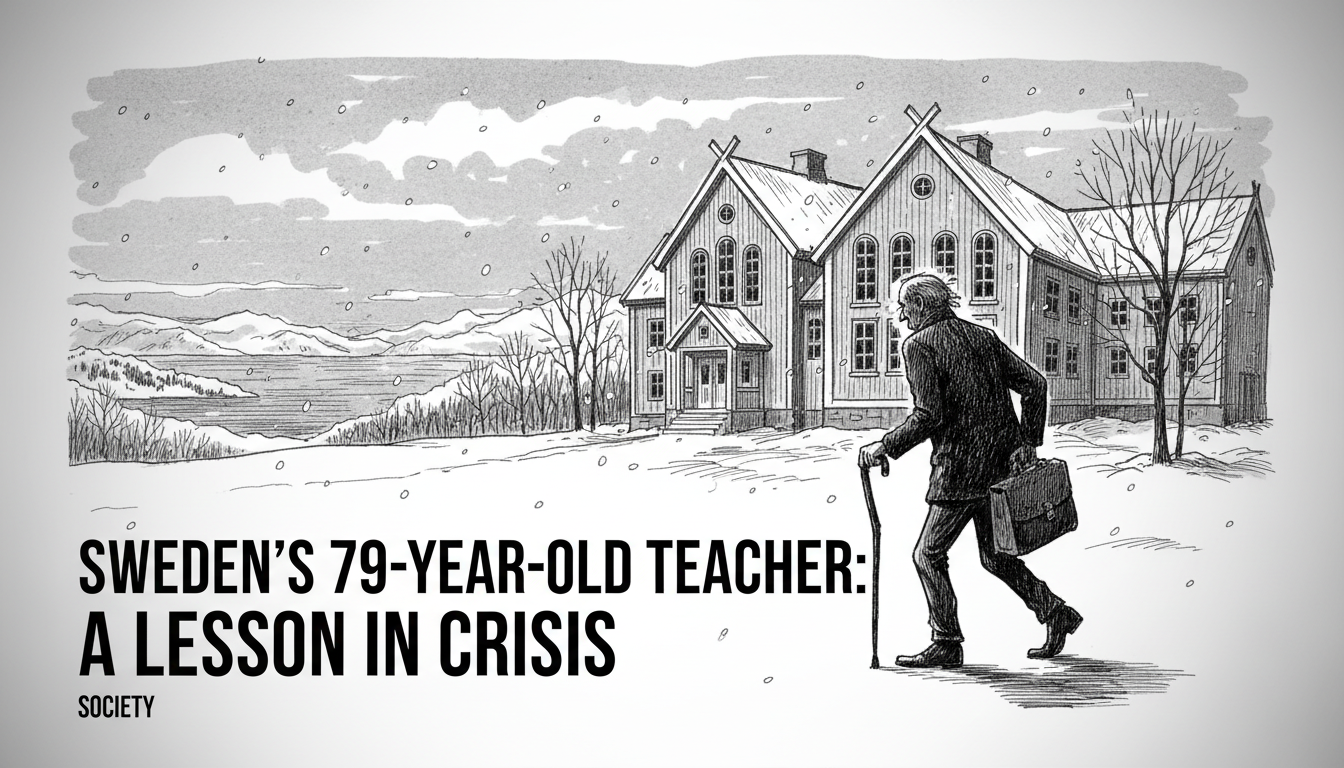
Sweden's teacher shortage has found an unlikely new recruit in 79-year-old Stig Ottosson, a retired municipal politician who just qualified as a teacher. His journey from local council chambers to the classroom highlights both the desperate need for educators and the deep-seated problems within Sweden's education system. Ottosson's story is a human-scale reflection of a national crisis debated in the Riksdag and managed from government offices in Rosenbad.
From Politics to Pedagogy
Stig Ottosson's path to teaching began with curiosity, not career planning. His experience as a municipal politician in southern Sweden exposed him to the operational challenges of local schools. "I became genuinely curious about how schools actually function," Ottosson explained. "Sitting on committees, you see budgets and policies, but not the daily reality for teachers and students." This curiosity transformed into action several years ago when he enrolled in a teacher education program. He recently completed his qualifications, becoming one of Sweden's oldest newly certified teachers. His transition underscores a potential reservoir of talent often overlooked in recruitment drives: experienced professionals from other fields.
A System Under Strain
The backdrop to Ottosson's career change is a severe and worsening teacher shortage. According to the Swedish National Agency for Education (Skolverket), Sweden faces a projected shortfall of tens of thousands of teachers in the coming decade. This crisis is most acute in STEM subjects, special education, and in rural regions. Teacher attrition compounds the problem, with many educators leaving the profession within their first five years due to high workloads, complex student needs, and perceived low societal status. The Swedish government has repeatedly tasked the Ministry of Education with developing strategies to address this, but systemic solutions remain elusive. Recruitment campaigns now explicitly target career-changers and older students, a demographic shift Ottosson embodies.
Critical Perspective on Teacher Training
Ottosson brings a critical eye to the system he just entered. His verdict on Swedish teacher education is blunt. "The teacher training program is outdated," he stated. He argues that the university-based curriculum lacks sufficient practical classroom preparation and fails to equip new teachers for the social and disciplinary realities of modern schools. This criticism echoes longstanding debates within the Riksdag's Committee on Education. Reform proposals often focus on increasing the practical apprenticeship elements of training. Ottosson's life experience provided a buffer, but he worries for younger peers. "You study educational theory, but the leap to managing a classroom of 30 teenagers is enormous," he noted. His perspective adds weight to calls for mentoring programs and better support for novice teachers.
The Value of Life Experience
Educational experts see individuals like Ottosson as a potential asset. "A diverse teaching workforce that includes people with extensive professional and life experience is incredibly valuable," said Professor Lena Andersson, an education policy analyst at Stockholm University. "They bring stability, different mentoring skills, and a practical worldview that can enrich the school environment." However, Andersson cautions that this is not a systemic solution. Attracting older recruits does not address core issues of salary competitiveness or workload. The Swedish government's policy must also ensure that alternative pathways into teaching are rigorous and well-supported. Ottosson's success suggests such pathways can work, but they require careful structuring.
Policy Responses and Political Debates
The teacher shortage is a persistent item on the Swedish government's agenda. Recent Riksdag decisions have aimed to simplify the qualification process for professionals with relevant experience. Proposals include fast-track programs and improved salary structures for hard-to-staff subjects. Opposition parties frequently criticize the pace of reform, arguing that underfunding at the municipal level, where schools are operated, undermines national initiatives. The debate often centers on whether the solution lies in higher pay, better working conditions, more attractive training, or a combination of all three. Stories like Ottosson's are cited by all sides—as proof of the profession's enduring appeal, but also of its need to cast a wider net.
A Personal Mission in a Professional Crisis
For Stig Ottosson, the motivation is personal rather than political. He is not seeking a full-time career but aims to work as a substitute teacher, offering his skills to local schools. He views teaching as a form of community service, a direct way to contribute after years of political work. "It's about being useful, about sharing what you know and learning from the students," he said. This attitude highlights a non-monetary incentive that recruitment campaigns struggle to quantify. His presence in the staff room also challenges age-related stereotypes about energy, adaptability, and career progression.
Looking Ahead: An Aging Solution to an Aging Workforce?
Stig Ottosson's story is inspiring but points to a complex future. As Sweden's population ages, tapping into the potential of older, second-career professionals could become a more deliberate strategy. Yet, this approach intersects with broader challenges in Sweden's education system, including digitalization, inclusion, and curriculum modernization. Can a system in crisis effectively integrate and utilize the unique skills of older novice teachers? The answer depends on targeted support and adaptive school leadership. Ottosson has entered the profession at a time of profound change, his own journey a small test case for larger reforms. His final lesson may be for policymakers: that solving the teacher shortage requires valuing diverse life stories as much as academic credentials. The true test will be whether the system is ready to learn.