
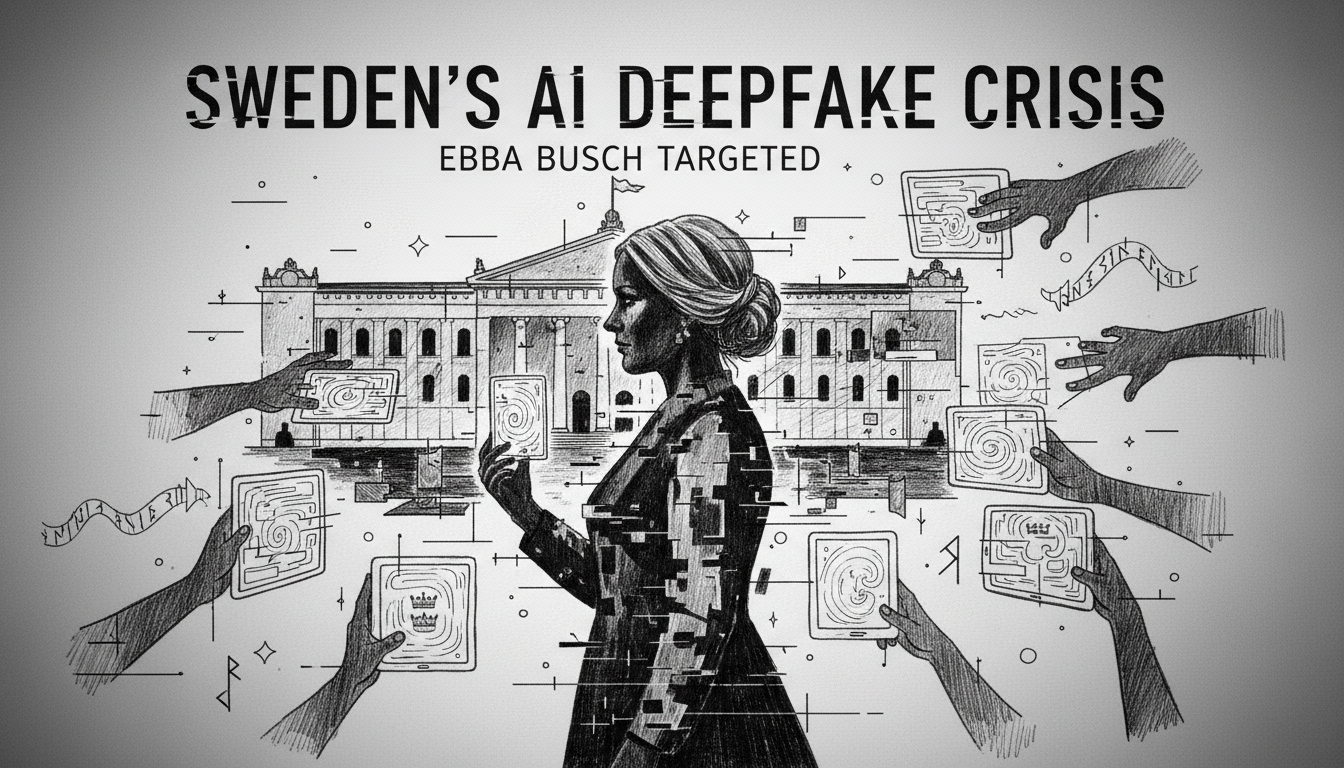
Sweden's political landscape faces a new digital threat as AI-generated fake images of senior minister Ebba Busch circulate online. Deepfake bikini pictures of the Energy and Industry Minister, created using the Grok AI tool on platform X, have been viewed by millions. This incident highlights a growing vulnerability for Swedish government officials and democratic processes. "When they spread, it clearly affects her and her conditions for conducting politics," said digital ethics expert Carl Heath. The attack on a cabinet member operating from the Rosenbad government offices signals a dangerous escalation in political disinformation.
A Minister Under Digital Assault
Ebba Busch, leader of the Christian Democrats and a pivotal figure in the Swedish government, finds herself at the center of a fabricated scandal. The images, artificially created to depict her in compromising situations, represent a direct assault on her personal integrity and professional credibility. For a minister whose portfolio includes shaping Sweden's industrial and energy future, such attacks undermine public trust. The Riksdag has previously debated digital security, but this event exposes a critical gap between policy discussion and practical protection for elected officials. The spread occurs as Busch leads complex negotiations on energy policy, a cornerstone of the government's agenda.
The Technology and the Platform
The fake images were generated using Grok, an AI service integrated directly into the social media platform X. This integration lowers the barrier for creating convincing forgeries, moving sophisticated disinformation tools into mainstream use. Unlike earlier, cruder digital forgeries, current AI can produce photorealistic results in seconds. The platform's algorithm then amplified the images, ensuring they reached an audience of millions before any corrective action could be taken. This sequence demonstrates how technology and distribution networks combine to maximize damage. The incident raises urgent questions about the responsibility of tech companies hosting such tools, especially during sensitive political periods.
Expert Analysis on Political Impact
Carl Heath, a researcher specializing in digital ethics and information influence, provided a stark assessment. He emphasized that such attacks are not merely personal but are fundamentally political acts. "The objective is to distort the public image of a political figure, to introduce noise and doubt that distracts from policy work," Heath explained. The impact is twofold: it consumes the target's time and emotional energy while poisoning the well of public discourse. For a minister, time spent managing a fabricated personal crisis is time not spent on official duties in the government districts of Stockholm. This diversionary tactic can have tangible effects on legislative timelines and government policy outcomes.
Legal Frameworks Lagging Behind
Swedish law currently struggles to address the rapid evolution of AI-generated disinformation. Existing statutes on defamation and image manipulation were not designed for content created by artificial intelligence. Prosecutors face challenges in identifying perpetrators who can operate anonymously across borders. The Ministry of Justice has acknowledged the need for legal updates but legislative processes in the Riksdag are slow. This creates a dangerous period of legal limbo where public figures are exposed. International cooperation within the EU is advancing, but national implementation remains a future prospect. The Busch case will likely become a key reference point in accelerating these legal reforms.
A Pattern of Digital Harassment
This incident is not isolated but part of a broader pattern of digital harassment targeting Swedish politicians, particularly women. Female officials across party lines report higher volumes of hateful and sexually charged online abuse. AI-generated content represents a severe intensification of this trend, weaponizing technology for harassment. The Swedish government has initiated studies on political violence and threats, yet digital dimensions often receive less focus. Protecting the democratic process now requires securing the digital space where voters form opinions. Failure to act risks deterring talented individuals, especially women, from pursuing public service careers.
The Broader Threat to Democracy
The manipulation of a cabinet minister's image points to a systemic risk for Swedish democracy. If citizens cannot trust the authenticity of what they see online, the foundation of informed public debate erodes. Deepfakes can be deployed to falsely show officials in scandalous contexts, uttering fabricated statements, or meeting with controversial figures. During an election period, such tools could destabilize the entire process. The Swedish Election Authority has expressed concern about foreign and domestic actors using AI to interfere. This event serves as a live-fire exercise, demonstrating the technique's potency and the current lack of effective countermeasures.
Pathways for Response and Resilience
Addressing this challenge requires a multi-faceted response from the Swedish government, civil society, and technology providers. First, rapid response protocols are needed for officials targeted by deepfakes. Second, public media literacy campaigns must help citizens identify manipulated content. Third, platforms like X must be held accountable for hosting and distributing tools designed for harassment. Finally, international legal frameworks must be strengthened to pursue cross-border offenders. The Swedish Parliament's Committee on the Constitution may need to examine how digital threats impact the constitutional principles of a democratic government. Building resilience is as crucial as pursuing punishment.
Looking Ahead: Policy in the Crosshairs
The ultimate target of this disinformation is not just Ebba Busch the individual, but Ebba Busch the Minister for Energy, Business and Industry. Her work on Sweden's nuclear energy expansion, industrial competitiveness, and green transition are high-stakes policies. Undermining her authority could indirectly influence these critical areas. Every moment spent confronting a digital phantom is a resource diverted from policy development. This is the strategic goal of such attacks: to degrade the effectiveness of governance itself. As the Swedish government crafts its response, it must protect both the person and the office, ensuring that policy formulated in Rosenbad proceeds without digital interference.
The circulation of AI-generated images of Minister Ebba Busch is a warning shot. It reveals how easily digital tools can be turned against the pillars of Swedish democracy. The question now is whether the Riksdag, the government, and the public can develop the vigilance and tools necessary to defend the integrity of political life. The answer will shape not only individual careers but the health of Swedish democracy in the digital age.