
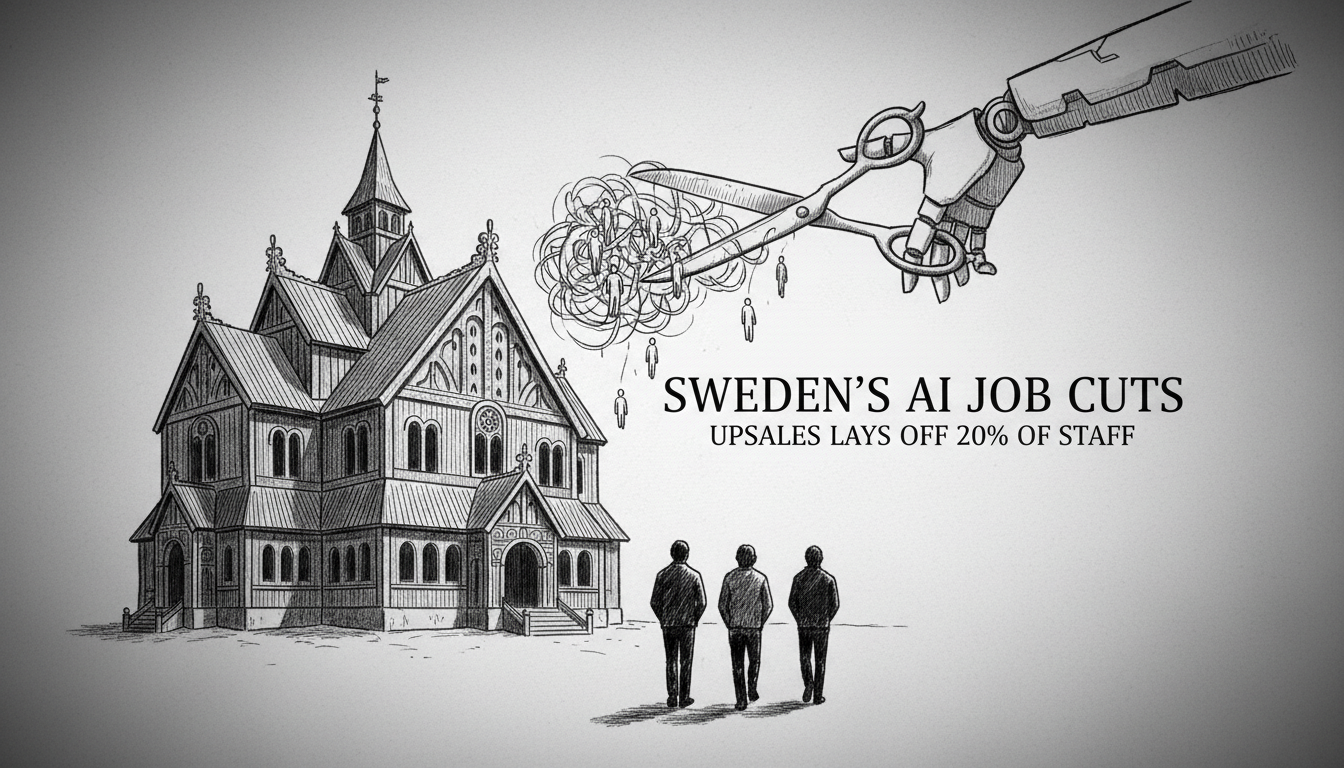
Sweden's AI job displacement debate has a new case study. Upsales, a Stockholm-based software company, is cutting 20% of its workforce. The firm is replacing approximately 14 positions with artificial intelligence. This move highlights the accelerating tension between technological efficiency and job security in one of Europe's most digitally advanced economies.
"It is simply a result of us finding many ways to become significantly more efficient in how we both build and design the product with AI," Upsales CEO Daniel Wikberg said. The layoffs target roles in product development and design. Wikberg argues the AI integration is a necessary step for competitiveness.
A Nordic Model Under Pressure
Sweden's labor market is built on a foundation of strong social safety nets and cooperative employer-union relations. Layoffs typically involve extensive negotiations with unions like Unionen. Companies must follow the "last in, first out" principle and provide transition support. The Upsales announcement tests how these traditional protections apply to displacement driven not by economic downturn, but by technological substitution.
"This is a different kind of restructuring," said Lena Bergström, a labor economist at Stockholm University. "It's not about saving a failing company. It's about a profitable company choosing capital over labor for core functions. The Swedish model was built for cyclical unemployment, not structural technological displacement." She notes the national conversation is shifting from job security to 'employment security'—the guarantee of retraining.
The Efficiency Equation
Upsales, founded in 2007, provides CRM and marketing automation software. It has been a stable player in Sweden's bustling Södermalm tech scene. The company's decision reflects a stark calculation. The cost of developing and licensing AI tools is now lower than the long-term salary and benefit costs of the human employees they replace.
Sweden ranks among the top three EU nations for business AI adoption. Over 35% of Swedish firms used AI in 2023, according to the European Commission's Digital Economy and Society Index. This widespread integration creates a potent business case for automation. For a SaaS company like Upsales, operating in a competitive global market, efficiency gains directly impact valuation and investor appeal.
Venture capital firms, including those in Stockholm's Östermalm district, increasingly scrutinize operational margins. "Investors are asking about AI implementation roadmaps," said Mikael Andersson, a partner at a Nordic venture fund. "Companies that demonstrate how AI reduces customer acquisition costs or R&D spend get higher valuations. The human cost is often a secondary line item in that analysis."
The Human Impact and Ethical Questions
Behind the 20% statistic are 14 individuals facing a changed job market. While Sweden's unemployment rate was around 7.7% in early 2024, finding a new role in tech may require new skills. The laid-off Upsales employees are entitled to Sweden's robust unemployment benefits, which can replace up to 80% of prior income. They also have access to state-funded retraining programs.
However, the psychological contract is broken. "There's a sense of betrayal," said a former Upsales designer who asked not to be named. "We helped build the product they now say can be built without us. It feels like we trained our replacement." This sentiment points to a broader ethical question emerging in Stockholm's business district: what responsibility do companies have for workers made redundant by the very technology they helped create?
Ethicists argue that the pace of AI adoption is outstripping the development of ethical frameworks. "Replacing 20% of your staff with AI isn't just a business decision; it's a social decision," said Professor Erik Karlsson, who teaches tech ethics at the KTH Royal Institute of Technology. "The company benefits from the efficiency. Society bears the cost of unemployment and retraining. We need a discussion about whether a tax or levy on AI-driven job displacement is needed to fund lifelong learning systems."
A Broader Trend in Swedish Tech?
Analysts are watching to see if Upsales signals a trend. Swedish startups and scale-ups are globally recognized for innovation. They are also under intense pressure to scale quickly and achieve profitability. AI presents a seemingly perfect tool to do more with less.
"We will see more of this, especially in software development, customer support, and content creation roles," predicted tech analyst Sofia Pettersson. "The early-stage startup burning VC cash on a big team is over. The new playbook is a lean team amplified by AI. The first major layoff round at a mature startup like Upsales makes that concrete."
Other Swedish tech firms have integrated AI without large-scale layoffs, opting for attrition or retraining. The question is whether Upsales's direct replacement strategy becomes a template. The company's next financial results will be closely monitored. If profitability and growth surge, it will provide a powerful data point for other CEOs and boards considering similar moves.
The Path Forward: Upskilling vs. Replacement
The Swedish government and unions emphasize a strategy of upskilling. Initiatives like the "National AI Strategy" aim to make Sweden a leader in AI while ensuring a just transition for workers. The focus is on teaching employees to work alongside AI, not be replaced by it.
Yet the Upsales case shows a gap between policy ideals and corporate reality. When AI can perform a discrete task—like generating code or designing a user interface—the incentive to retrain a human for a hybrid role may be less than the incentive to eliminate the role entirely.
"The challenge is that the skills gap is widening," Bergström explained. "Moving a designer from Figma to prompting an AI image generator is one thing. Moving them into a strategic role that AI cannot do is another. That requires a much larger investment in education, which takes time a laid-off worker doesn't have."
Unions are strengthening their demands for "right to train" clauses in collective agreements. They want guaranteed access to AI training during work hours. The goal is to make employees partners in automation, not its casualties.
A Global Issue with a Swedish Lens
AI-driven job displacement is a worldwide concern. Sweden's experience is unique because of its strong welfare state and collaborative labor model. The country has the resources to cushion the blow and a history of solving problems through dialogue. Whether these institutions can adapt quickly enough is the central drama.
The Upsales layoffs are more than a corporate restructuring. They are a stress test for the Nordic social contract in the digital age. Can Sweden maintain its high living standards and equitable society if core tech jobs begin to vanish? The answer will depend on whether innovation is managed for the benefit of shareholders alone, or for the broader workforce.
As Daniel Wikberg focuses on a more efficient, AI-driven Upsales, Sweden must find an efficient, humane path forward for all its workers. The nation's future as both an innovation hub and a fair society may depend on it.