
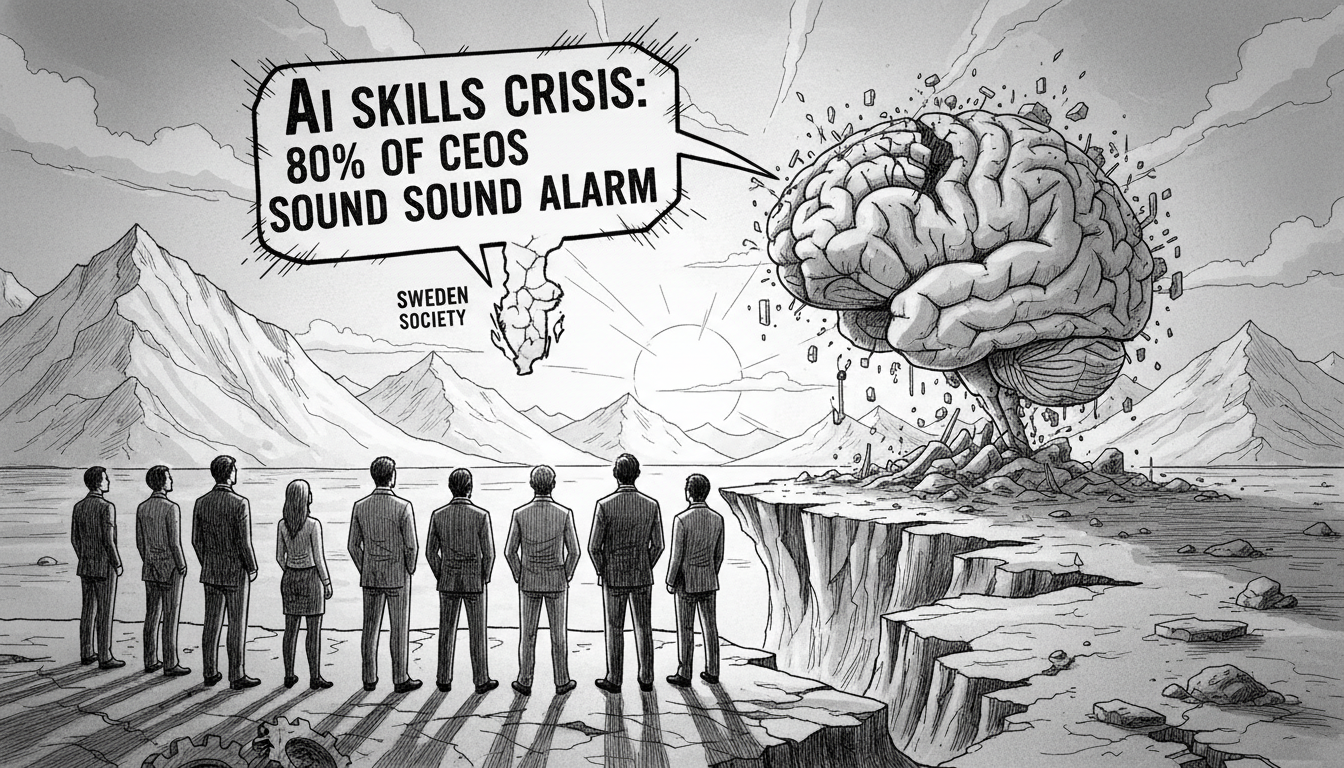
Sweden's top corporate leaders are issuing a stark warning about a critical skills gap that threatens the nation's economic future. A new survey reveals 80% of Swedish stock exchange CEOs identify AI competence as the single most important factor for company success. Yet, over half of those same leaders admit their own employees lack sufficient AI knowledge. This contradiction sits at the heart of a growing national challenge.
“The pace of change is extremely fast. This is a transformation moving significantly quicker than anything we have seen before in technical development,” said Theresa Lagerbielke, head of People & Change Consulting at KPMG Sweden. Her firm conducted the survey, which paints a picture of ambitious strategic goals colliding with a workforce unprepared to execute them.
The Leadership Mandate Versus Ground Reality
The survey results highlight a profound disconnect. In boardrooms across Stockholm's business districts, from the historic finance hubs of Östermalm to the startup clusters in Södermalm, AI dominates the agenda. CEOs are convinced that mastering artificial intelligence is non-negotiable for survival and growth. They see it as the key driver for efficiency, innovation, and maintaining Sweden's competitive edge in sectors like fintech, cleantech, and life sciences.
However, this top-down conviction has not fully translated into organizational capability. The finding that more than 50% of CEOs view their staff's AI knowledge as too low suggests training and development initiatives are lagging. It points to a potential failure in translating high-level strategy into practical, company-wide upskilling. For a country that prides itself on a highly educated workforce and a history of seamless tech adoption—from broadband to mobile payments—this gap is particularly striking.
Why Sweden's Model Faces a New Test
Sweden's economic strength has long been built on a foundation of widespread digital literacy and a collaborative model between industry, government, and academia. The country consistently ranks high in global innovation indexes. Government initiatives have for years emphasized digital transformation. The national strategy has focused on building infrastructure and fostering a pro-innovation regulatory environment.
The AI skills crisis, however, exposes a new layer of complexity. Previous technological shifts often required specialized IT departments to manage new systems. The AI revolution, by contrast, demands a baseline understanding across nearly all functions—from marketing and sales to supply chain management and customer service. A developer in Kista or a fintech product manager in Stockholm needs to understand AI's potential and limitations. This requires a different kind of investment: continuous, pervasive education rather than one-time software implementation.
“The challenge is scale and speed,” explained a tech investor with a major Swedish venture capital firm, who requested anonymity to speak candidly. “We fund startups whose entire product is AI-driven. But for our larger portfolio companies, the listed ones, integrating AI is about retraining thousands of people. The CEOs get it. The middle management and frontline employees often don’t have the tools or time to learn. The pace of business doesn’t pause for upskilling.”
The Concrete Costs of Inaction
The risks of this skills deficit are not theoretical. For Sweden's flagship companies, falling behind in AI adoption could mean eroded market share against global competitors from the US and Asia. It could slow productivity gains, impacting profitability. For the vibrant startup ecosystem, a shallow talent pool could make it harder to scale promising ventures, potentially stifling the next generation of unicorns.
Investors are already scrutinizing AI readiness. “When we evaluate a potential investment, the management team’s understanding of AI and their concrete plan for embedding it is now a key due diligence point,” said Sofia Bövik, a partner at a Nordic-focused venture fund. “It’s no longer just about having a data scientist on staff. It’s about the strategic literacy of the entire leadership team and their roadmap for building capability. A company that dismisses this is a red flag.”
The problem also has a geographical dimension. While Stockholm, Gothenburg, and Malmö may concentrate talent, companies in smaller cities and rural areas could face an even steeper climb to attract and retain employees with AI skills, potentially exacerbating regional economic divides.
Bridging the Gap: From Awareness to Execution
Recognizing the problem is the first step, but CEOs now face the harder task of execution. Solutions will need to be multi-faceted. First, internal training programs must move beyond one-off workshops to become embedded, continuous learning pathways. Companies may need to partner more deeply with universities and specialized bootcamps to create tailored curricula.
Second, recruitment strategies must evolve. Hiring for AI aptitude alongside role-specific skills will become standard. This doesn't mean every new hire must be a machine learning engineer, but rather that employees should demonstrate curiosity and a capacity to work with AI-driven tools.
Third, leadership itself must become more literate. CEOs stating its importance is a start, but they and their executive teams need a hands-on understanding to make sound strategic choices and allocate resources effectively. “The leader’s role is to create the space for learning and experimentation, even if it means short-term efficiency dips,” Lagerbielke noted. “This requires a cultural shift, not just a budget line.”
Finally, the traditional Swedish model of social partnership could be pivotal. Industry organizations, unions, and the government could collaborate on national upskilling initiatives, sharing best practices and co-funding training to raise all boats. This would prevent a wasteful “training war” where companies simply poach scarce talent from each other.
A Defining Moment for Swedish Business
The KPMG survey is a canary in the coal mine. It signals that Sweden’s celebrated adaptation to technological change is facing its most urgent test. The nation’s future prosperity is tightly linked to its ability to navigate the AI transition. The good news is that awareness at the highest level is nearly universal. The alarming news is that awareness alone is worthless without action.
The years to 2026 will be critical. Will Swedish companies build the internal academies, forge the necessary partnerships, and foster the cultures required to turn their AI ambitions into reality? Or will they risk being left behind, watching as the very innovation they champion becomes their strategic weakness? The answers will be written not in boardroom strategies, but in the daily upskilling of employees across the country. The clock is ticking, and the CEOs, it seems, are finally checking the time.