
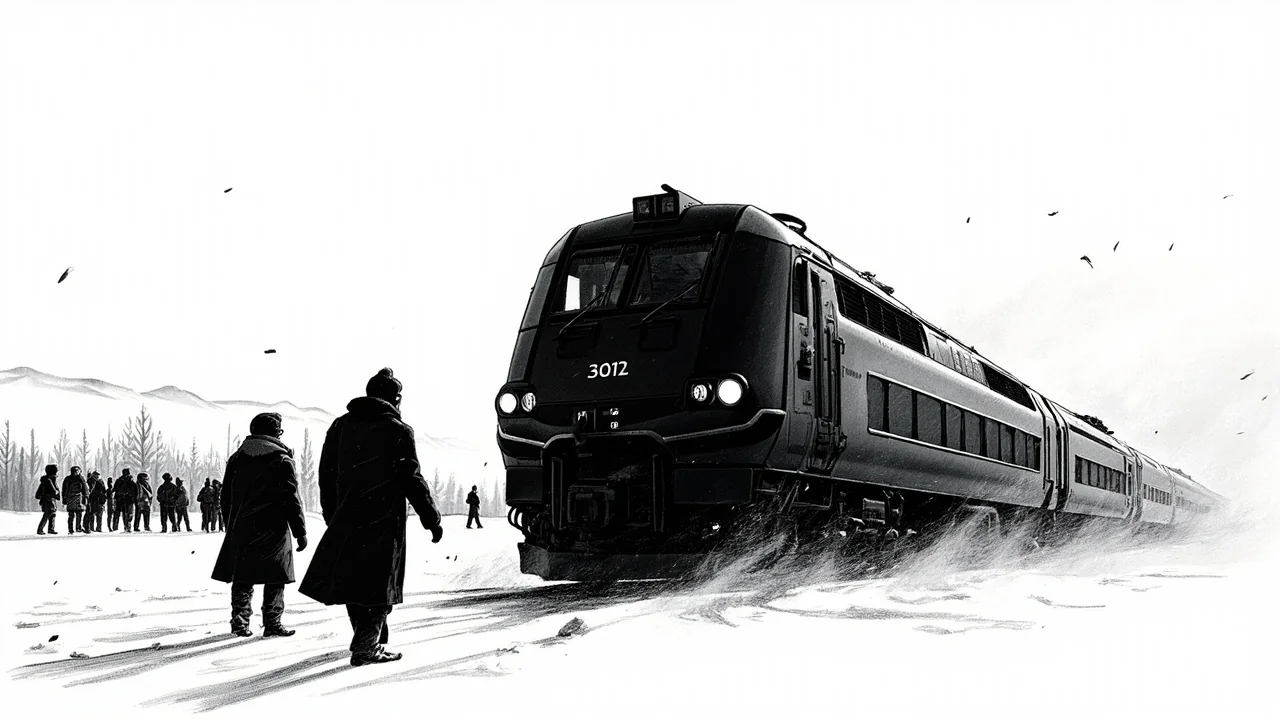
Sweden's overnight train service to the Arctic Circle has resumed after a 48-hour freeze that stranded passengers and highlighted the nation's climate vulnerability. The critical Stockholm-to-Luleå route restarted Sunday night following a suspension blamed on temperatures plummeting to -38°C. Yet further north, connections to Kiruna and Narvik remain severed, with operator SJ offering no timeline for their return, citing dangerous conditions too severe even for replacement buses. This marks the second major freeze-related disruption in just two weeks, exposing the fragility of vital northern lifelines.
Passengers like Elin Mårtensson describe the experience as isolating. She was scheduled to travel from Umeå to Kiruna on Friday. 'You feel stuck,' she told me by phone. 'The train isn't just transport here; it's the only link for many. When it stops, everything stops.' Her journey, meant to return her to work at a Kiruna hotel, is now on indefinite hold. This sentiment echoes across Norrbotten county, where distances are vast and alternatives scarce.
The state-owned operator SJ confirmed the decisions were purely safety-driven. 'If it's too cold to run trains, we certainly won't run buses there either,' said press officer Johannes Cleris. He pointed to the remote, exposed stretches of track where a breakdown could become critical. 'Some places are far from everything if something were to happen.' The company's protocols mandate suspensions when extreme cold risks rail fractures, power failures, or passenger safety during potential evacuations.
A Region in Limbo
While the main southern Arctic link is moving, the silence north of Luleå speaks volumes. Norrtåg, which operates regional services, has also canceled all traffic between Luleå and Kiruna. This dual suspension by both major operators cuts off Sweden's northernmost city and its vital mining industry. The Iron Ore Line (Malmbanan) to Narvik, Norway—a crucial freight artery for Swedish ore—is also paralyzed. The economic ripple effects are immediate, impacting shift workers, tourists, and supply chains.
The disruption transcends simple inconvenience. In towns like Gällivare and Kiruna, the train is a mobile community center. 'It's where students commute to university, where families visit, and where goods are moved,' explains local journalist Petra Lundström from her home in Boden. 'A car isn't an option for everyone, especially in this weather. This isolation is a stark reminder of our geography.' Winter festivals and mid-week tourism bookings in the Aurora Zone now face uncertainty.
Infrastructure Pushed to Its Limits
This repeated failure raises tough questions about Sweden's preparedness. The country prides itself on all-weather functionality, yet its rail network buckles under predictable Arctic conditions. 'We design for cold, but these extremes are challenging our historical benchmarks,' says infrastructure analyst Lars Fälting, who studies northern transport networks. 'The issue isn't just the tracks. Signaling systems, overhead wires, and even the diesel in backup generators can fail.'
Fälting points to a critical underinvestment in secondary systems. 'The focus has been on maintaining the primary track. But we lack redundant bus networks or shelter plans for these specific, high-risk zones. When the tech fails, the human solution isn't there.' He contrasts this with Norway's more robust contingency planning along its northern coast, which often includes pre-arranged heated shelters and coordinated road convoys for stranded travelers.
The economic argument for resilience is strong. The northern mining and green tech industries are national priorities. Frequent transport halts threaten productivity and investor confidence. 'Every stalled day is a cost,' says a logistics manager for LKAB, the state-owned mining company, who asked not to be named. 'While freight can be rescheduled, the uncertainty is problematic. It signals a weakness.'
Cultural and Social Impact
The train's role in Swedish culture, especially the romanticized 'nattåg' (night train), adds another layer. It represents a sustainable, cozy way to traverse the long land. Authors and filmmakers have long portrayed the journey north as an adventure. This disruption punctures that narrative, replacing it with one of vulnerability. Social media is filled with images of empty platforms in snowy stations, a powerful visual of disconnect.
Local response has been a mix of frustration and understanding. 'You can't fight nature,' says Mikael Svensson, a shopkeeper in Luleå's city center. 'But we knew the cold was coming. The communication could be faster. People wait for hours not knowing.' There's a call for clearer real-time information and better access to cancellation policies, which many travelers find confusing.
The Climate Change Paradox
Here lies the central irony. While this crisis stems from extreme cold, analysts link the increasing volatility of such polar conditions to broader climate change. A warming Arctic can disrupt polar vortex patterns, sending bursts of severe cold further south. 'We are likely to see more of these sharp, dangerous dips in temperature, even as average winters get milder,' explains climate researcher Dr. Anna Kjellström. 'Our infrastructure is built for a stable cold, not a rollercoaster.'
This presents a paradoxical challenge: preparing for deeper freezes in a warming world. Future-proofing the rail network may require investing in both heat-resilient materials for summer and cold-proofing for winter extremes—a costly dual approach. 'It's a difficult equation for planners,' Kjellström admits. 'The business case for hardening against -40°C events that might happen once or twice a decade is hard to make, until it happens.'
An Expert Perspective on Resilience
To understand the way forward, I spoke with Professor Henrik Ek, a specialist in critical infrastructure at Luleå University of Technology. 'This is a systemic issue,' he states bluntly. 'We have optimized the network for efficiency, not resilience. The moment something exceeds the design parameters, the whole chain breaks.' He advocates for a mindset shift, from preventing all stoppages to managing stoppages better.
His proposals include establishing designated 'weather shelters' along remote track sections and pre-approved contracts with Arctic-capable transport contractors for emergency use. 'We also need to integrate weather forecasting directly into operational planning with more lead time,' he adds. 'This wasn't a surprise cold snap. The models saw it coming days in advance.'
Professor Ek also highlights a social responsibility. 'Operators have a duty to inform passengers of the risks of Arctic travel in winter. It's not like taking a train in central Europe. There should be clear guidelines on what to pack, how to prepare for a delay. This empowers people and reduces panic.'
Looking Down the Track
As the short January daylight fades over Luleå station, the resumed train's departure is a cautious relief. But the problem is merely parked, not solved. With climate predictions indicating more weather instability, Sweden faces a fundamental choice. Can it modernize its northern lifelines to withstand the very extremes its landscape is famous for?
The answer will determine more than just train schedules. It will decide the connectivity and cohesion of its vast northern territories. The silence on the line to Kiruna is more than an operational hiccup; it's a question echoing across the snow. How does a modern nation honor its promise to remote communities when nature says no? The journey to find that answer is just beginning.