
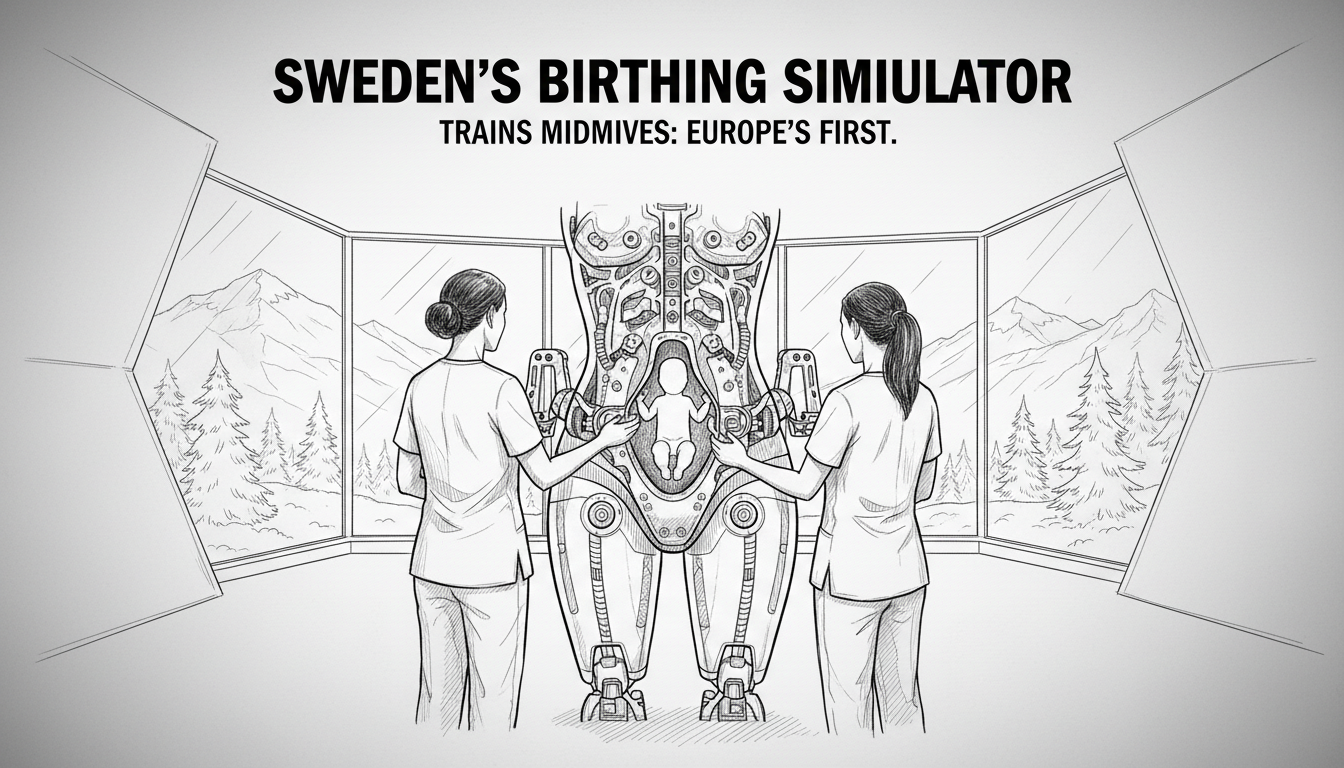
Sweden's midwifery education is entering a new era with MamaAnne, Europe's first advanced birthing simulator. In a training room at Dalarna University, a patient named MamaAnne breathes, blinks, and has a pulse. She can vocalize during contractions. For the midwifery students gathered around her, she represents a revolutionary step in their training. They are the first in Europe to use this high-fidelity simulator to practice both routine and complicated deliveries before ever touching a real patient. This is not just a mannequin. It's a bridge between textbook theory and the intense reality of the delivery room.
"The first time you see her 'breathe,' it's startling," says Elin, a second-year midwifery student. She adjusts the monitor tracking MamaAnne's simulated vital signs. "You forget she's not real. Your focus shifts completely to the scenario, to the 'mother' and 'baby.' It makes the learning visceral." This shift from abstract knowledge to embodied practice is the core goal. Simulation in Swedish healthcare training is growing, driven by a national focus on patient safety and outcomes. By investing in technology like MamaAnne, Sweden aims to ensure its future midwives are as prepared as possible for the unpredictable nature of childbirth.
A Realistic Practice Ground for Critical Moments
The MamaAnne simulator can be programmed for countless scenarios. A normal, low-risk delivery allows students to practice their communication and coaching techniques. More critically, it can mimic emergencies like postpartum hemorrhage, shoulder dystocia, or fetal distress. In these high-pressure simulations, students must diagnose the problem and intervene correctly, all while managing the 'patient's' anxiety and pain. "We can create situations a student might only see once in their entire clinical rotation," explains Professor Lena Karlsson, who leads the midwifery program. "Here, they can see it ten times. They can make mistakes, learn from them, and build muscle memory—all without any risk to a real mother or child."
This safe space for failure is invaluable. Research from other medical fields shows simulation-based training significantly improves clinical skills and confidence. Studies also indicate a link between such training and fewer medical errors in real clinical settings. For midwifery, where decisions are time-critical and emotionally charged, this preparatory practice is transformative. Students learn not just the mechanical skills but also the soft skills: how to keep a calm demeanor, how to explain procedures clearly, and how to work as a team under stress.
The Human Element in a High-Tech Tool
While the technology is impressive, Swedish educators are careful to frame it as a tool, not a replacement. The cultural context of Swedish childbirth is unique. There is a strong emphasis on the woman's autonomy, a low-intervention philosophy for normal births, and the central role of the midwife as the primary caregiver. Training must reflect these values. "The simulator teaches the 'what' and the 'how,'" says Karlsson. "But our program's soul is in teaching the 'why.' Why we support natural birth, why we listen to the mother, why patience is often the best intervention. MamaAnne helps students master the science so they can better practice the art."
This balance is evident in Stockholm's maternity wards, like those at Karolinska University Hospital or Södersjukhuset. Midwives there describe a profession that blends deep technical knowledge with profound emotional support. The new simulator training aims to fortify both sides. A student who has repeatedly managed a simulated cord prolapse in Falun will carry that competence with them to a hospital in Malmö or a rural birthing center in Norrland. They will also carry the reinforced understanding that every birth is a human story, not just a clinical event.
Looking Beyond the Delivery Room
The introduction of MamaAnne speaks to broader trends in Swedish society and its healthcare system. Sweden consistently invests in education and innovation to maintain high public welfare standards. With an aging population and ongoing challenges in staffing the healthcare sector, efficient and effective training is more crucial than ever. Furthermore, as Sweden's population becomes more diverse, midwives must be prepared for a wide variety of cultural backgrounds and expectations around childbirth. Simulation can help prepare students for these nuanced interpersonal dynamics as well.
Experts in medical education see this as a logical and necessary progression. "High-fidelity simulation is the gold standard for moving from knowing to doing," says Dr. Anders Berg, a specialist in medical pedagogy. "It closes the gap between the classroom and the clinic. For a high-stakes field like obstetrics, it's an ethical imperative to train this way. Sweden is showing leadership in Europe by adopting this for midwifery." The hope is that this technology will become standard, improving not just individual competency but also team performance across entire maternity units.
The Future of Birth in Sweden
Back in the simulation lab, the students have successfully 'delivered' MamaAnne's baby. They discuss what went well and what could be improved. The conversation is detailed, constructive, and confident. This debriefing is as important as the simulation itself. It turns experience into lasting learning. For these students, their first real patient will still be a moment of profound responsibility. But it will no longer be their first time feeling a synthetic perineum, seeing a simulated hemorrhage, or hearing the urgent beep of a faux fetal heart monitor.
Sweden's embrace of the birthing simulator is more than a tech upgrade. It is a commitment to the next generation of families. By giving midwives the gift of practiced experience, the country aims to make the ancient, miraculous, and sometimes terrifying process of birth just a little bit safer. The question is no longer whether simulation has a place in midwifery education, but how quickly other nations will follow Sweden's lead. As MamaAnne takes another simulated breath in her Dalarna classroom, she represents a quiet revolution in how Europe prepares for life's most dramatic beginning.