
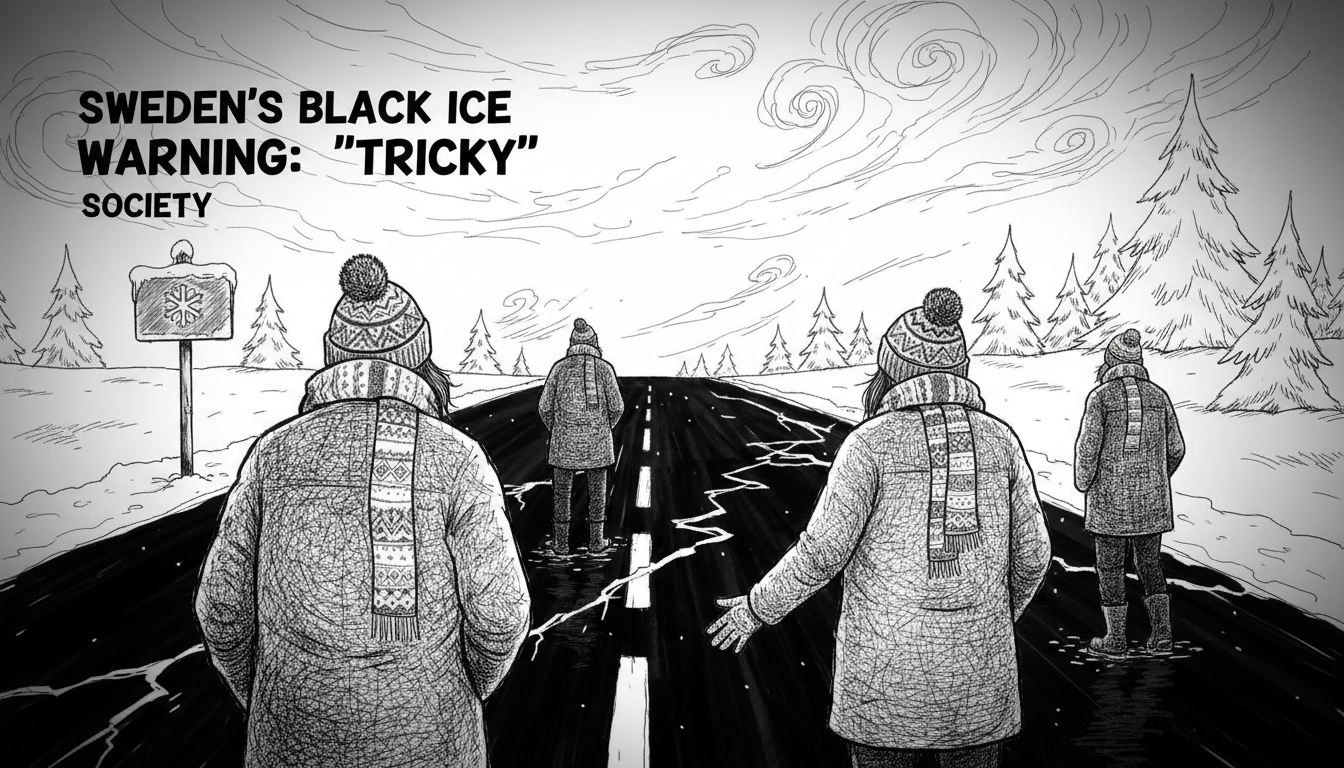
Sweden's Transport Administration has issued urgent warnings for treacherous 'blixthalka' or black ice across central and southern regions just days before Christmas. This invisible hazard has already caused multiple accidents and led to the closure of a major highway in neighboring Norway. Authorities are scrambling with preventive salting as holiday travel picks up.
'It's a tricky situation,' a Trafikverket spokesperson said about the road conditions. The warning specifically highlights the E4 highway north of Uppsala and many major roads across central Sweden. Police reports confirm slippery conditions and accidents in the Strängnäs and Kungsör areas. Just across the border, the E6 in southern Norway was closed Sunday due to ice.
For Swedes, 'blixthalka' is a familiar but feared winter term. It refers to a thin, transparent layer of ice that forms on road surfaces. It blends in with asphalt, making it nearly impossible for drivers to spot until it's too late. Rapid temperature drops around dawn or freezing rain are typical causes.
Trafikverket has deployed extra crews for salting operations. They have also staffed their traffic management centers more heavily ahead of the long holiday weekend. 'We are working preventively,' the agency stated. However, they emphasized that winter road maintenance follows the same protocols as any other winter day, despite the holiday traffic surge.
A Nation Gripped by Slippery Roads
The warnings come during 'klämdagar,' the squeeze days between weekends and holidays. Many Swedes are traveling to celebrate Christmas with family. This annual migration puts thousands more cars on roads already compromised by winter. Trafikverket expects slightly lighter traffic this year due to the calendar. Yet the risk remains acute on open highways and secondary roads.
In Sörmland and Västmanland counties, police reported multiple vehicles skidding off the road. The E20 near Strängnäs saw two such incidents. These are not just statistics. Each represents a disrupted holiday, a frightened family, or a costly repair. For emergency services, it means diverted resources during an already busy period.
Winter tires are legally required in Sweden from December 1st to March 31st. But experts say tires are only part of the solution. 'The most important tool is adjusted behavior,' says a veteran driving instructor from Stockholm. 'Reduce your speed. Increase your following distance to five or six seconds. Smooth, gentle inputs with the steering wheel and brakes.'
The High Cost of Winter's Invisible Threat
The economic impact of winter road maintenance in Sweden runs into billions of kronor annually. This includes salt, gravel, machinery, and labor. Black ice contributes significantly to the winter accident toll. Trafikverket's statistics consistently show a spike in collisions during periods of icy conditions.
Salting is the first line of defense. Salt lowers the freezing point of water, preventing ice from bonding to the pavement. But it has limitations. It becomes less effective below -7°C (19°F). It also requires moisture to activate. On a seemingly dry but cold road, black ice can still form. This creates the 'tricky' scenario authorities are warning about.
Environmental concerns are leading to more precise salting strategies. Authorities aim to use the minimum effective amount to reduce corrosion and pollution. This balancing act between safety, cost, and environment defines Swedish winter road management.
Cultural Reflections on Winter Risk
Living with this seasonal danger shapes Swedish culture. There's a shared, unspoken understanding of winter driving risks. Conversations at work or in shops often include road condition updates. 'Åkte du på halka?' ('Did you hit ice?') is a common question after a near-miss.
The Swedish approach combines personal responsibility with systemic support. Drivers are expected to equip their cars properly and drive to the conditions. In return, the state works to keep the major arteries as safe as possible. This social contract is tested during holiday rushes when time pressure and weather collide.
Local traditions adapt, too. In Stockholm's archipelago, or in rural villages, people might delay trips if conditions are poor. The concept of 'lagom' – not too much, not too little – applies to risk assessment. Pushing your luck against the weather is often seen as unwise.
Looking Ahead: A Cautious Holiday Forecast
With Christmas Eve falling on a weekday this year, the travel pattern is stretched out. This could help reduce congestion. However, the weather forecast remains the dominant factor. Meteorologists monitor for the clear, cold nights that are perfect for black ice formation.
Trafikverket's advice is straightforward but vital. Check road condition reports before you travel. Allow extra time. Ensure your vehicle is winter-ready. Their real-time traffic information system is a crucial tool for every driver.
As families across Sweden prepare their Julbord and wrap presents, the hope is for safe travels. The silent, clear ice on the roads poses a direct threat to those plans. This year, as every winter, the message is a blend of seasonal greeting and serious caution: 'God Jul – and drive carefully out there.' Will the warnings be enough to prevent a holiday marred by accidents? Only careful driving and continued vigilance will tell.