
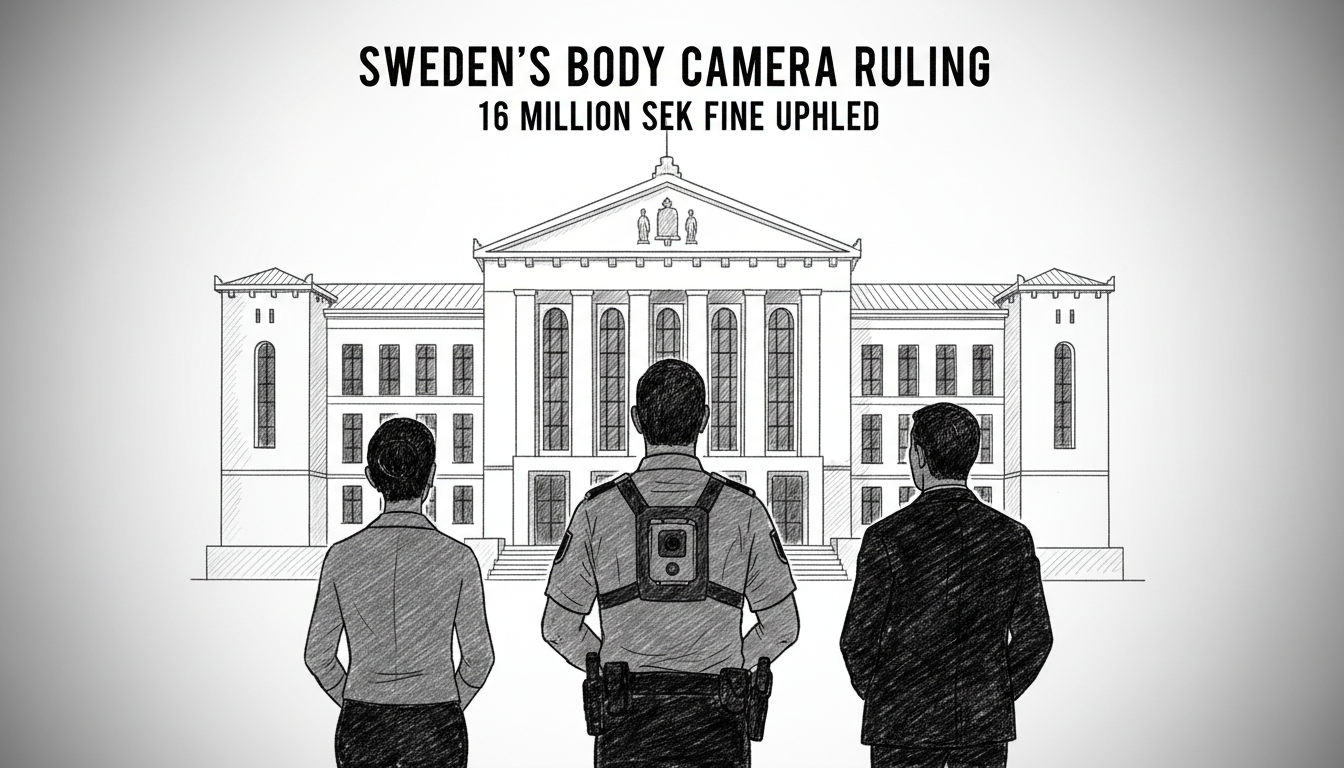
Sweden's public transport authority has lost a landmark legal battle over privacy and surveillance. The EU Court of Justice has ruled against Stockholm Public Transport (SL), upholding a 16 million SEK fine for violating GDPR with its body camera program. This decision forces a major shift in how surveillance is conducted on Sweden's buses, subways, and trams, setting a precedent for transparency across the European Union.
For years, ticket inspectors for SL have worn body cameras. The stated goals were to identify fare evaders more easily and to increase safety for the inspectors themselves. The practice, however, operated in a legal gray area. In 2021, the Swedish Authority for Privacy Protection (IMY) intervened decisively. IMY concluded the program breached the General Data Protection Regulation (GDPR) and criticized SL for failing to inform passengers about the recordings. This led to the substantial administrative fine, equivalent to approximately $1.5 million USD.
SL contested the fine, arguing the data collection was indirect. The case ascended through the Swedish legal system to the Supreme Administrative Court, which then referred key questions to the EU's highest court. The central dispute was simple: must a transport company directly inform someone they are being filmed by a body camera? The EU Court of Justice delivered a clear and unambiguous answer. Individuals must receive immediate information about the recording, both through clear signage and a verbal notification from the inspector. The court rejected SL's indirect collection argument, stating body cameras constitute direct personal data gathering.
A Legal Precedent for European Surveillance
This ruling extends far beyond Stockholm's subway platforms. It establishes a rigorous standard for transparency when using body-worn cameras in public spaces across the EU. The court's insistence on dual notification—visual and verbal—creates a high bar for compliance. Legal experts note this will influence police forces, private security firms, and any entity employing similar technology. The judgment reinforces that security measures cannot override fundamental privacy rights without clear, immediate safeguards for those under surveillance.
"The court has drawn a firm line," said a Stockholm-based data protection lawyer familiar with the case. "GDPR principles of lawfulness, fairness, and transparency are not optional. You cannot secretly film people in the name of security or efficiency. This ruling makes the balance very concrete: if you film, you must inform, actively and without delay." The decision empowers national data protection authorities like IMY, confirming their interpretations of GDPR are aligned with EU jurisprudence.
The Stockholm Transport Authority's Compliance Challenge
For SL, the ruling necessitates an immediate operational overhaul. The company must now equip and train its several hundred ticket inspectors to provide verbal warnings. It must also install new signage across the vast Stockholm public transport network. This involves metro stations, bus interiors, tram stops, and ferry terminals. The logistical and financial implications are significant, coming on top of the upheld multi-million krona penalty.
A spokesperson for SL stated the company is analyzing the full judgment to understand the precise requirements for implementation. "Our priority has always been the safety of our staff and passengers," the spokesperson said. "We now must integrate this clear legal requirement into our daily procedures." The transition period will be closely watched. Any misstep could lead to further scrutiny from IMY and potential additional sanctions, keeping the issue in the public and legal spotlight.
Balancing Security and Privacy in Swedish Society
The case encapsulates a persistent tension in Swedish and European policy. How do authorities protect public safety and enforce rules without eroding personal privacy? Sweden has a generally high level of public trust in institutions, but also a strong cultural and legal commitment to individual integrity. The use of surveillance technology often tests this balance. The Riksdag has debated surveillance laws repeatedly, with government policy attempting to navigate between these competing values.
Privacy advocates have hailed the EU court's decision as a victory for civil liberties. They argue that covert surveillance, even for administrative purposes like ticketing, creates a chilling effect and normalizes being constantly monitored. "This isn't just about fare evasion," said an analyst from a Swedish digital rights organization. "It's about establishing that in a democratic society, you have a right to know when the state or its contractors are collecting your personal data. Transparency is the foundation of accountability."
Implications for Future Government Policy in Sweden
The ruling sends a direct message to Swedish government agencies and municipalities using or considering surveillance tech. Projects involving facial recognition, automated number plate reading, or other forms of observation must now account for this strengthened transparency obligation. The decision provides IMY with a powerful tool to audit and sanction non-compliant practices. It will likely influence ongoing discussions in Rosenbad, the Swedish government offices, about national surveillance frameworks.
Future Riksdag decisions on security matters will be made against this legal backdrop. The court has clarified that GDPR is a living framework that applies dynamically to new technologies. Policymakers cannot assume that beneficial aims justify opaque methods. This will affect legislation concerning everything from crowd monitoring at major events to municipal crime prevention initiatives. The bureaucratic process for approving such technologies will require more rigorous privacy impact assessments.
What Comes Next for Passengers and Inspectors?
The immediate human impact is twofold. For Stockholm's commuters, the environment on public transport will change. The sight of body cameras will now be accompanied by clear warnings. The question remains how this will affect passenger behavior and the perceived legitimacy of ticket inspections. For the inspectors, the ruling adds a procedural step to potentially tense encounters. While intended to enhance legal certainty, the requirement to announce recording could escalate or de-escalate situations, a dynamic SL must now manage through training.
The 16 million SEK fine stands as a costly lesson in regulatory compliance. It demonstrates that even public authorities with security concerns are not exempt from Europe's stringent data protection regime. As Sweden and other EU members continue to integrate technology into public services, this case will be a standard reference point. It affirms that in the digital age, the right to privacy is not passively protected; it requires active, ongoing defense through precise legal instruments and courageous judicial enforcement. The final outcome proves that no organization, however large or public-minded, operates above the fundamental law governing personal integrity in Europe.