
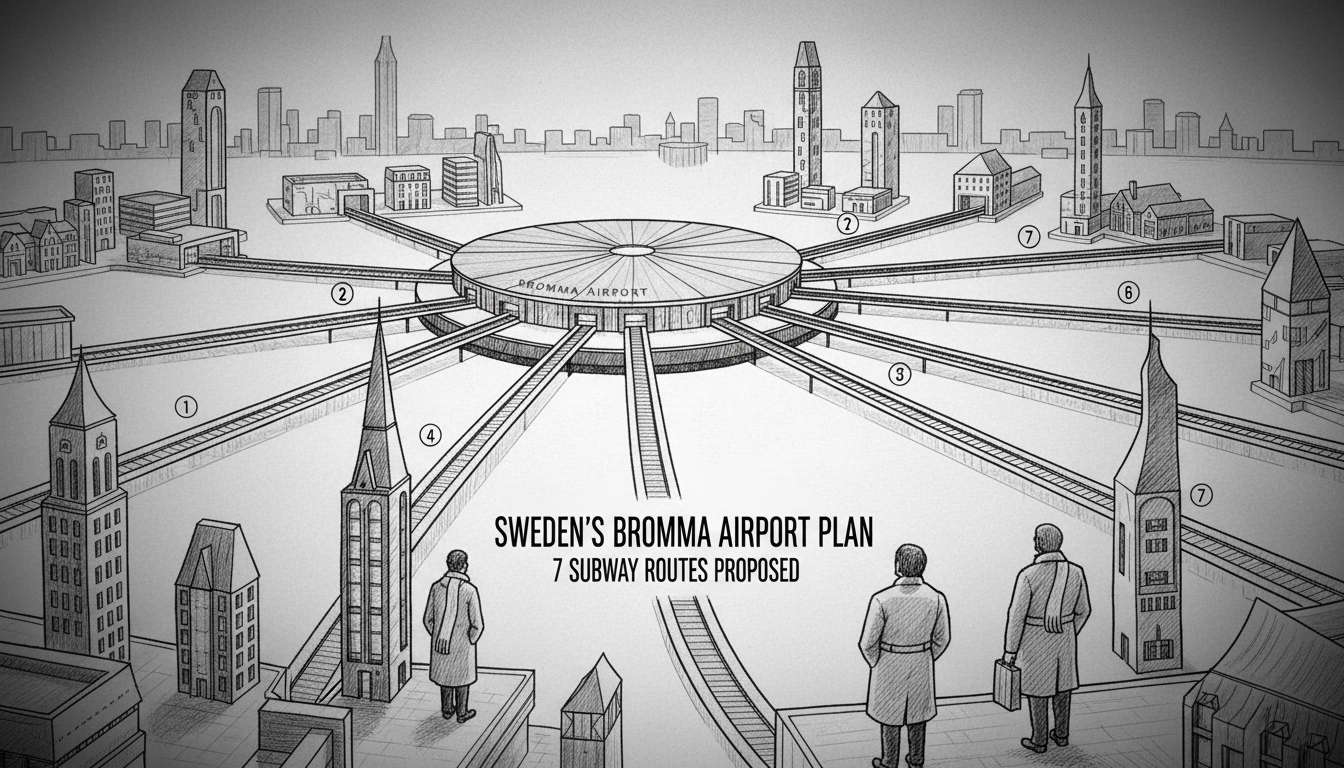
Stockholm's subway expansion plans are targeting the future Bromma Parkstad, with seven new route alternatives now on the table. The proposals aim to connect a potential new city district, planned for the current airport site, to the capital's metro network. This move signals a major shift in urban planning for Sweden's capital region.
"With such a large number of homes and workplaces planned, we need high-capacity public transport. The subway is interesting to study further," says Jörgen Altin, the region's project leader. His comment highlights the scale of ambition. The redevelopment of Bromma Airport into a mixed-use urban district is a cornerstone of the city's red-green coalition's vision.
Several of the seven proposed routes for extending the subway to Bromma affect Solna municipality. One leading idea involves extending the Green Line from its current terminus at Arenastaden. The line would then run south, through Sundbyberg, to reach the Bromma airport area. This would physically link a major entertainment and retail hub with a future residential and business zone.
From Runways to Residential Streets
The plan to close Bromma Airport and build a new city district, often called Bromma Parkstad, has been debated for years. Bromma Airport, located just 7 kilometers from Stockholm's city center, handled around 1.3 million passengers in its last full pre-pandemic year. Its prime location makes it incredibly valuable real estate in a city grappling with a chronic housing shortage.
Proponents argue that repurposing the land for thousands of new homes and offices is a smarter use of space. They point to the need for sustainable, dense urban development with excellent public transport links from the start. Critics, however, question the loss of a convenient city airport and the immense costs of both decommissioning the airport and building an entirely new subway branch.
"Infrastructure projects of this magnitude are always a balancing act," says Karl Lundström, an urban planning expert at KTH Royal Institute of Technology. "The upfront cost is enormous, often running into tens of billions of kronor. The calculation must be whether the long-term benefits—more housing, reduced car dependency, new commercial spaces—justify that investment over 50 years."
The Seven Routes: A Technical Puzzle
The seven alternatives presented by Region Stockholm are more than just lines on a map. They represent different philosophies for integrating the new district into the wider transit network. The color of the arrows on the planning documents indicates which existing metro line each proposal would connect to, primarily focusing on the Green and Red lines.
Extending the Green Line from Arenastaden is a logical contender. Arenastaden is already a major node, home to the Friends Arena and the massive Mall of Scandinavia. A direct subway link would create a powerful urban axis. Other proposals might involve connections from the Red Line, potentially offering more direct routes to the southern parts of central Stockholm.
Each route comes with its own set of engineering challenges, estimated costs, and potential ridership numbers. Building through Sundbyberg, for instance, requires careful coordination with an existing, dense urban fabric. The region must also consider how these new tracks and stations would integrate with the existing network's capacity and signaling systems.
A Cultural Shift in Stockholm's West
For residents in western Stockholm boroughs like Bromma and Sundbyberg, the proposals are about more than concrete and rails. They signal a fundamental change in the character of their part of the city. Bromma has traditionally been a more suburban, car-oriented area compared to the inner city. A subway extension, coupled with dense new development, would dramatically increase connectivity and urban feel.
"It's the difference between getting a bus that gets stuck in traffic and stepping onto a train that gets you to T-Centralen in 15 minutes," says Mira Bengtsson, a long-time Bromma resident. "It would change everything about daily life here. But we also have to get the housing mix right—it can't just be luxury apartments."
This cultural dimension is crucial. Swedish urban planning strongly emphasizes creating livable, accessible neighborhoods with services, schools, and green spaces within walking distance. The success of Bromma Parkstad will depend on it feeling like a cohesive part of Stockholm, not just a transit-oriented development project.
The Long Road from Proposal to Platform
It is vital to understand that these seven alternatives are just the beginning of a very long process. Stockholm's subway history is one of meticulous, and often slow, planning. The first line opened in 1950, and the system has grown to about 100 stations through successive expansions, each taking years of debate and construction.
The next steps involve detailed impact assessments, public consultations, and intense political negotiations to secure funding. The municipal, regional, and national governments will all need to agree. Given the current economic climate, with high construction costs and strained public budgets, the timeline is uncertain.
"The political will is there in Stockholm City, but the financial reality is a hurdle," notes political analyst Eva Strand. "These plans will compete with other major infrastructure needs across the region, like the ongoing extension of the Blue Line. The final decision will hinge on which project is seen as delivering the most value for the entire metropolitan area."
What Happens to the Airport?
The subway plans are entirely dependent on the airport closing—a decision that is itself not yet final. While the city's political leadership is committed, the process involves national transport authorities and existing airport leases. The debate pits the value of inner-city land for housing against the utility of a short-haul airport for business and domestic travel.
If the airport does close, the redevelopment would be one of the largest in Stockholm in decades. The vision is for a climate-smart district built according to the latest environmental standards. The promise of a subway connection from day one is a key selling point to make this a truly public transport-first neighborhood.
For now, the seven colored lines on the planner's map represent a future possibility. They chart a course for how Stockholm could grow, addressing its housing crisis while betting big on sustainable transit. The journey from these proposals to hearing the familiar chime of a subway door opening at a new Bromma Parkstad station will be a defining project for a generation. The question remains: which color line will they choose?