
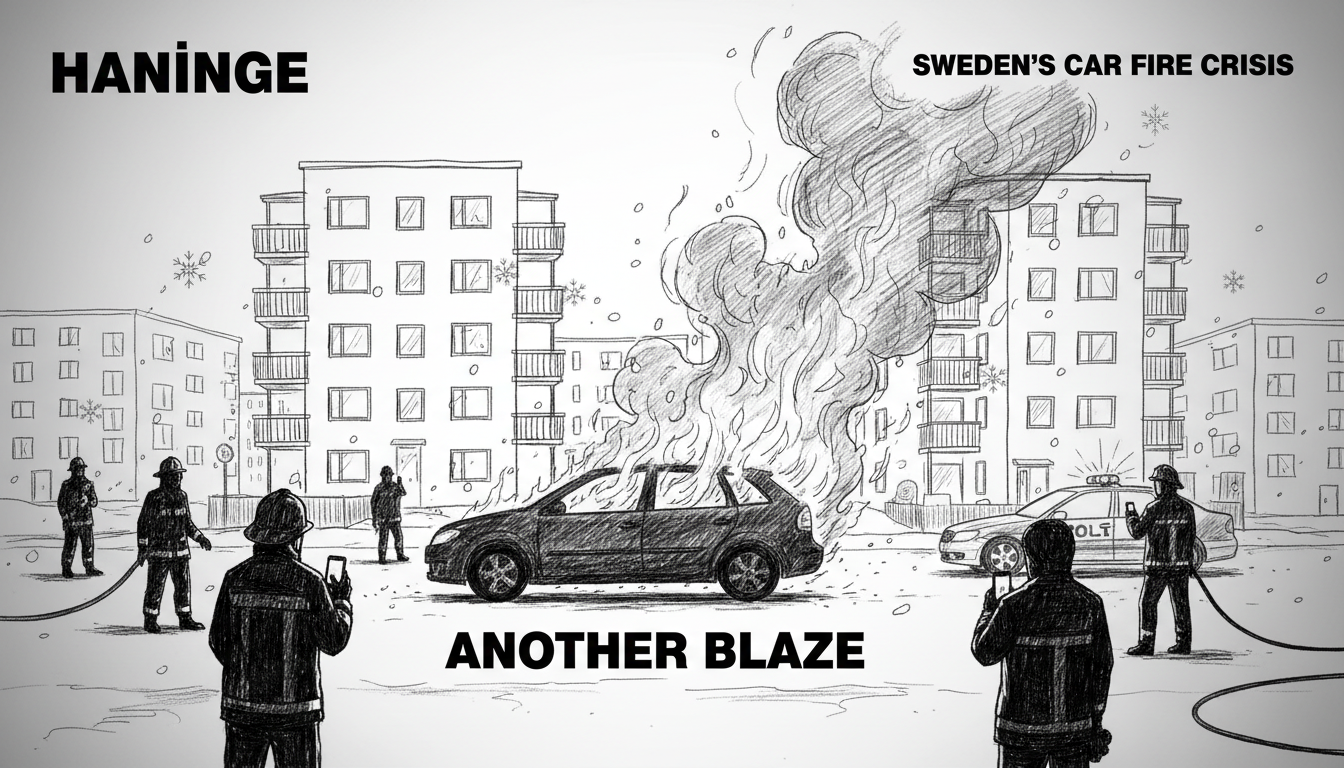
Sweden recorded over 1,500 vehicle arson cases last year, a troubling backdrop to the loud bang that shattered the night in Jordbro. A car was left burning after witnesses reported hearing an explosion and seeing another vehicle speed away. Police suspect deliberate vandalism using illegal pyrotechnics. This single incident in a Stockholm suburb opens a window into broader questions about social cohesion, youth alienation, and the challenges facing communities on the city's periphery.
A Night of Noise and Fire
It was a typical quiet night in Jordbro, a district in Haninge municipality, until the silence was broken. Residents described a sudden, sharp report—a high smäll—followed by the sight of flames engulfing a parked car. According to police spokesperson Rebecca Landberg, the sequence was clear from emergency calls. "A caller heard a bang, saw a vehicle drive off, and then a car burning," Landberg said. Preliminary investigation points to pyrotechnics as the ignition source. In Sweden, such explosives are strictly illegal outside permitted events, with even New Year's Eve use heavily regulated. The act fits a pattern not unique to Jordbro but felt in many suburban areas: property damage as a disruptive, visible signal of discontent or criminal activity.
Between Concrete and Green Spaces
To understand Jordbro is to understand modern Swedish urban planning. Located about 25 kilometers south of Stockholm's center, it's part of Haninge, a municipality of roughly 95,000 people. Jordbro itself is a mix of post-war apartment blocks, terraced houses, and generous green spaces. It's a place designed for community, with schools, sports facilities, and shopping centers. Yet, like several suburbs in Sweden's major cities, it grapples with socio-economic challenges. Statistics often show higher unemployment rates and lower average incomes compared to inner-city districts. This doesn't define the community, but it forms part of its reality. "We have many proud residents here, families who have lived here for generations and newcomers who are building their lives," says local community center worker, Amir Hassan. "But when things like this happen, it's the whole neighborhood's name that gets dragged through the mud."
The Pyrotechnics Problem and a Wider Pattern
The use of illegal pyrotechnics in crimes has become a pointed concern for Swedish police. These aren't simple firecrackers but often powerful, industrial-grade explosives that cause severe damage and risk lives. Their use in this incident elevates it from petty vandalism to a potentially lethal act. Social scientists who study urban Sweden often point to a cocktail of factors behind such acts: feelings of exclusion, lack of constructive outlets for young people, and sometimes connections to gang rivalries where territory is marked through intimidation. Professor Lena Karlsson, a sociologist focusing on urban development, notes that while car fires are statistically rare, their impact is profound. "They are a highly visible crime that creates a sense of insecurity," she explains. "It's not just about the material damage. It burns a symbol of mobility and personal freedom, and it sends a message that the public space is not safe or controlled. For residents already feeling neglected, it reinforces a negative spiral."
The Human Cost Beyond the Ashes
The immediate cost of a car fire is calculable: the destroyed vehicle, the police and fire service resources, the potential property damage nearby. The human cost is harder to measure. For the car owner, it's a profound violation and a practical nightmare. For neighbors, it's a night of fear and disruption that lingers. "My children woke up screaming," shares Maria, a mother living two buildings over from the fire, who asked not to use her full name. "The flash lit up their room. Now they ask if our car will be next. How do you answer that?" This erosion of everyday security is what troubles community leaders most. Local initiatives, from youth football clubs to mentorship programs, work tirelessly to provide alternatives. Festivals like the annual Jordbrodagen, a community day with music and food, aim to foster pride and connection. Yet, as one volunteer puts it, "We build for 364 days a year. It takes one night like this to make people question it all."
A Suburb at a Crossroads
Haninge municipality itself represents the complex face of contemporary Sweden. It contains affluent coastal villages, dense suburban districts like Jordbro, and vast forests. Managing this diversity is its central challenge. Municipal policies focus on improving schools, investing in public spaces, and supporting local businesses to create robust job markets. The goal is to combat the segregation—both economic and social—that can fuel disillusionment. "Integration is a two-way street," says Haninge municipal councilor, Erik Lundgren. "It requires effort from society to offer opportunity and a sense of belonging, and from individuals to engage. Incidents of destruction hurt that fragile process. They make people withdraw." The police response to the car fire will likely involve forensic investigation and patrols, but long-term solutions lie beyond law enforcement. They touch on education, housing policy, and the very idea of the Swedish welfare model's promise of equality, no matter your postal code.
Looking Ahead: More Than Just Extinguishing Flames
The charred shell of the car in Jordbro will be towed away. The news cycle will move on. But for the people living there, the questions remain. Is this an isolated act of mischief, or a symptom of deeper fractures? Sweden's suburban areas are not monolithic zones of trouble; they are vibrant, evolving communities. Yet they are also the front line where national issues of immigration, integration, and inequality play out in daily life. The conversation after a car fire often focuses on crime and punishment. Perhaps it should also focus on investment and inclusion. As the clean-up in Jordbro begins, the real work continues—building a community where a loud bang in the night is not a symbol of division, but an anomaly in a shared space of belonging. The future of Swedish suburbs depends on which narrative wins out.