
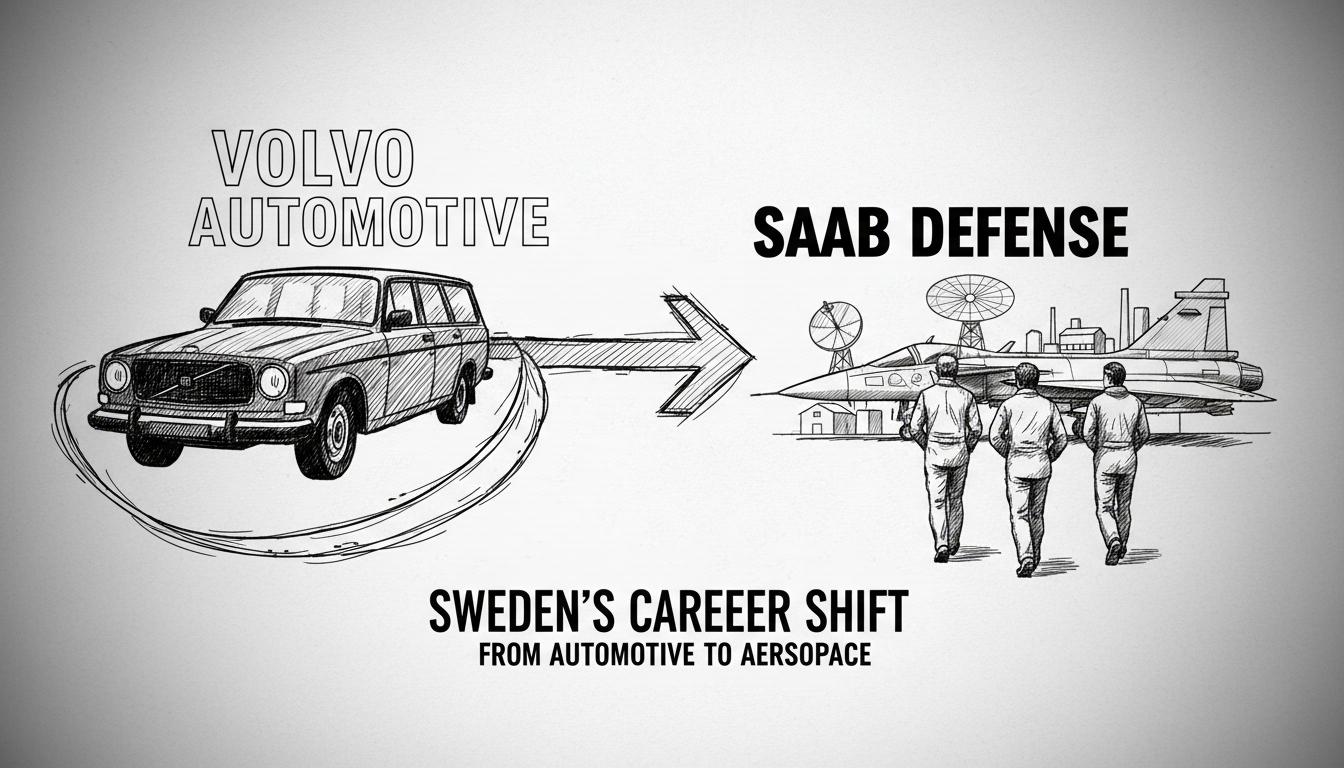
Sweden's defense industry is attracting engineers like Claes Jansson, who left Volvo Cars after 38 years for a new role at defense giant Saab in Kallebäck. He represents a quiet but significant shift in the Swedish job market. As the automotive sector faces headwinds, the resurgent defense industry is hiring thousands. This trend reflects deeper changes in Swedish society and the nation's security posture.
The Phone Call That Changed Everything
For nearly four decades, Claes Jansson's professional identity was intertwined with Volvo Cars. His career spanned generations of vehicle development in Gothenburg, Sweden's traditional automotive capital. Then, last year, he made a call that surprised his colleagues. He accepted a position at Saab's Kallebäck facility, joining over a thousand other new hires at the defense contractor. 'What Saab manufactures helps keep us safe, which I think is important,' Jansson says, explaining his late-career pivot. His move from consumer automobiles to military defense systems is a personal decision with national symbolism.
A Nation Re-arming
This personal story unfolds against a backdrop of rapid change. Sweden's military expenditure is projected to reach 2% of GDP by 2026, a significant increase driven by the deteriorating security situation in Europe. Saab AB's order backlog hit a record high in 2023. The Kallebäck site, a key hub for advanced defense systems, is expanding. Meanwhile, Volvo Cars has announced significant layoffs in Sweden in recent years, citing economic challenges and a costly transition to electric vehicles. 'We are seeing a clear transfer of engineering competence,' notes a Stockholm-based labor market analyst who requested anonymity. 'The skills developed in automotive—systems engineering, software, precision manufacturing—are highly transferable to the defense sector. The demand is now there, and the mission has changed.'
The New Industrial Landscape of Gothenburg
Gothenburg's identity has long been shaped by the blue-and-white Volvo logo. The city's rhythms were tied to shift changes at the Torslanda plant. Today, a different pulse beats in neighborhoods like Kallebäck. Here, Saab's growth is palpable. The sector's revival marks a return for Sweden, which downsized its defense industry after the Cold War. 'It's a complete turnaround,' says Karin Möller, a professor specializing in industrial policy. 'For twenty years, we discussed peace dividends and scaling back. Now, we are in a period of rebuilding not just capability, but also an entire industrial ecosystem. The jobs follow that investment.'
The Human Cost of Economic Transition
The shift creates winners and losers. For skilled engineers like Jansson, it offers new opportunities and a sense of contributing to national security. For others in the automotive supply chain, the transition is harder. The skills mismatch is real, and not every laid-off assembly worker can retrain as a radar systems technician. Swedish society is grappling with this economic realignment. The government is funding retraining programs, but analysts say the pace of change is swift. The defense sector's growth is stable and funded by long-term government contracts, a contrast to the volatile global car market.
Cultural Shifts and Public Perception
This industrial shift also signals a subtle change in Swedish culture. For a nation proud of its neutral stance and peacekeeping heritage, embracing a growing defense industry requires a psychological adjustment. Public support for increased defense spending is now high, a change accelerated by geopolitical events. Working for Saab carries a different connotation than it did a decade ago. It's increasingly seen as vital, innovative, and secure. 'There's a renewed sense of purpose,' says one Saab employee at the Kallebäck site. 'What we do here directly connects to the security we see on the news. It's very concrete.'
The Road Ahead for Swedish Industry
Experts believe this trend is not a temporary blip but a structural realignment. As long as geopolitical instability persists, demand for Swedish defense technology will remain strong. Saab's Gripen fighter jets, submarines, and surveillance systems are major export products. Concurrently, the automotive industry's transition to electric vehicles is a turbulent process requiring huge investments with uncertain returns. This puts a premium on job stability, which the defense sector currently offers. The flow of talent from one iconic Swedish brand to another—from Volvo to Saab—is a powerful indicator of which way the economic winds are blowing.
A Personal Choice with Broader Meaning
Claes Jansson's story is ultimately a human one. It's about recalculating a career path at a stage when many are thinking of retirement. It's about finding meaning in one's work amid global turmoil. His daily commute may end in a different part of Gothenburg, but he remains part of the country's proud engineering tradition. The tools have changed, from safety belts and crumple zones to advanced electronic warfare systems. The underlying ethos of problem-solving and technical excellence remains. As Sweden navigates this new era, thousands of individual choices like his are collectively reshaping the nation's industrial base and, in some ways, its future.