
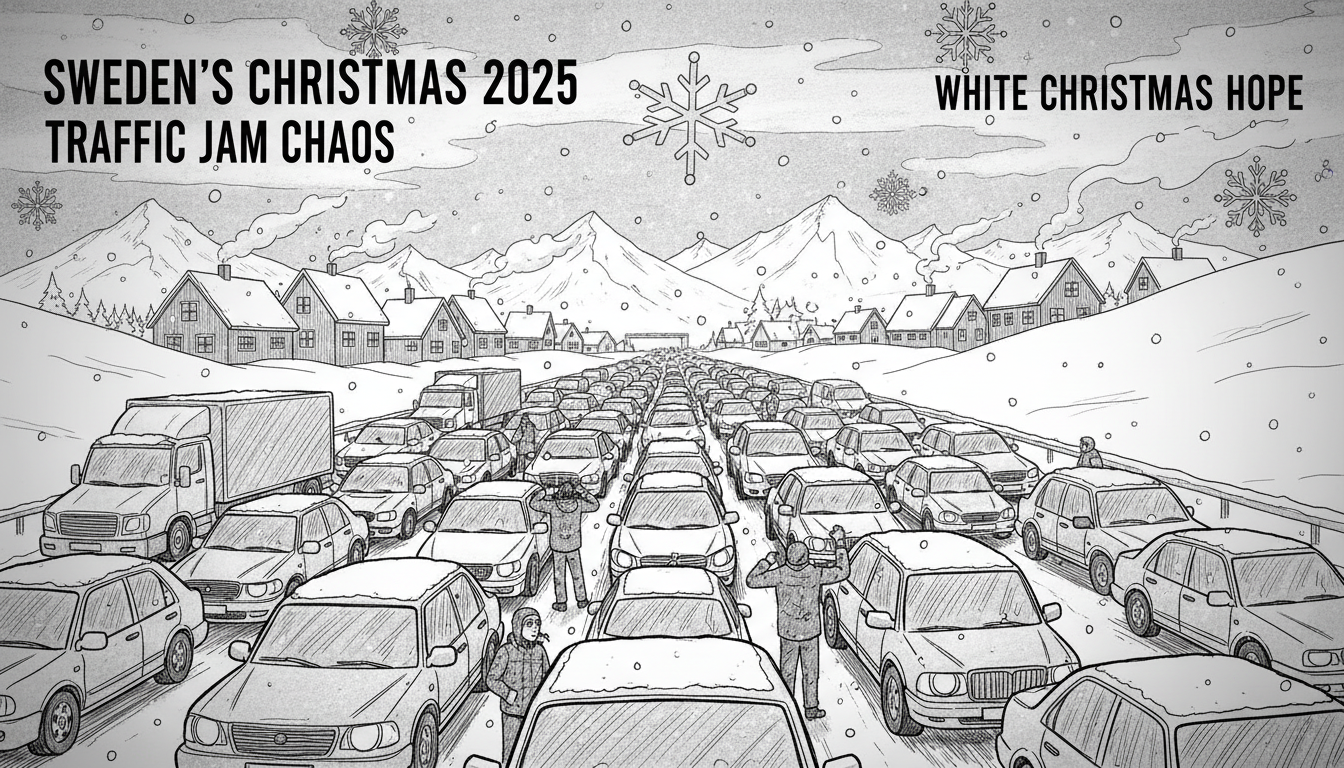
Sweden Christmas travel saw major arteries in the capital clog and close on Monday, as a 15% surge in pre-holiday traffic tested the nation's infrastructure. The temporary shutdown of the Södra länken tunnel, a critical artery for Stockholm commuters and travelers, offered a stark preview of the hectic days ahead. For hundreds of thousands of Swedes, the annual migration to childhood homes and family gatherings is now fully underway. All eyes are also turned skyward, with the age-old question lingering: will there be snow on the ground come the 24th?
The Gridlock Before the Glögg
The scene at Sickla and Gullmarsplan was one of familiar frustration. By 2 PM on Monday, queues inside the Södra länken tunnel had grown so severe that the Swedish Transport Administration made the call. They closed the entrances. 'It may happen that we have to close it again,' said Katarina Wolffram at Trafikverket. This proactive measure is a standard, if disruptive, protocol to prevent total gridlock inside the tunnel itself. For Stockholmers, it meant detours and delays during the most precious travel window of the year. The tension is palpable at train stations too, like Centralstationen, where students, families, and workers laden with gifts crowd platforms, hoping for a smooth trip north to Gävle or west to Gothenburg.
This congestion isn't accidental. It's the product of a deeply ingrained Swedish tradition: celebrating Christmas at home, often meaning the place where one grew up. This creates a massive, synchronized exodus from cities. Traffic analysts note that the concentration of Sweden's population in the Stockholm-Mälaren region acts as a giant pump, sending waves of vehicles onto the E4 and E18 highways. The 15% increase in traffic volume Trafikverket recorded in 2023 on these routes is expected to hold steady or grow. The pre-Christmas rush is more than a commute; it's a cultural ritual, marked by packed cars, listening to 'Julkalendern' on the radio, and the first sight of candles glowing in farmhouse windows.
The Eternal Weather Lottery
While traffic is a predictable challenge, the weather remains the great variable. The dream of a 'vit jul' (white Christmas) is a powerful part of the Swedish festive psyche. The official meteorological definition requires at least one centimeter of snow covering the ground on Christmas Eve. Historically, Stockholm's odds sit between 30% and 40%—a gamble every year. In the north, in cities like Luleå or Kiruna, it’s a near certainty. In the southern regions of Skåne, it’s a rare event. This geographical divide adds another layer to the travel narrative: southerners heading north are often guaranteed their white Christmas, while the hope in Stockholm is fragile.
Meteorologists point to a concerning trend, however. The increasing unpredictability of winter weather patterns, linked to broader climate shifts, makes reliable long-range forecasting difficult. 'The patterns are becoming less stable,' one climatologist explained. 'We see more frequent swings between mild, wet periods and sharp cold snaps.' This means the iconic image of a snow-dusted Stockholm on Christmas morning, while still possible, may become a less frequent feature of Swedish holiday cards. The uncertainty itself is becoming a new tradition.
Navigating the Holiday Rush
How are Swedes adapting? The advice from authorities is consistent: travel off-peak if you can, use real-time traffic apps, and pack patience. For many, the stress of the road has bolstered the appeal of train travel, despite its own seasonal crowds. The SJ rail operator adds extra carriages, but seats are hot commodities. Others are rethinking the tradition altogether, choosing a 'hemmajul' (home Christmas) in their own city to avoid the chaos. This shift is subtly changing the dynamic in Stockholm neighborhoods like Södermalm and Vasastan, where more locals stay put, creating a quieter, more communal city-centre holiday.
The economic and social implications are significant. Retail and hospitality see a sharp divide—booming in city centers until the 23rd, then becoming ghost towns as everyone leaves. Petrol stations and roadside cafes along major highways become oases of frenetic activity. The very rhythm of Swedish society changes for a week. For immigrants and newer Swedes, navigating this period is a unique insight into national culture. The collective focus on travel and weather forecasts is a shared experience that cuts across backgrounds, a unifying topic of small talk in offices and schoolyards nationwide.
Beyond the Traffic Report
Ultimately, the scramble and the snow obsession point to something deeper than logistics. The pressure to travel reflects the immense value placed on family and shared tradition in Swedish culture, even in an increasingly secular and individualistic society. The desire for a white Christmas is a connection to nature and a specific, postcard-perfect aesthetic of comfort ('mys') that defines the Swedish winter ideal. The potential disappointment of a green, rainy Christmas in Stockholm is about more than weather; it feels like a missing piece of the emotional backdrop.
Will the Södra länken close again before the 24th? Almost certainly. Will Stockholm have a white Christmas in 2025? The odds are, as ever, against it. Yet, the hope persists. As families finally reunite in cottages in Dalarna or apartments in Malmö, the travel stress fades. It’s replaced by the glow of the advent star, the taste of pepparkakor, and the quiet joy of being together. The journey may define the start of the holiday, but it’s the arrival that truly matters. In the end, perhaps the most Swedish tradition of all is enduring the frantic pre-Christmas week to achieve that moment of peaceful holiday calm, with or without snow.