
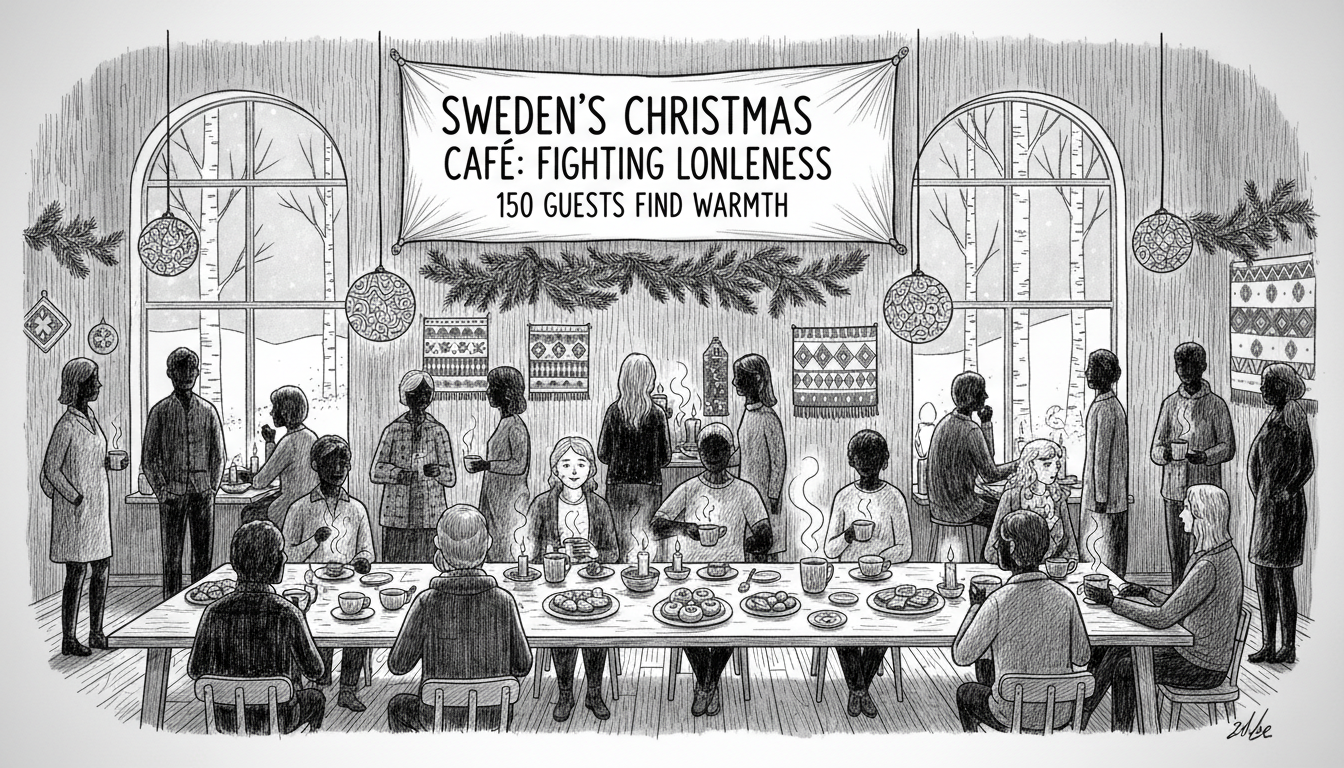
Swedish culture news often highlights traditions like the festive 'julbord'. In a quiet café in Hälleforsnäs, one woman is rewriting that script. Monica Larsson opened her doors this Christmas to people who would otherwise be alone. Her simple act of hosting a community Christmas buffet touched 150 lives. It revealed a deep need for connection in Swedish society.
Inside Café Moni, the air is thick with the scent of gingerbread and mulled wine. Laughter mixes with the clatter of cutlery on classic julbord dishes. There are pickled herring, meatballs, and saffron buns. For many here, this is their first shared holiday meal in years. Monica Larsson moves between tables, refilling coffee cups and sharing stories. She started this initiative three years ago. "There is a need to come together, whether you are poor or rich," Larsson says. Her words cut to the heart of a widespread but often silent issue in Sweden.
The Heart of a Café
Monica Larsson is not new to supporting communities. She worked at Fryshuset in Stockholm for 27 years. That experience shaped her approach. "I've thought about trying to organize similar events once a month here at the café," she explains. Her vision extends beyond December. She wants a place where people can eat and meet regularly. The café in Hälleforsnäs, a town of about 1,500 people, becomes a social anchor. Leftover food from the Christmas buffet is never wasted. Larsson ensures it goes to others in need. This creates a cycle of generosity that lasts beyond the holiday itself.
One guest, pensioner Anita Andersson, describes the difference it made. To not be alone on Christmas Eve was everything. Her story is not unique. In 2020, around 1.4 million people in Sweden lived alone. That represents a significant part of the population. For the elderly, weekends and holidays can be the hardest. Traditions that emphasize family can amplify feelings of isolation. Monica's café offers a gentle alternative. It is a model of informal, grassroots community care.
A Growing Silence in Swedish Society
Social isolation is a recognized challenge across the Nordic region. Sweden's high proportion of single-person households is a key factor. Studies consistently link loneliness to poorer physical and mental health. This is especially true for older adults. The Swedish welfare state provides strong material support. Yet, the need for social belonging is harder to structure through official policy. "Initiatives like Monica's are crucial," says sociologist Erik Lundgren, who studies community cohesion. "They fill the gaps that systems cannot. They rebuild social fabric from the ground up, person by person."
This is not just a big-city issue. In smaller towns like Hälleforsnäs, public transport might be limited. Social networks can shrink as people age. Community hubs like local cafés become vital. They are neutral, welcoming spaces. Lundgren points out that Swedish lifestyle trends towards independence can sometimes backfire. "We prize self-sufficiency," he notes. "But human beings are fundamentally social. We need these points of contact, especially as we get older."
More Than Just a Meal
The event in Hälleforsnäs shows the power of low-threshold solutions. A shared meal requires no formal application. There is no stigma. It mirrors traditional Swedish 'fika' – the ritual of coffee and conversation – but on a larger, more intentional scale. Stockholm events today might be grander. Yet, the impact here is profound. Guests are not just recipients of charity. They are participants in a shared celebration. They contribute to the atmosphere simply by being present.
Monica Larsson uses her experience intuitively. She knows how to make people feel seen and included. This skill is as important as the food she serves. Her monthly event idea could provide a sustainable model for other small businesses. A regular 'community table' could combat loneliness year-round. It builds routine and predictable points of human contact. For local residents, it transforms a commercial space into a civic one.
The Ripple Effect of Connection
Sweden immigration news often discusses integration. This story touches on a parallel theme: the integration of the isolated into the heart of community life. The need for belonging is universal. It crosses lines of age, income, and background. Monica's initiative quietly challenges the notion that holidays are exclusively for family units. It expands the definition of a holiday gathering to include chosen community.
The leftover food donation adds another layer. It ensures the event's goodwill extends further into the neighborhood. This practical kindness reinforces a culture of looking out for one another. It is a powerful example of local resourcefulness. In an era of global challenges, the solution often starts on a Main Street. It starts with someone deciding to set a few extra places at the table.
Looking Ahead to a Less Lonely Future
As the lights come down on another Swedish Christmas, the question remains. How can society foster more connections like those in Café Moni? Experts suggest supporting local meeting places. They advocate for urban planning that encourages casual interaction. The success in Hälleforsnäs proves there is a hunger for this. It is a reminder that Swedish society trends are not predetermined. They can be reshaped by simple, compassionate action.
Monica Larsson's café offers a blueprint. It shows that fighting loneliness does not always require a large budget or a government program. Sometimes it needs a warm room, an open door, and a hearty meal. It requires the insight to see a need and the heart to address it. As the new year begins, the hope is that the spirit of that Hälleforsnäs julbord lingers. Not just as a happy memory, but as an inspiration for others to pull up a chair. For 150 people this year, Christmas was not about being alone. It was about being, simply, together. That may be the most cherished Swedish tradition of all.