
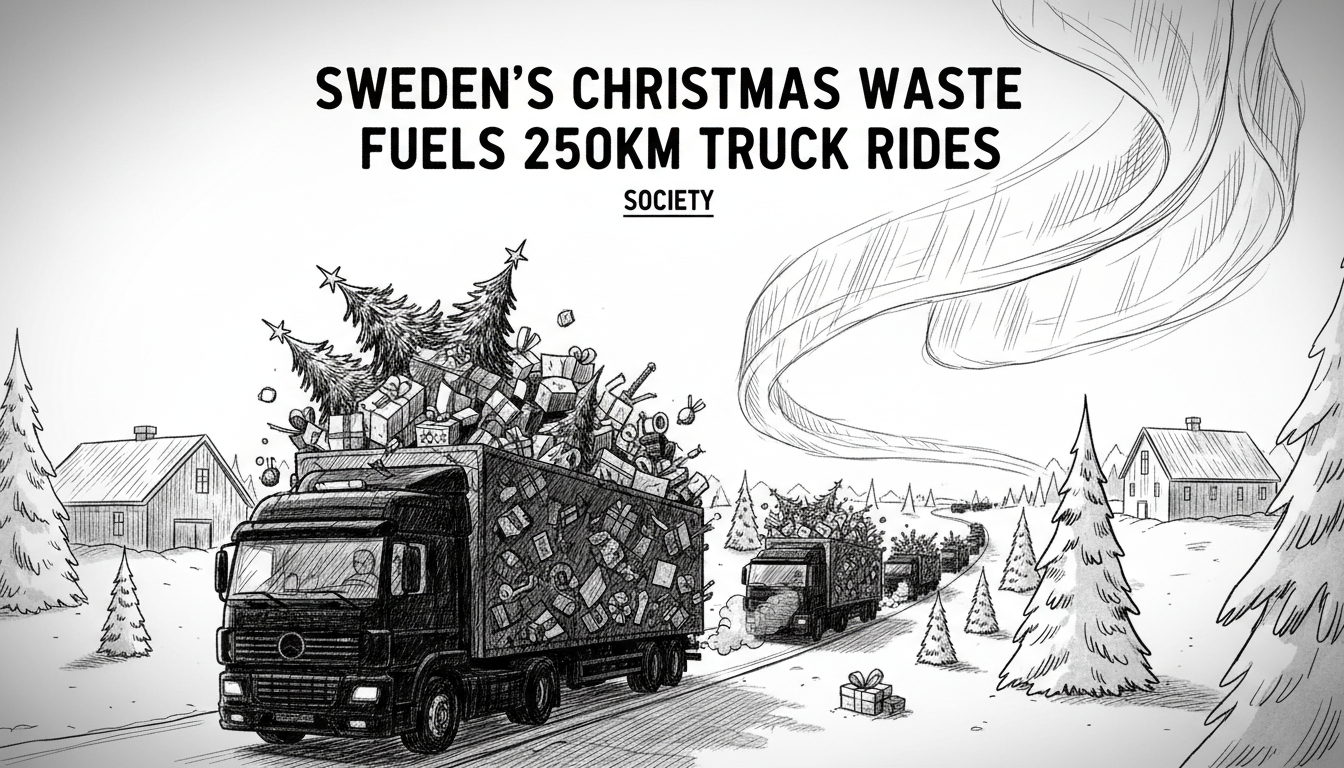
Sweden is powering heavy trucks for 250 kilometers using biogas made from discarded Christmas food, a vivid example of its circular economy in action. At the newly opened biogas station in Jordbro, just south of Stockholm, driver Maris Kamss pulls on thick gloves. He connects a hose, frosted at minus 160 degrees Celsius, to fill his truck's tank with liquid biogas.
“A full tank lets me drive a maximum of 250 kilometers, depending on how heavy the load is,” Kamss says. The fuel in his truck has a very local origin. It was produced just a short distance away at the St1 Biokraft facility in Gladö, using organic waste from brown food recycling bags.
This year, the holiday leftovers from Södertörn residents’ Christmas tables will complete that loop. Their discarded julskinka (Christmas ham) and lussekatter (saffron buns) will be transformed into clean fuel for trucks delivering goods back to their communities.
From Holiday Feast to Clean Fuel
The process begins in Swedish homes during the jul season, a time known for abundant julbord feasts. After the holidays, food scraps go into separate brown bags for biological waste. These bags are collected by municipal services and transported to treatment plants like the one in Gladö.
There, through anaerobic digestion, microorganisms break down the organic matter without oxygen. This produces biogas, primarily methane. The gas is then purified and cooled to an extreme -162°C, turning it into liquid biogas (LBG). This drastic cooling reduces its volume, making it efficient to store and transport by tanker truck to filling stations.
“It’s completely fantastic. Every time I say it, it almost sounds too good to be true,” says Fredrik Nordin, responsible for St1 Biokraft’s Nordic station network. He watches as Kamss finishes refueling. The station in Jordbro is a quiet hub in this local energy cycle.
The Science of Turning Leftovers into Energy
Biogas is a key player in Sweden's renewable energy mix. In 2022, it accounted for approximately 3% of the country's total energy supply. While that number might seem small, its role in decarbonizing heavy transport is critical. Trucks and buses are difficult to electrify fully due to their weight and long-range needs.
Liquid biogas offers a practical solution. It provides a high energy density, similar to diesel, but with far lower carbon emissions. When burned, it mainly releases carbon dioxide that was recently absorbed by the plants eaten as food, creating a near-neutral cycle.
“This isn't just about waste management; it's about resource efficiency,” explains environmental scientist Karin Lundström, who studies circular systems. “Using organic waste for fuel reduces landfill methane emissions and replaces fossil diesel. It's a double win for the climate.”
The Gladö plant is part of a broader national infrastructure. Sweden aims for a fossil-free vehicle fleet by 2030, and biogas is essential for meeting that goal, especially for the transport and logistics sector.
A Local Cycle with Global Implications
The Jordbro-Gladö loop is a model of hyper-local sustainability. Residents in Stockholm's Södertörn region can literally see their waste become fuel for the trucks that supply their local supermarkets. This tangible connection boosts public participation in sorting waste.
“People in Haninge and Botkyrka municipalities are very proud of this,” notes local councilor Anna Berg. “During our jul markets, we now talk about the ‘second life’ of the holiday meal. It makes the concept of a circular economy real, not just a policy term.”
Cultural traditions are adapting. The Swedish practice of julmat (Christmas food) is now intertwined with environmental consciousness. Families discuss how their festive choices contribute to a larger system, from buying local ingredients to ensuring scraps are sorted correctly.
Challenges and the Road Ahead
Despite the success, scaling up faces hurdles. Biogas production requires consistent, high-quality organic waste streams. Contamination from plastics in food waste bins can disrupt the process. Public education remains crucial.
Infrastructure is another challenge. While stations like Jordbro are growing, a more extensive network is needed for long-haul transport across Sweden. Investment in production facilities and distribution is ongoing, driven by both corporate initiatives and state incentives.
Economically, the model shows promise. It creates local jobs in waste management, plant operation, and logistics. It also reduces costs associated with waste disposal and fossil fuel imports.
“The economic benefits of a circular model are clear,” says economist Lars Pettersson. “You turn a cost center—waste treatment—into a revenue stream through energy production. It builds regional resilience.”
A Sustainable Tradition for the Future
As next Christmas approaches, the cycle will continue. The vision is to expand this model to other regions and waste streams, including agricultural and industrial bio-waste. For now, the image of a truck running on julmat encapsulates Sweden's pragmatic approach to green innovation.
It blends deep-rooted cultural traditions with cutting-edge technology. The story isn't about sacrificing comfort for sustainability; it's about integrating the two. As Maris Kamss drives his biogas-powered truck out of Jordbro, he carries more than cargo. He carries the tangible result of a society rethinking its resources.
Can the rest of the world learn from Sweden's holiday-fueled trucks? The answer lies in seeing waste not as an endpoint, but as the beginning of a new, cleaner journey.