
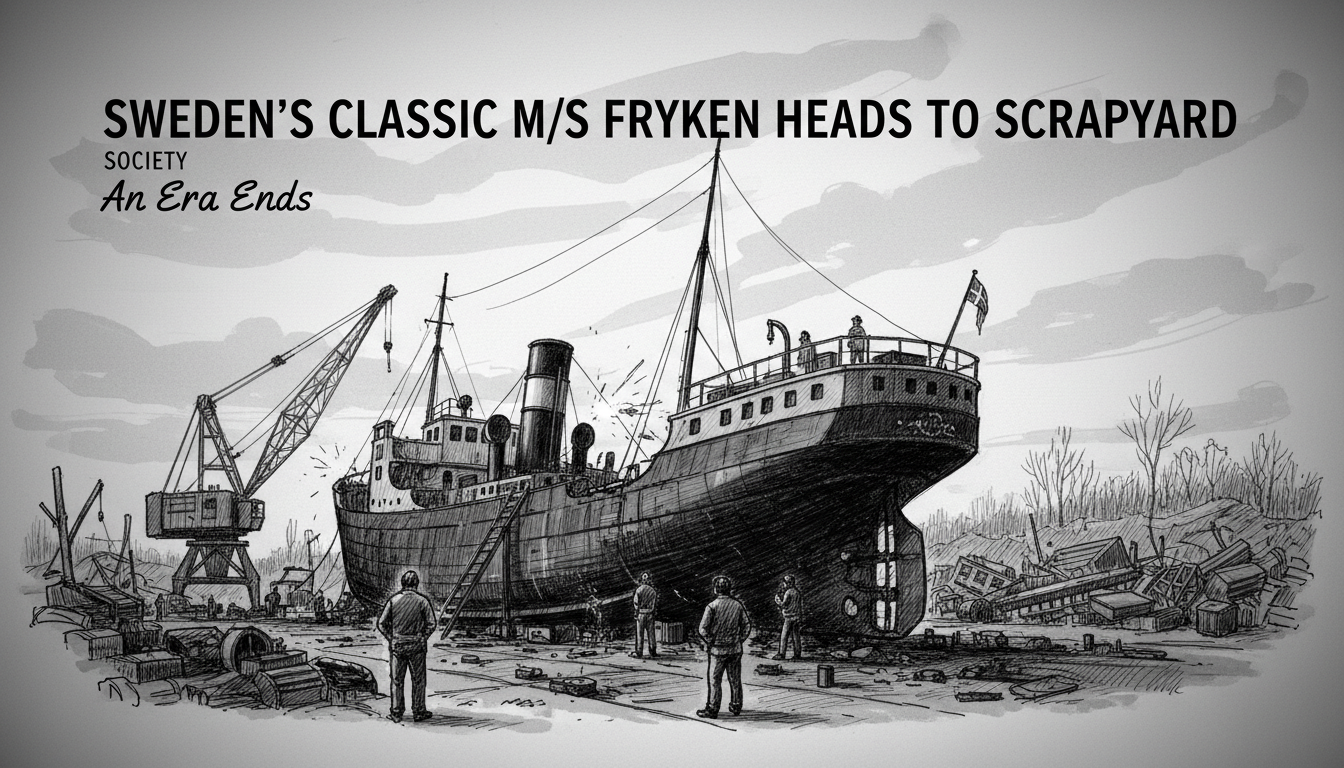
Sweden's maritime heritage is losing a nearly 90-year-old piece of its history. The classic vessel M/S Fryken, a long-time resident of Gothenburg's Eriksberg harbor, is being sent for recycling at a Danish shipyard. Its owner, the Maritiman floating museum, confirmed the decision after failing to find a buyer or tenant for the aging ship.
"Naturally, we think it's sad," said Frida Svensson, operations manager at Maritiman. Her statement carries the weight of a difficult but inevitable choice. The ship hasn't been open to the public for years. Its condition has deteriorated, a suitable berth is scarce, and the cost of a full restoration is simply too high. "We have tried to sell and find new tenants," Svensson explained, "but the cost to renovate and restore is too high for us."
For almost four decades, M/S Fryken's silhouette was a familiar sight along the Göta River. Its impending departure marks the end of an era for the Eriksberg area, a former industrial shipyard zone now transformed into sleek apartments and offices. The ship's quiet presence was a living link to Gothenburg's proud shipbuilding past, a tangible memory slowly succumbing to rust and economic reality.
The End of a Nearly Century-Long Voyage
The story of M/S Fryken is a classic Swedish industrial tale. Built in the 1930s, the ship served faithfully for decades, likely on Sweden's extensive network of lakes and coastal routes. Its specific history before arriving in Gothenburg is a story now at risk of being lost. For the past 40 years, it found a final home as part of Maritiman's collection—a museum dedicated to preserving the very kind of vessel it now must let go.
Maritiman itself is a unique institution, a cluster of historic ships moored together that tells the story of Swedish naval and merchant marine history. The decision to scrap one of its own is not taken lightly. It highlights the constant, silent struggle faced by maritime museums worldwide: the battle against time, saltwater, and finite budgets. A ship is not a painting in a climate-controlled gallery; it is a massive, complex structure constantly fighting decay.
"The ship has not been shown to the public for a long time," Svensson noted, pointing to a practical reality. Without visitors, a museum artifact loses its primary purpose and its source of revenue. M/S Fryken had become a dormant exhibit, a cost center in a mooring space that could potentially host a vessel that people can actually board and explore.
The Economics of Preserving History
The fate of M/S Fryken opens a wider conversation about the value and cost of preserving industrial heritage. From a purely economic standpoint, the decision is logical. Recycling the steel and materials provides some financial return and is environmentally responsible. Maintaining a large, aging steel hull involves staggering expenses: anti-corrosion treatments, hull inspections, safety certifications, and constant minor repairs.
"The cost to renovate and restore is too high for us," Svensson's simple statement is the core of the issue. There is no villain here, only arithmetic. Public funding for cultural heritage is always limited and must be allocated where it has the greatest impact. For Maritiman, prioritizing funds towards ships that can still welcome the public is a necessary, if painful, strategic choice.
Yet, economists who focus on cultural value might argue differently. A historic ship is not just an object; it's a catalyst for memory, education, and local identity. It contributes to the cultural capital of a city like Gothenburg, which markets itself on its maritime soul. Every time a physical piece of that history disappears, the city's tangible connection to its roots weakens slightly. The question becomes: how do you quantify the loss of a landmark that has silently witnessed the city's transformation from an industrial powerhouse to a modern tech hub?
A Changing Eriksberg and Lost Landmarks
The ship's location in Eriksberg is deeply symbolic. This area was once the heart of Swedish shipbuilding, where giants of industry like the Eriksbergs Mekaniska Verkstad launched ocean-going vessels. Today, the cranes are silent, replaced by construction cranes building luxury apartments. The old workshops are trendy restaurants and offices.
M/S Fryken, docked there, was a poignant holdout from that earlier era. It was a piece of living archaeology. For older residents, it was a reminder of their working past. For new arrivals living in the glossy developments, it was a curious relic, perhaps not fully understood but adding character to the waterfront. Its removal will clean up the shoreline, making it more uniform, but also more generic.
This pattern repeats across Sweden. As cities develop and former industrial zones become prime real estate, the physical evidence of the 20th-century working class often gets curated into a few preserved buildings or removed entirely. The loss of M/S Fryken is part of this slow-motion editing of the urban landscape. The story of manual labor and engineering prowess is condensed into museum displays, while the actual, large-scale objects become too burdensome to keep.
What Does It Mean for Swedish Maritime Heritage?
The recycling of M/S Fryken in Denmark is a final, practical journey. Danish shipyards are specialists in responsible ship dismantling, ensuring materials like steel, copper, and aluminum are recovered and reused. In this sense, the ship's end is environmentally sound. Yet, for maritime historians, it’s a small defeat.
"Each ship like this is a unique document," a maritime historian might argue. "Its design, its modifications over the years, tell a story about technology, trade, and daily life that you can't get from a book." When such a ship is gone, that primary source is lost forever. We keep the Viking ships at the museum in Stockholm because they are irreplaceable. The 20th-century working vessels, perhaps seen as less glamorous, face a much harder fight for survival.
Maritiman's dilemma is a microcosm of a national challenge. Sweden has an incredibly rich maritime history, but it cannot save every single boat. Tough choices must be made. The focus inevitably shifts to preserving the most iconic, the most historically significant, or the most structurally sound vessels. Ships like M/S Fryken, which are important but not necessarily iconic, often fall into a dangerous middle ground.
The Human Cost of Letting Go
Beyond the economics and historical debate, there is a simple human emotion: loss. For the volunteers, former crew, and maritime enthusiasts who knew M/S Fryken, this is the end of a long acquaintance. Ships have personalities. They have names, not numbers. People form attachments to them.
Frida Svensson's tone—"Naturally, we think it's sad"—captures this perfectly. It’s the resigned sadness of a caretaker who has done everything possible but must finally make a call. The staff at Maritiman are custodians of history. Sending a part of that history to be cut into pieces is the opposite of their mission, a professional admission of defeat against time and resources.
For the people of Gothenburg, it’s the loss of a familiar sight. Another small piece of the city's texture changes. The waterfront will look different. A chapter closes quietly, without fanfare, marked only by the absence of a silhouette that had become part of the scenery.
As M/S Fryken makes its final voyage to Denmark, it leaves behind questions for Sweden. How do we decide what parts of our industrial past are worth the high cost of preservation? When does a historic object stop being a cultural asset and start being a liability? And as our cities rapidly change, what are we willing to sacrifice for progress and development? The silent departure of this nearly 90-year-old ship doesn't provide answers, but it insists that we keep asking.