
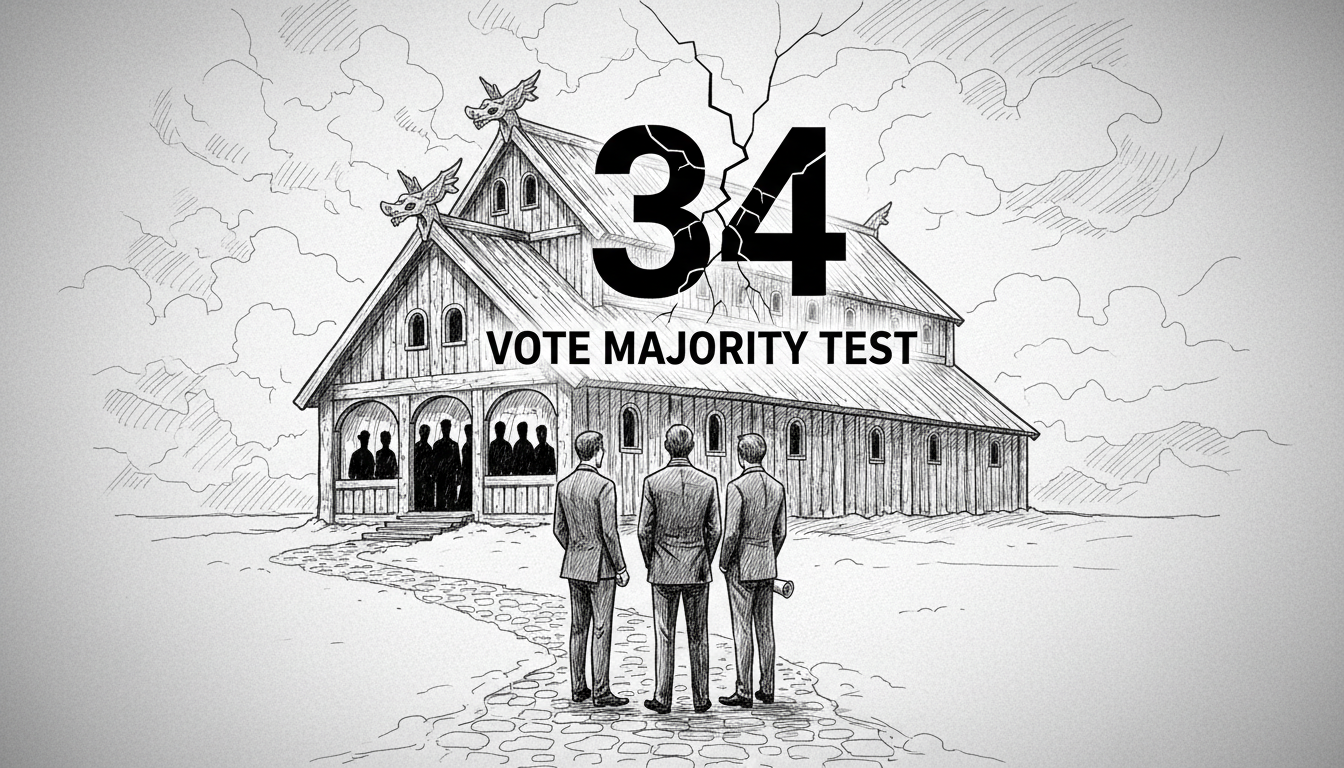
Sweden's ruling coalition faces a critical stress test as its 34-vote parliamentary majority remains under constant strain. Prime Minister Ulf Kristersson has summoned the party leaders from his government's supporting bloc to a high-stakes lunch meeting in Strängnäs. The orchestrated media setup at a nearby restaurant reveals the meeting's primary purpose: managing public perception and demonstrating unity. This gathering comes at a pivotal moment for Swedish politics, where internal cohesion directly dictates legislative success.
The Fragile Arithmetic of Governance
Governing from the Rosenbad complex requires precise coordination. The Swedish government, led by Kristersson’s Moderates, formally consists of the Moderate Party, the Christian Democrats, and the Liberals. Their survival depends on a detailed cooperation agreement with the Sweden Democrats, who provide the necessary votes for a majority. This arrangement grants the Sweden Democrats significant informal influence over the government’s agenda without ministerial portfolios. Any fracture in this delicate alliance threatens to paralyze the legislative process in the historic Riksdag building.
Political analysts note that such meetings are less about policy formulation and more about political theater. “The location outside Stockholm is symbolic,” said a Stockholm University political scientist. “It aims to project an image of focused, private negotiation away from the capital's media frenzy, while simultaneously controlling the media narrative through staged access.” The choice of Strängnäs, a town with historical significance as a former episcopal seat, subtly implies a meeting of weight and consequence.
A Government Built on Negotiated Consensus
The current administration's policy trajectory is not set by a single party manifesto. Instead, it results from continuous negotiation among the four parties in the governing underlag, or support base. Major Riksdag decisions, from the budget to migration policy, require signatures from all partners. The Tidö Agreement, named for the castle where it was forged, is the foundational document outlining this cooperation. Its provisions are tested daily in parliamentary committees and during votes on the Riksdag floor.
Recent months have seen public tensions, particularly on issues like energy policy and NATO integration details. The Christian Democrats and Liberals have occasionally voiced concerns over the speed and direction of certain reforms pushed by their support partner. These disagreements force Kristersson to act as a perpetual mediator. His role is to balance demands and ensure the coalition’s collective priorities, such as addressing gang crime and managing the economy, remain on track.
The High Stakes of Public Disunity
For the party leaders attending, the stakes are profoundly asymmetrical. Prime Minister Kristersson has the most to lose from a public display of discord. A failed meeting could undermine his authority and signal governmental weakness to both the opposition and international observers. For the Sweden Democrats’ leader, Jimmie Åkesson, the dynamic is different. His party’s influence is already secured through the agreement; his main risk is appearing too compliant, which could alienate his party's base, which expects tangible results for their support.
Ebba Busch of the Christian Democrats and Johan Pehrson of the Liberals face a different calculus. They must demonstrate they are shaping government policy, not merely following the lead of the larger Moderate and Sweden Democrat blocs. Their political survival depends on maintaining distinct profiles while remaining loyal coalition members. A meeting perceived as a dictated peace from the larger partners can damage their credibility. Every public statement following such gatherings is meticulously crafted to serve these dual purposes.
The Mechanics of Power in Stockholm
The workings of Swedish government policy depend on this backroom coordination. Before a bill reaches the parliamentary chamber in Helgeandsholmen, it is vetted through the coalition’s internal channels. The State Secretary meetings and party leader lunches are where real compromises are made. The formal cabinet meetings at Rosenbad often ratify decisions pre-negotiated elsewhere. This system ensures stability but can also lead to policy ambiguity, where differing interpretations of the Tidö Agreement surface later, causing friction.
This meeting in Strängnäs follows this established pattern. Its agenda likely includes aligning narratives on upcoming budget negotiations and key votes scheduled for the spring session. With local and European elections on the horizon, presenting a cohesive front is politically urgent. Disunity is a gift to the opposition Social Democrats and the Left Party, who consistently poll as the largest single bloc. They are poised to capitalize on any visible crack in the governing alliance.
An Uncertain Path Forward
The ultimate success of the Strängnäs meeting will not be measured by its immediate press release. Success will be determined over the coming weeks by the government’s ability to pass legislation smoothly. Can it maintain discipline on controversial votes? Will ministers speak with one voice on key issues? The narrow 34-vote margin offers no room for rebellion. Even a few absent or dissenting members from within the allied parties can derail a proposal, handing a symbolic victory to the opposition.
This constant pressure to maintain unity shapes every aspect of governance. It influences which bills are brought forward and how they are amended. Some political observers argue this arrangement leads to cautious, lowest-common-denominator policies. Others contend it forces a broader, more sustainable consensus. What is clear is that the Swedish political landscape has been fundamentally altered. The traditional cordon sanitaire around the Sweden Democrats has been replaced by a complex, operational partnership.
The lunch in Strängnäs is therefore more than a photo opportunity. It is a necessary ritual in the maintenance of a modern Swedish government that relies on a party once considered untouchable. The carefully arranged workspace for journalists nearby is a testament to the understanding that in modern politics, perception is a core component of power. The true test, however, remains unseen: whether the compromises made over that lunch table will hold when subjected to the fierce scrutiny and pressures of the Riksdag.