
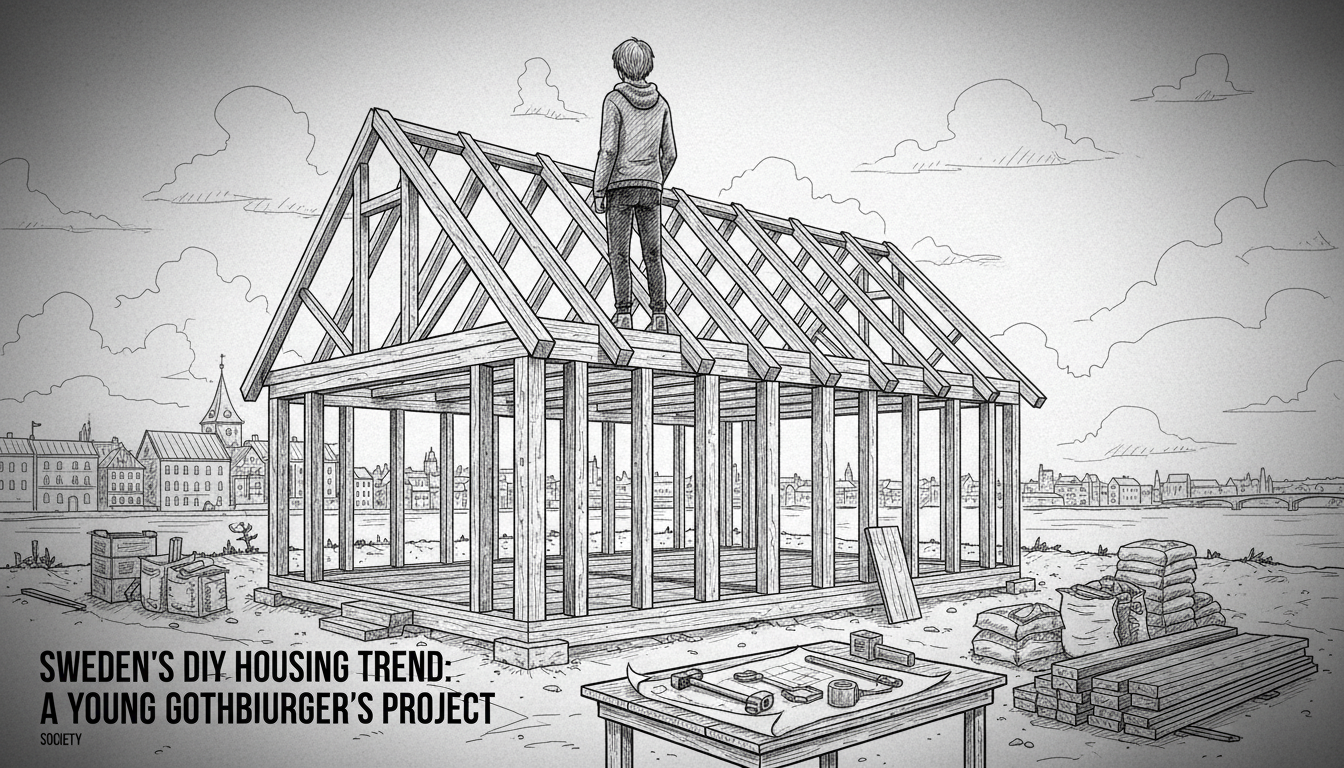
Sweden's housing market challenges are pushing young people toward creative solutions, like 21-year-old Alica Andersson's bold project in central Gothenburg. Last spring, she used her savings to buy an unfinished attic on Linnégatan for 2.3 million kronor. She then transformed the raw space into a liveable apartment entirely on her own, a move that has significantly increased the property's value. 'I've learned an incredible amount,' she says, reflecting on the demanding process.
A Vind Becomes a Home
Linnégatan is a desirable, bustling street in Gothenburg's Linnéstaden district, known for its cafes and boutiques. Purchasing an unfinished attic, or 'vind', is a known but challenging path to homeownership in Swedish cities. These spaces are essentially empty shells, requiring everything from insulation and plumbing to flooring and walls to be installed. For Alica, it represented a rare opportunity to get a foothold in a competitive market. 'It was the only way I could afford something in this area,' she explains, gesturing around her newly finished living room. The decision meant committing not just money, but months of physical labor and logistical planning.
Her project highlights a growing trend among young Swedes priced out of traditional apartments. With average property prices in Gothenburg having risen sharply over the past decade, and strict bank lending rules, alternatives are becoming more attractive. Converting unconventional spaces requires navigating building permits, construction codes, and significant upfront costs, but the potential payoff—a centrally located home and built-in equity—is a powerful motivator.
The Sweat and Sawdust of Self-Building
The journey from dusty attic to finished apartment was far from simple. Alica spent weeks researching building regulations, sourcing materials, and learning skills she never imagined needing. 'One day I was studying electrical diagrams, the next I was learning to lay flooring,' she recalls with a tired smile. She managed the project herself, coordinating deliveries and working evenings after her day job. The physical toll was substantial, but she describes a deep sense of satisfaction with each completed phase.
This hands-on approach is not for everyone, but it reflects a practical, 'do-it-yourself' spirit that resonates within Swedish culture. From summer house renovations to furniture assembly, the concept of 'egen kraft' (one's own strength) is valued. However, experts caution that such projects carry risk. 'It requires careful planning and a realistic budget,' says real estate analyst Jens Karlsson. 'Many underestimate the complexity of systems like ventilation or the final costs. But for those who succeed, it can be a very smart financial move, especially in a rising market.'
The Broader Gothenburg Housing Picture
Alica's story is a microcosm of a national issue. Sweden's major cities, including Stockholm, Malmö, and Gothenburg, continue to experience housing shortages and high demand. This pushes prices upward and elongates queue times for rental apartments. For young adults, the traditional path to homeownership is increasingly blocked, leading to innovative thinking. Converting attics, basements, or even larger commercial spaces are options now being seriously explored.
The central location of such projects is key. Neighborhoods like Linnéstaden, Majorna, and Vasastan offer a lifestyle many young people desire—proximity to work, culture, and social life. Buying an unfinished space there, even at a premium, can be cheaper per square meter than a finished apartment nearby. The investment is not just in the property, but in the community and personal time saved on commuting.
A Model for Others?
While Alica's success is inspiring, it raises questions about the sustainability of such solutions. Can converting every available attic realistically address systemic housing shortages? Urban planners suggest that while small-scale conversions add to housing stock, broader policy and construction efforts are still critically needed. 'Individual projects are fantastic and show great initiative,' notes housing policy researcher Elin Mårtensson. 'But we also need focused efforts on building more affordable, sustainable housing in urban areas to create a balanced market.'
The financial aspect remains a hurdle. Saving enough for the down payment on even an unfinished space requires significant discipline, often over many years. Alica's achievement underscores the sacrifice involved. Yet, the potential reward—a valuable asset and a home built to personal specification—is a powerful narrative in a difficult market.
The Finished Product and Future Dreams
Standing in her completed apartment, Alica points out the features she's most proud of: the efficient kitchen layout, the custom-built storage, and the light flooding in from the new windows. The space is worth considerably more than her initial investment plus renovation costs. More than the financial gain, she speaks about the intangible benefits. 'I know every corner of this place. I solved every problem that came up. That knowledge and confidence is something no one can take away.'
Her story ends not with a conclusion, but with a new beginning. She is now considering her next project, perhaps helping friends or exploring other development opportunities. Alica Andersson's vind on Linnégatan is more than an apartment; it's a testament to a generation finding its own way home, one hammer strike at a time. As Sweden grapples with its housing future, how many more will follow her lead, trading convenience for creativity and a chance to build their own space in the city?