
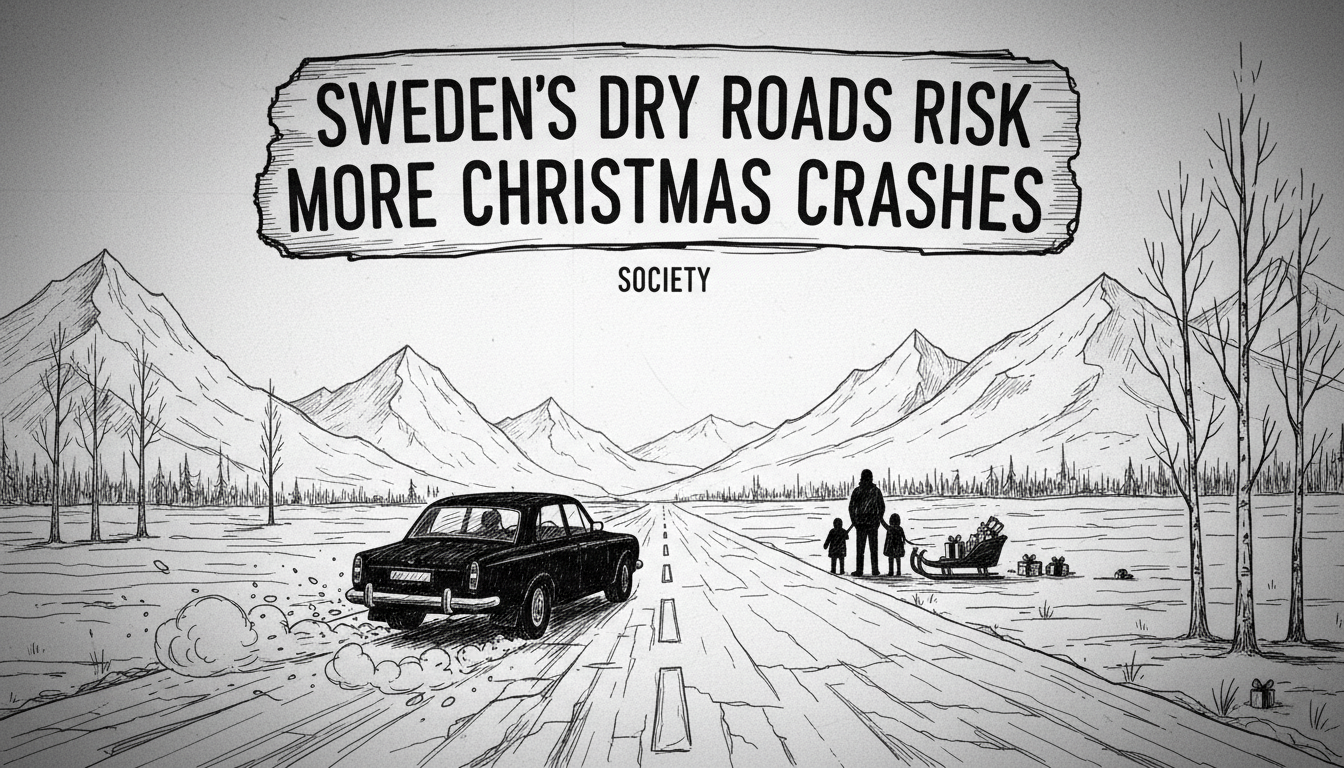
Sweden's road safety authorities warn that 12 deaths and 3,000 injuries from last year's holiday traffic could be exceeded. The paradoxical culprit is an absence of snow and ice, creating conditions that encourage higher speeds and more severe collisions. Director of Traffic Safety Maria Krafft states dry roads and a lack of snowbanks are removing natural behavioral and physical safeguards for drivers.
A Counterintuitive Winter Danger
Maria Krafft, Traffic Safety Director at the Swedish Transport Administration (Trafikverket), presents a clear case. "When we have winter road conditions, people create bigger margins and simply drive more calmly," Krafft explains. "When we perceive conditions as dry, speeds become higher." This behavioral shift is the primary risk factor. Compounding the issue is the loss of a physical barrier. Snow piled along roadsides historically acts as a buffer during accidents. "In winter, we actually get help from the snow, which becomes like a cushion," Krafft notes. This cushioning effect can soften the outcome of collisions that do occur. Current weather forecasts for southern and central Sweden predict bare ground, not a white Christmas, extending these summer-like driving risks into the heart of the holiday travel period.
Trafikverket's Safety Push Amid Unseasonal Weather
The Swedish Transport Administration is now emphasizing speed moderation and adjusted driving behavior. Their message directly confronts the overconfidence dry asphalt can instill. Experts point to a well-documented phenomenon in traffic psychology: perceived safety often leads to increased risk-taking. Drivers adapt their behavior not just to real conditions, but to their perception of those conditions. A clear, dry road in December triggers summer driving habits, despite the season's hallmark dangers like limited daylight and lower sun angles. Trafikverket's campaigns consistently stress that appropriate tires and lowered speed are the cornerstone of winter safety, regardless of visible snow. This year, that message carries extra urgency as meteorological winter presents as an extended autumn across much of Götaland and Svealand.
The Vision Zero Framework in a Changing Climate
This situation tests Sweden's pioneering Vision Zero policy, adopted by the Riksdag in 1997. The policy's core principle is that life and health can never be exchanged for mobility benefits; the road system must adapt to human error. Unusually mild winter weather represents a new systemic challenge. Infrastructure designed for predictable seasonal conditions—including the safety benefit of snowbanks—becomes less reliable. The policy mandates that authorities like Trafikverket identify and preempt such emerging risks. Their current warnings are a direct application of this principle, shifting focus from snow and ice management to speed management. The goal remains unchanged: to prevent fatalities and serious injuries, even when traditional winter hazards are absent.
Historical Data and Seasonal Patterns
Statistics clearly show that accident frequency does not necessarily spike in summer, but severity often does. Higher speeds on dry roads lead to more violent collisions. The holiday period amalgamates several risk factors: increased long-distance travel, potential driver fatigue, social alcohol consumption, and, this year, deceptive road conditions. Last year's toll of 12 fatalities serves as a grim benchmark. Analysts cross-reference this data with weather models to predict high-risk periods. The current forecast, indicating a high probability of bare ground across southern Sweden, directly aligns with conditions known to produce severe outcomes. This predictive approach is key to modern road safety work, allowing for targeted public information campaigns before holiday travel peaks.
Expert Analysis on Driver Psychology
Traffic safety researchers elaborate on Krafft's observations. The human factor is the most volatile element in the transport system. A driver on a familiar road, devoid of visual winter cues like snow, will instinctively revert to baseline speed. The psychological comfort of a dry surface overrides the calendar. Furthermore, the protective design of roadside environments—clear zones, forgiving barriers—is partially undone when those same areas are hard and exposed. Experts stress that defensive driving in these conditions means consciously overriding instinct. It requires maintaining winter-level following distances, anticipating the blinding glare of a low winter sun on dry pavement, and being prepared for isolated patches of frost or ice in shaded areas.
Regional Forecasts and Travel Advice
Weather services indicate a stark north-south divide. While Lapland, Norrbotten, and Jämtland can expect full snow cover, the picture is uncertain for central regions and clear for the south. For travelers in Västernorrland or Dalarna, snow may only be found in western parts. This variability itself is a hazard, as drivers may embark on long journeys under one set of conditions only to encounter another. Trafikverket's advice is uniformly cautious. They recommend planning for winter, checking vehicle condition thoroughly, and allowing ample travel time to avoid the pressure to speed. The agency underscores that the statutory requirement for winter tires remains in effect, providing essential grip even on cold, dry roads.
A Broader Trend of Milder Winters
This year's warnings may point to a longer-term trend. Milder, wetter winters are a predicted consequence of climate change in parts of Sweden. This could gradually alter the fundamental landscape of Swedish road safety, reducing classic ice-related skids but increasing high-speed, dry-road incidents during the darkest months. Adapting the Vision Zero system to this new normal will require ongoing analysis. It may influence everything from road surface design and speed limit settings to the timing of public safety campaigns. The immediate task is public awareness, but the long-term project is systemic resilience in the face of changing environmental patterns.
The ultimate responsibility, authorities reiterate, rests with every individual behind the wheel. The message from Rosenbad and Trafikverket headquarters is unambiguous: a green Christmas does not mean a safe Christmas. In fact, the opposite may be true. This holiday season, the greatest threat on Swedish roads may not be the traditional perils of winter, but the false sense of security that comes when those perials seem to disappear.