
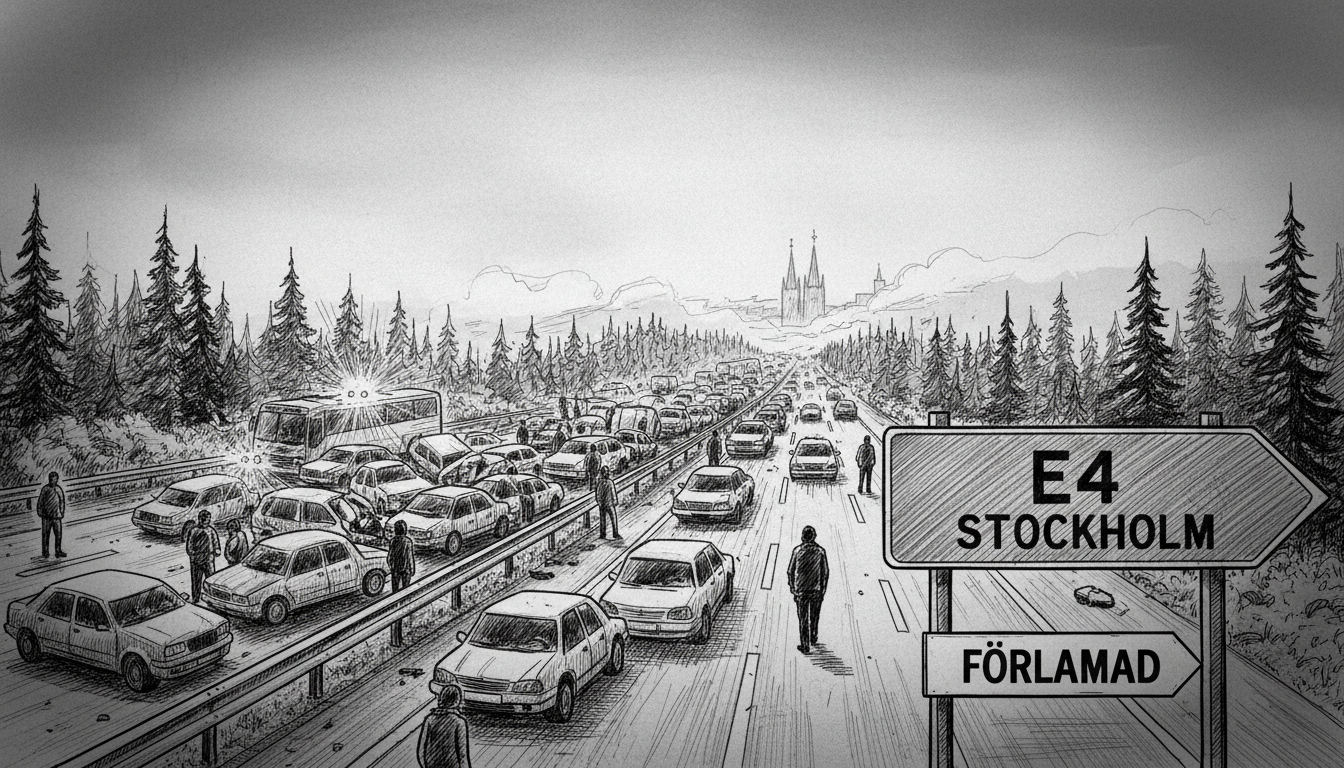
Sweden's E4 highway, the nation's critical north-south artery, came to a complete standstill on Tuesday after a serious accident involving a heavy vehicle. The crash occurred at the entrance to the Gärdestunneln tunnel, heading towards Uppsala, creating massive traffic chaos across Stockholm's northern suburbs. In a separate but compounding incident, the Norrortsleden ring road was also closed following a multi-vehicle collision. The Swedish Transport Administration, Trafikverket, reported there is no estimate for when traffic will flow again, warning of severe and widespread consequences for the capital region's commuters and freight transport.
For thousands of Stockholmers, the morning routine dissolved into gridlock. The E4 isn't just a road; it's the backbone of the region, connecting the city to Uppsala, the university towns, and the northern reaches of the country. A stoppage here doesn't cause a delay—it triggers a systemic failure. "It's total chaos," said Erik Lundström, a logistics coordinator whose delivery schedule was thrown into disarray. "Everything that moves goods in or out of the north of Stockholm is now stuck. This isn't just about being late for work; it's about perishable goods, medical supplies, and the basic function of the city."
A Domino Effect Across the Capital
The dual incidents created a perfect storm. The closure at Gärdestunneln blocked the main route north from the city center, while the shutdown of Norrortsleden (Route 265) severed a key alternative artery feeding into the E4. This left drivers in suburbs like Sollentuna, Täby, and Danderyd with few viable escape routes. Navigation apps lit up with dark red lines, and secondary roads quickly became saturated, pushing congestion deep into residential neighborhoods. Public transport, including buses that use these highways, was also severely impacted, leaving many commuters stranded.
The human cost of such disruptions is often measured in lost hours and frayed tempers. But for some, the impact is more tangible. "I had a crucial client meeting in Uppsala at 10 AM," shared Anna Forsberg, a business consultant who was still in her car in Solna two hours after her planned departure. "This isn't just an inconvenience. It's a professional and financial setback. The entire economy of the region slows to a crawl when the E4 stops." Her sentiment echoes across the business community, where just-in-time logistics and cross-regional collaboration are the norm.
The Fragile Spine of Swedish Transport
This incident throws a harsh light on the fragility of Sweden's key infrastructure. The E4 handles a colossal volume of traffic, including a significant percentage of the country's heavy freight. In 2023 alone, Swedish authorities reported approximately 4,300 injury accidents on the roads. While not all were on highways, accidents involving heavy vehicles on critical routes like the E4 have an outsized impact. Recovery is complex, often requiring specialized equipment to clear wreckage and conduct thorough investigations, leading to extended closure times.
"Our highway network is efficient but vulnerable," explained traffic analyst Mats Johansson, who has studied Nordic transport systems for over a decade. "A single point of failure, like a major tunnel or bridge, can have cascading effects. Today's situation shows why incident management and rapid response are so crucial. But it also highlights a deeper need: we must continue to invest in both physical infrastructure resilience and digital systems for smarter traffic management and alternative route planning."
Life in the Slow Lane: A Cultural Shift?
Swedes pride themselves on punctuality and efficiency, concepts deeply embedded in the national culture. A sudden, hours-long traffic standstill challenges this self-image. It forces a pause—an unplanned fika in the driver's seat. Some drivers turned off their engines, stepping out to chat with fellow stranded motorists. Others used the time to make calls they'd been putting off. In a society often focused on moving forward, the stoppage created an odd, collective moment of stillness.
However, this cultural coping mechanism has its limits. The disruption also feeds into ongoing debates in Swedish society about sustainable transport, urban planning, and dependency on cars. Stockholm has invested heavily in its tunnelbana (metro) and pendeltåg (commuter rail), but many suburbs remain heavily car-dependent. Incidents like this amplify calls for more robust, decentralized public transport networks and infrastructure that can withstand shocks.
Looking Ahead: Resilience on the Road
The immediate focus for Trafikverket is on clearing the scenes, assisting those involved, and restoring safe passage. The long-term conversation, however, will likely center on prevention and preparedness. This includes examining road design around critical chokepoints like the Gärdestunneln, the role of advanced driver assistance systems in heavy vehicles, and the public communication protocols during major disruptions.
For now, the people of Stockholm are left navigating the aftermath. The reopening of the E4 will bring relief, but the memory of the gridlock will linger. It serves as a stark reminder of the intricate web that connects modern life—a web where a single accident on a wet highway can unravel the plans of an entire region. As the evening commute approaches, the question on everyone's mind is not just when the roads will clear, but what can be learned to prevent a single crash from halting a capital city.