
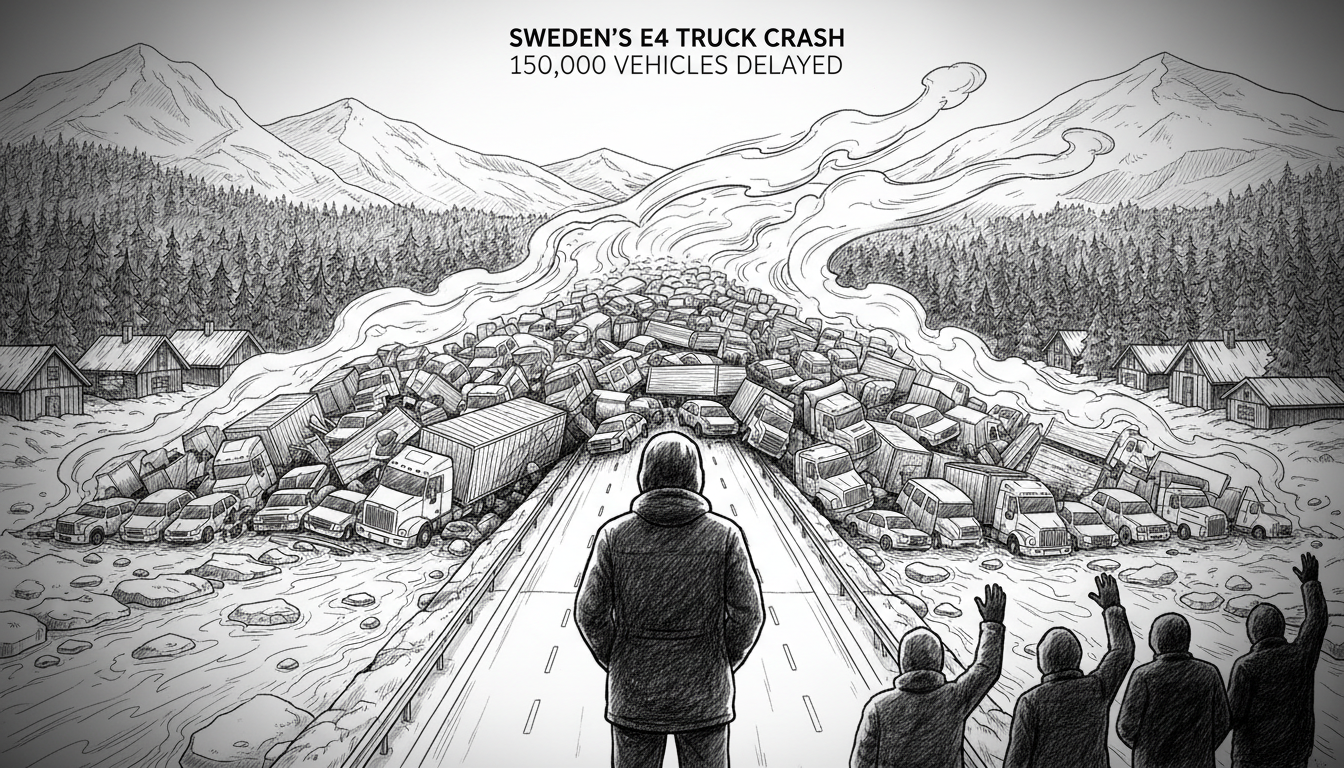
Sweden's critical E4/E20 highway, Essingeleden, faced major disruption after a truck overturned during slippery morning conditions. The driver and a passenger managed to exit the vehicle on their own, but the accident caused significant traffic chaos for the thousands of commuters relying on this Stockholm artery. The incident highlights the perennial tension between Sweden's harsh winter climate and its need for reliable infrastructure.
A Morning of Chaos on Stockholm's Main Artery
The crash occurred during the morning rush, a time when Essingeleden is at its most congested. Police reports state the truck driver lost control, skidded into the central barrier, and then overturned. "The road conditions were slippery at the accident site," a police spokesperson said in a statement. For the 150,000 vehicles that use this stretch daily, the result was immediate gridlock. Commuters faced delays stretching for kilometers, with alternative routes through neighborhoods like Liljeholmen and Gröndal quickly becoming saturated. This single incident demonstrated the fragility of Stockholm's traffic network.
Local resident Elin Mårtensson, who was caught in the backup, described the scene. "It was a typical Stockholm standstill," she said. "You could see the frustration. Everyone was checking their phones, recalculating their ETA to work or daycare. These events ripple through your entire day." Her sentiment is common in a city where punctuality is deeply ingrained in the culture, yet winter weather frequently challenges it.
The High Stakes of a Highway Halt
Essingeleden is not just any road. Completed in 1966, it was a engineering feat that connected the western and southern parts of Stockholm across Lake Mälaren's islands. Today, it functions as the city's primary vehicular spine. It carries not only local cars but also a constant flow of heavy goods vehicles supplying the capital. A closure here has economic consequences far beyond annoyed commuters. Deliveries are delayed, logistics chains are broken, and productivity drops across the region.
Traffic analyst Magnus Fjellström, who has studied flow patterns on Essingeleden for years, explains its outsized importance. "Essingeleden has very few redundancy options," he notes. "When it stops, there is no true plan B. The surrounding street network cannot absorb that volume. The economic cost per hour of a major stoppage like this runs into millions of kronor." He points to the combination of high volume, high speed, and challenging geography as a persistent risk factor, especially during the October to April period when ice and snow are common.
Winter's Relentless Test for Swedish Drivers
The police citation of "slippery road conditions" points to a recurring Swedish narrative: the annual battle with winter. Despite being exceptionally well-prepared, with mandatory winter tires from December to March and efficient plowing services, accidents persist. This crash will likely reignite discussions about driver preparedness. Are winter tires enough? Should speed limits on key arteries like Essingeleden be automatically reduced during certain weather conditions?
Road safety expert Lena Karlsson emphasizes adaptation. "The technology in cars and tires is better than ever," she says. "But the first variable is always the driver. Adjusting speed to the actual conditions, not just the posted limit, is crucial. On a highway, people often feel a false sense of security." She suggests that real-time, condition-based speed advisories on digital signs could be a next step for roads of this importance.
The Human Story Behind the Headline
While the traffic story dominates, there's a human element that narrowly avoided tragedy. The fact that both individuals in the truck cab were able to exit on their own is the most positive outcome of the day. It speaks to the safety standards of modern vehicles and a degree of luck given the violence of an overturning truck. The incident will nonetheless be a traumatic event for the driver and passenger, a sudden rupture in a routine workday.
For emergency services, the response is a well-rehearsed ballet. Police, ambulance, and tow truck operators must coordinate rapidly not just to clear the accident, but to manage the cascading traffic crisis. Their goal is twofold: ensure safety at the site and restore flow as quickly as possible. On this day, the process took several hours, a testament to the complexity of righting a heavy vehicle and ensuring the road surface was safe and clear of debris.
A City Forced to Pause and Reflect
Events like this force a momentary pause. They make visible the immense, usually invisible, flow that sustains a modern city. Commuters stranded in their cars had time to reflect—perhaps on their dependence on the car, or the lack of attractive alternatives for certain journeys. Stockholm's public transport is robust, but for many living in the suburbs or requiring a vehicle for work, the car remains non-negotiable.
This crash also touches on broader Swedish society trends around infrastructure stress and climate adaptation. As weather patterns become more unpredictable, with freeze-thaw cycles creating "black ice," the challenge for maintainers grows. The Swedish Transport Administration (Trafikverket) constantly balances maintenance budgets with rising demands. Each accident adds data points to their safety models, but the human and economic cost is already incurred.
Looking Beyond the Tow Trucks
By late afternoon, the truck was righted and towed away. Traffic on Essingeleden slowly returned to its normal, heavy flow. The physical evidence of the crash was gone, but the questions remain. Is this just an unavoidable cost of winter mobility in the Nordics, or can more be done? Could technology, like sensors that detect ice formation and automatically warn drivers or trigger brine trucks, make a difference?
For now, Stockholm moves on. The rhythm of the city reclaimed the highway. But for those who were hours late, for the company awaiting its delayed shipment, and for the two people who walked away from an overturned truck, this was more than a news headline. It was a stark reminder of how quickly normalcy can tip over, and how interconnected the threads of daily life truly are. The next frosty morning on Essingeleden will be watched a little more closely by everyone.