
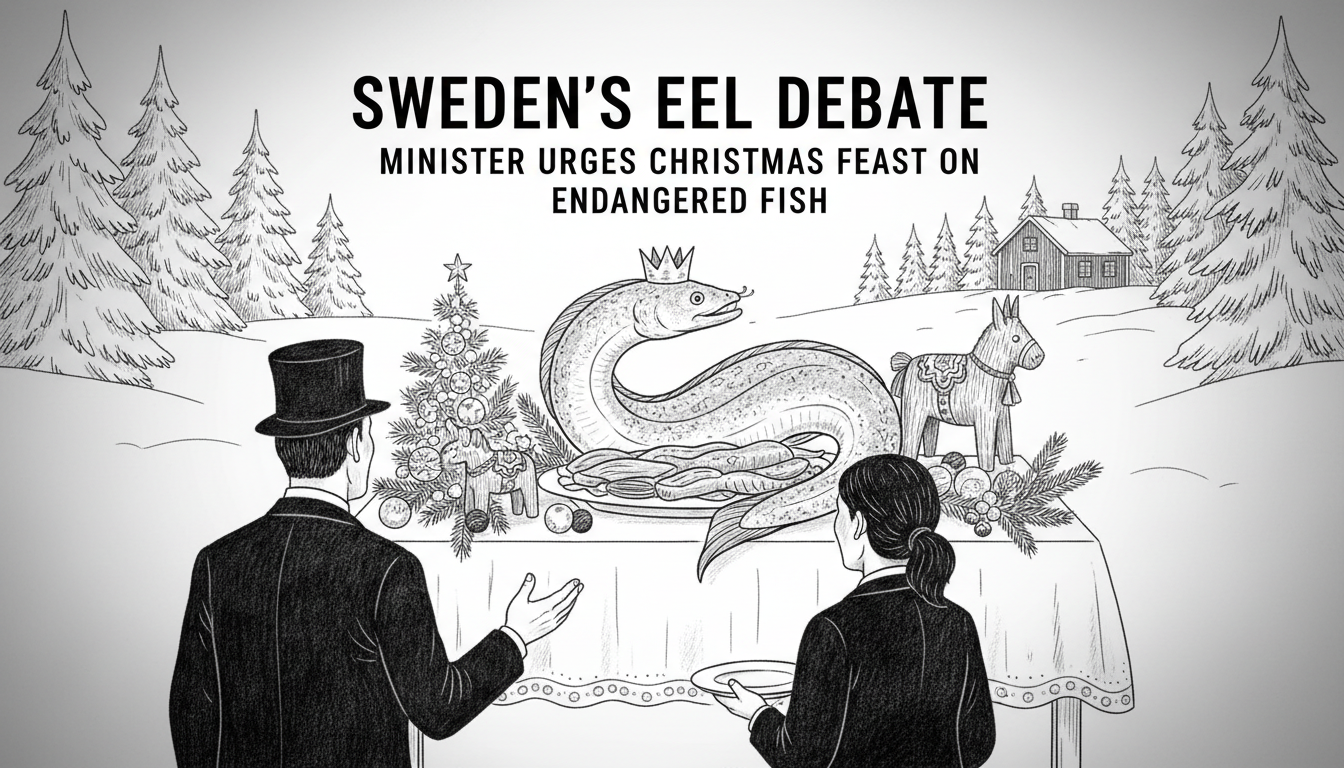
Swedish Rural Affairs Minister Peter Kullgren has ignited a fierce political and scientific debate by urging Swedes to buy eel for their Christmas tables. The minister's recommendation directly contradicts the European eel's status as a critically endangered species, placing a cherished culinary tradition on a collision course with urgent conservation needs. This controversy, erupting from the pages of a regional newspaper, has quickly escalated into a national discussion about policy, science, and cultural heritage.
Kullgren, a member of the Christian Democrats and part of the governing Tidö Agreement coalition, framed his advice as support for local fishermen and cultural preservation. "Att köpa ål bidrar till att stötta lokala fiskare och värna ett kulturarv" (Buying eel helps support local fishermen and protect a cultural heritage), he wrote. His statement represents a clear government policy signal from Rosenbad, aiming to balance economic interests in rural districts with environmental concerns. The Riksdag has previously grappled with eel management within broader fisheries and agricultural legislation.
A Critically Endangered Christmas Delicacy
The scientific reality presents a stark contrast to the minister's festive suggestion. The European eel (Anguilla anguilla) population has collapsed by approximately 95% since the 1980s. The International Union for Conservation of Nature (IUCN) classifies the species as Critically Endangered, the highest risk category before extinction in the wild. This classification is based on a catastrophic decline in recruitment, the number of young eels returning to European coasts from their spawning grounds in the Sargasso Sea.
Henrik Svedäng, a leading marine ecologist and eel researcher, offered a blunt assessment of the minister's comments. "Jag tycker det är väldigt märkligt" (I think it is very strange), he stated. Svedäng's criticism underscores a fundamental conflict between political messaging and ecological crisis management. Experts point to a lethal combination of overfishing, habitat loss, pollution, climate change, and parasites as drivers of the decline, making each harvested eel a significant loss to the struggling population.
The Complicated Framework of Eel Management
Swedish eel policy operates within a complex EU regulatory framework. In 2007, the European Commission mandated all member states to implement Eel Management Plans (EMPs). These plans have a core objective: to allow at least 40% of the silver eel biomass to escape to the sea and migrate to spawning areas. This escapement target is measured against a theoretical baseline with no human impact. Sweden's plan, approved by the government and scrutinized by the Riksdag, includes measures like fishing restrictions, restocking programs, and habitat improvement.
However, the effectiveness of these measures is intensely debated. A 2023 scientific study indicated that eel populations in many European waters, including the Baltic Sea, continue to decline despite management efforts. This casts doubt on whether current policies, which permit limited legal fishing, are sufficient to reverse the trend. The Swedish Agency for Marine and Water Management (Havs- och vattenmyndigheten) consistently reports that the 40% escapement target is not being met in most Swedish waters.
| Management Challenge | Current Status in Sweden |
|---|---|
| EU Escapement Target (40% of silver eel biomass) | Not being met in most waters according to national agency reports. |
| Population Trend | Continued decline despite national Eel Management Plan. |
| Fishing Pressure | Legal, regulated commercial and recreational fishing still permitted. |
Cultural Heritage Versus Conservation Imperative
The heart of this dispute lies in the weight given to cultural tradition. The Christmas table, or julbord, is a central Swedish tradition, and eel (ålen) has historically been a prized component, particularly in southern regions. Minister Kullgren's argument taps into a genuine desire to preserve coastal communities and their ways of life. Supporting local, small-scale fishermen is a stated priority for his ministry and the Swedish government's rural policy.
Conservationists and scientists argue this perspective is dangerously outdated given the species' perilous state. They contend that "cultural heritage" cannot justify pushing a species closer to extinction. The debate echoes larger global conflicts, such as those over bluefin tuna or pangolins, where gastronomic demand threatens survival. In Sweden, it forces a difficult question: when does a tradition become unsustainable, and who has the authority to declare it so?
Policy Implications and Political Repercussions
This episode reveals a potential fissure in Stockholm politics between ministerial advocacy and environmental commitments. Sweden has both national and international obligations to protect endangered species. The government's own environmental objectives, often debated in the Riksdag building, include halting biodiversity loss. Promoting consumption of a critically endangered species appears to directly undermine those goals.
Opposition parties were quick to seize on the contradiction. The Green Party (Miljöpartiet) and the Left Party (Vänsterpartiet) criticized the minister for irresponsible messaging that could stimulate demand for a threatened species. Even within the governing coalition, tensions may arise between rural interests represented by Kullgren's Christian Democrats and the environmental policy lines managed by other ministries. The controversy tests the Tidö Agreement's cohesion on matters where economic and environmental interests clash.
A Path Forward for Swedish Eels?
Experts like Henrik Svedäng suggest the only responsible path is a significant reduction in fishing pressure, potentially a complete moratorium, coupled with massive investment in habitat restoration. This includes removing migration barriers like dams and weirs, improving water quality, and protecting coastal wetlands. Restocking programs, where young eels are released into inland waters, are costly and their long-term effectiveness for population recovery remains uncertain.
The minister's comments have inadvertently placed the Swedish eel dilemma on the national agenda. It forces a public conversation about the true meaning of sustainability. Is it sustaining fishing communities in the short term, or sustaining the species for future generations? The Swedish government's policy decisions following this debate will send a powerful signal about its commitment to biodiversity. As Swedes prepare their Christmas feasts, they are now confronted with an ethical and ecological choice that reaches far beyond the dining table. Can a tradition survive if it consumes the very thing it celebrates?