
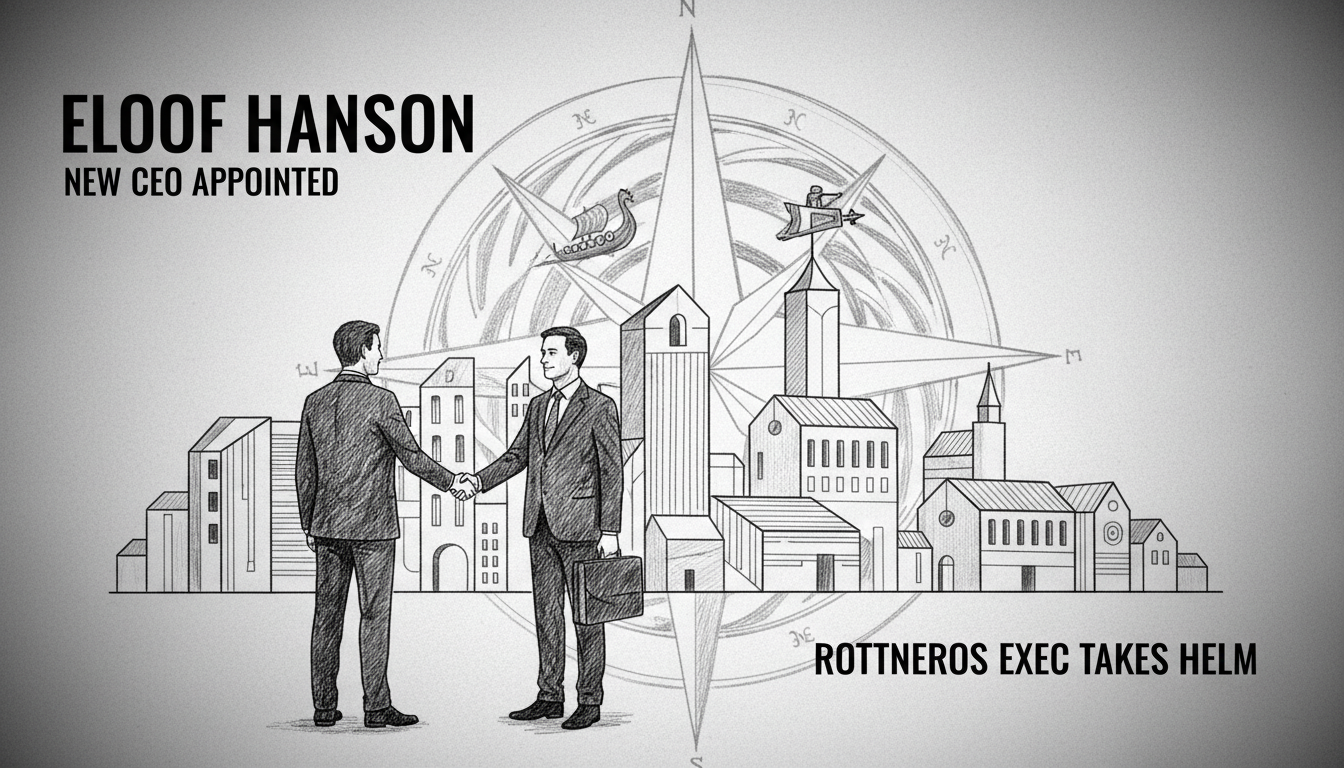
Swedish trading house Elof Hansson has appointed a new chief executive officer after a decade under Mikael Forslund. The company is recruiting its next leader from publicly listed pulp and paper group Rottneros, signaling a potential strategic pivot for the 127-year-old Gothenburg-based firm. This leadership change at one of Sweden's historic trading companies highlights the evolving pressures on traditional intermediaries in a globalized digital economy.
Elof Hansson confirmed the transition in a brief statement. Mikael Forslund is stepping down after ten years as CEO. The company did not provide a specific reason for his departure. The incoming CEO's name has not yet been disclosed, but their background at Rottneros is the defining feature of the announcement.
Rottneros is a Swedish pulp producer listed on the Nasdaq Stockholm exchange. It operates mills in Sweden and South Africa, focusing on niche market pulp. The company reported sales of approximately 3.2 billion SEK in 2023. Selecting a leader from this sector suggests Elof Hansson may be deepening its commitment to forest industry products, a traditional strength for Swedish trade.
A Legacy of Global Trade Faces New Challenges
Founded in 1897, Elof Hansson is a pillar of Sweden's export economy. For generations, trading houses like Elof Hansson acted as essential bridges, connecting Swedish manufacturers with international buyers. They handled logistics, financing, and market knowledge that individual producers could not manage alone. The company's headquarters on the waterfront in central Gothenburg, a city built on maritime trade, symbolizes this legacy.
Today, that model faces existential challenges. Digital platforms allow buyers and sellers to connect directly. Global supply chains have become more integrated, and manufacturers often establish their own international sales offices. The value proposition of the traditional trading house must constantly evolve. "The role of the trading company is no longer just about moving goods from point A to point B," said Lars Magnusson, a professor of economic history at Uppsala University. "It's about providing integrated solutions, financing, and deep market intelligence that cannot be easily replicated online."
Under Mikael Forslund's decade-long leadership, Elof Hansson navigated this shifting landscape. The company operates through divisions focused on forest products, industrial materials, and consumer goods. It maintains a global network with offices across Europe, Asia, and the Americas. Financial details for the privately held group are not publicly disclosed, making its performance and strategic direction harder for outsiders to assess.
The Rottneros Connection: A Strategic Signal?
The recruitment of a CEO from Rottneros is the most telling part of this announcement. It points to a specific area of focus. Elof Hansson has a long-standing business in wood products, pulp, and paper. Placing a leader with direct experience from a production-focused, publicly listed company in this sector could indicate several strategic intentions.
First, it may signal a desire to strengthen ties with the Nordic forest industry, a core sector for Swedish exports. Second, it could reflect a move towards more specialized, value-added trading services in this niche, moving beyond basic brokerage. Third, the experience of managing a listed company brings a different discipline regarding transparency, investor relations, and quarterly performance—a perspective that might be new to the privately held Elof Hansson.
"Bringing in a CEO from a production company like Rottneros is a clear statement," commented Sofia Bergman, a Stockholm-based analyst covering industrial and trading sectors. "It suggests the board wants leadership with deep, operational insight into a specific supply chain, not just trading expertise. This could mean Elof Hansson plans to integrate further up or down the value chain in its key sectors, perhaps offering more technical or production-linked services to its partners."
Leadership in a Time of Transition
The CEO change comes at a complex time for global trade. Geopolitical tensions, rising protectionism, and a focus on supply chain resilience are reshaping international commerce. For a company like Elof Hansson, these macro trends present both risk and opportunity. Trading houses can thrive in volatile environments by leveraging their networks and expertise to navigate tariffs, find alternative suppliers, or secure logistics.
Mikael Forslund's tenure saw the company through the aftermath of the 2008 financial crisis, the trade wars of the late 2010s, and the massive supply chain disruptions caused by the COVID-19 pandemic. Stepping down after a decade is a natural point for reflection and renewal. The incoming CEO will inherit an organization with a strong brand and network but facing relentless competitive pressure.
The new leader's immediate challenges will be clear. They must define and communicate a renewed vision for the historic firm. They will need to integrate their production-side experience from Rottneros with the trading culture of Elof Hansson. They must also address the ongoing digital transformation of global trade. "The successful trading house of the future will be a tech company that trades, not just a trading company that uses tech," Bergman added.
The Unwritten Chapter for a Swedish Institution
For now, the story is incomplete. The name of the incoming CEO and their precise start date are pending. The strategic roadmap they will implement remains unknown. The board of Elof Hansson, likely representing the founding family and long-term stakeholders, has made a deliberate choice to look outside the traditional trading sector for its next leader.
This appointment will be closely watched within Sweden's tight-knit business community, particularly in Gothenburg. It serves as a case study in how century-old family-influenced businesses are adapting to modern markets. Will the new CEO seek to take Elof Hansson public, following the path of their former employer Rottneros? Will they pursue mergers or deeper alliances with production companies? Or will they focus on streamlining and digitizing the existing business model?
The answers to these questions will determine the next chapter for Elof Hansson. The company's 127-year history is a testament to adaptability. From the era of steamships and telegrams to containerization and the internet, it has survived by evolving. This leadership transition is the latest test of that resilience. The choice of a Rottneros executive is a bold bet that the future lies not in being a generalist trader, but in possessing unshakeable, industrial-grade expertise at the core of its operations. The global market will now judge if that bet pays off.