
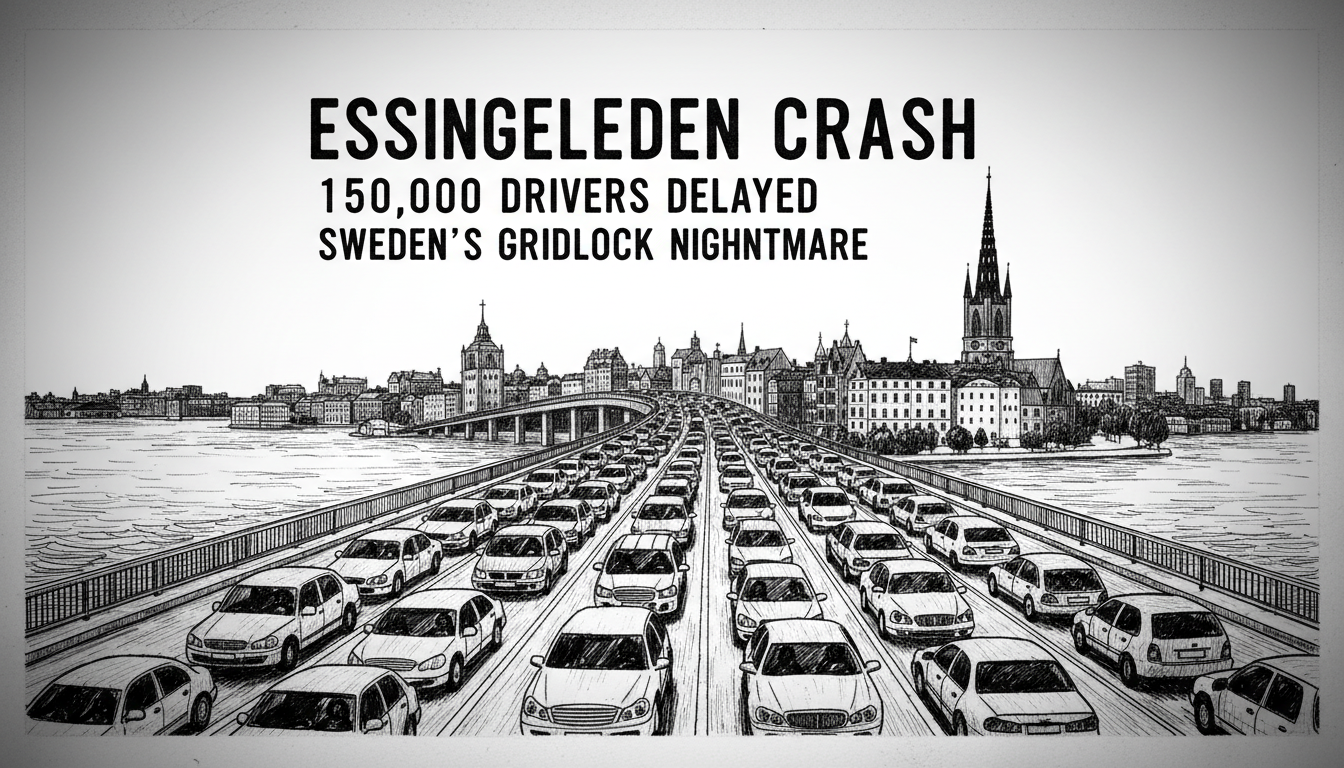
Sweden's crucial Essingeleden motorway faced total gridlock after a truck overturned near Stora Essingen in Stockholm. The accident, which occurred during the morning commute, brought northbound traffic to a complete standstill. Two people were in the truck but managed to get out on their own. This single incident exposed the fragility of Stockholm's traffic network, impacting an estimated 150,000 daily users and causing ripple effects across the city.
For hours, the scene was one of chaos and frustration. The overturned truck blocked multiple lanes on the elevated motorway section. Slippery conditions were reported at the site, complicating recovery efforts. Emergency services worked to secure the vehicle and clear the wreckage. Meanwhile, thousands of commuters found themselves trapped in a sprawling metallic snake, their plans unraveling by the minute.
A City Brought to a Halt
The impact was immediate and severe. Essingeleden is not just any road; it's part of the E4 and E20 European routes, forming Stockholm's vital inner ring. When it stops, the city's circulatory system seizes. Alternative routes through neighboring districts like Liljeholmen and Gröndal quickly became saturated. Bus schedules were thrown into disarray, and the ripple effects reached far beyond the crash site. This is the recurring nightmare of Stockholm commuters: a single point of failure creating city-wide paralysis.
Local resident Elin Mårtensson, who was caught in the backup, described the scene. "It was just endless red brake lights," she said. "You could see the island of Stora Essingen, but you couldn't move toward it. Everyone was just sitting there, checking their phones for any information. It’s a stark reminder of how dependent we all are on this one strip of asphalt."
The High Cost of Congestion
Accidents like this are a primary driver of Stockholm's notorious congestion. Statistics show road incidents account for a significant percentage of the city's total annual congestion hours. With Essingeleden handling approximately 150,000 vehicles every day, the economic and personal cost of a prolonged shutdown is immense. Lost productivity, missed appointments, and increased stress are the immediate results. For freight and delivery drivers, the delays translate directly into financial loss.
Traffic analysts point to this vulnerability as a systemic issue. "Stockholm's traffic system is highly efficient under normal conditions, but it lacks redundancy," explains a transport planner familiar with the city's infrastructure, who preferred not to be named. "When a major artery like Essingeleden is blocked, there are very few viable alternatives for the volume of traffic it carries. Incidents highlight an urgent need for more resilient traffic management and real-time rerouting strategies."
Safety and Slippery Conditions
While the investigation into the precise cause is ongoing, initial reports noted the road was slippery. Autumn in Stockholm brings rapidly changing conditions—rain, frost, and early morning ice. For heavy vehicles, these conditions pose a particular risk on complex interchanges and elevated sections like those on Essingeleden. Road safety experts will examine factors including vehicle maintenance, driver fatigue, and the specific weather conditions at the time of the incident.
The fact that both occupants exited the vehicle on their own is a relief. However, the accident serves as a seasonal warning. As daylight shortens and temperatures drop, Swedish drivers must adapt. The Swedish Transport Administration repeatedly emphasizes adjusting speed to conditions and ensuring vehicles are winter-ready. This crash is a physical manifestation of what happens when those warnings go unheeded, or when conditions overcome even cautious drivers.
A Pattern, Not an Anomaly
For Stockholmers, this feels familiar. Major disruptions on Essingeleden occur with frustrating regularity. Each event follows a similar script: the accident, the total stoppage, the scramble by authorities to clear it, and the hours-long recovery for the traffic system. Public debate inevitably follows, with calls for better public transport links, investment in alternate road corridors, and smarter traffic technology. Yet, the fundamental geometry of Stockholm—built on islands and waterways—limits easy solutions.
The incident also sparks conversation about freight movement through the capital. Should more heavy goods traffic be rerouted outside the inner city? Can delivery times be staggered to avoid peak commuter hours? These are complex logistical questions with trade-offs for business efficiency and urban living. The overturned truck is a symbol of this ongoing tension between a functioning metropolis and the infrastructure that serves it.
Looking for Solutions in a Wired City
In response to these chronic issues, authorities are increasingly turning to technology. Dynamic message signs, integrated traffic management centers, and apps that provide real-time alerts are part of the toolkit. The goal is to inform drivers before they enter a queue, allowing for earlier diversion. However, as Tuesday's crash proved, when the main route is blocked, the secondary streets fill almost instantly. The problem isn't information—it's physical capacity.
Some urban planners advocate for a more fundamental shift. They point to the need for a stronger commitment to decentralized work hubs and improved regional public transport, like the pending extensions to the metro network. The idea is to reduce the sheer number of people whose daily lives depend on passing through the Essingeleden bottleneck. It’s a long-term cultural and infrastructural project, far beyond clearing a single crashed truck.
The Human Impact Beyond the Commute
Beyond the traffic statistics and economic costs, these disruptions have a human texture. They are about the parent late to pick up their child from daycare, the student missing a crucial exam, the small business owner waiting for a delivery that never comes. They fray the social fabric of punctuality and reliability that Swedish society values. In a culture that prizes efficiency and planning, unexpected gridlock creates a unique form of stress.
As the clean-up on Essingeleden concluded and traffic began its slow return to normal, the city exhaled. The immediate crisis passed, but the underlying questions remained, hanging in the damp autumn air. How many more times will this happen before winter's end? And when will the solution move from simply reacting to crashes to actively preventing the systemic gridlock they cause? For the 150,000 drivers who use the road tomorrow, the only certainty is that their commute hangs in a delicate balance.