
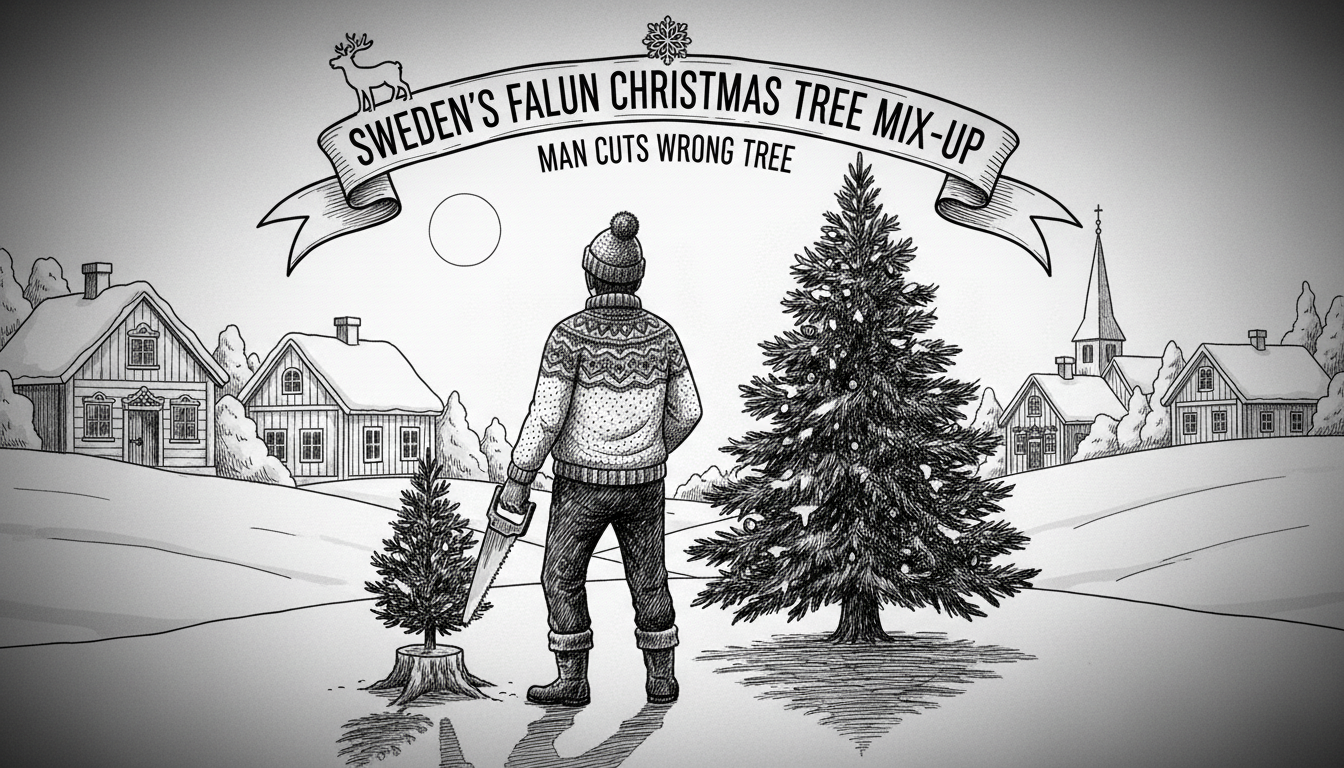
Sweden's Christmas tree laws came into sharp focus this week after a man in Falun was reported to police for cutting down a tree on municipal land. The man claimed he was simply getting a 'julgran' for the holidays. Officers arrived to find a felled birch tree, not a fir, and have filed a report for damage to property. The case highlights the fine line between festive tradition and property rights in a country where nature is deeply cherished but strictly regulated.
A Festive Foray Gone Wrong
The incident unfolded in the quiet hours of a Thursday night leading into Friday. A resident in Falun, a historic city in central Sweden known for its copper mine and iconic Falu red paint, alerted authorities. They reported seeing a man actively cutting down a tree on land owned by the local municipality. When confronted, the man offered a simple, seasonal explanation. "He told the caller he was cutting down a Christmas tree," said police spokesperson Lars Hedelin. The caller, however, knew the rules. In Sweden, you cannot simply help yourself to trees, even during the most wonderful time of the year.
The man left the scene after being informed of the violation. Police found the cut tree where it fell. Their investigation quickly revealed a botanical error at the heart of the case. The tree was not a Christmas tree at all. "It turned out not to be a fir tree, but a birch," Hedelin confirmed. This detail adds a layer of cultural confusion to the legal breach. For Swedes, a 'julgran' is specifically a spruce or fir, not a deciduous birch with its pale bark and delicate leaves.
The Law of the Land and the Forest
In Sweden, the concept of 'Allemansrätten' – the Right of Public Access – is a sacred part of the national identity. It allows people to roam freely in nature, pick berries and mushrooms, and camp for a night. But this freedom comes with clear responsibility. It does not grant the right to damage, destroy, or take what is not yours. Cutting down trees on someone else's property, whether public or private, is a clear violation. The police report was filed for 'åverkan', a term covering damage or vandalism to property.
"This is a basic principle of Swedish law and outdoor ethics," explains Karin Lundström, a legal expert specializing in environmental and property law in Stockholm. "The Right of Public Access is about non-destructive enjoyment. The moment you start cutting living trees, you cross a line. Municipalities spend significant resources managing their green spaces, and each tree has a value, both ecological and economic." The penalty for such damage can range from fines to, in severe cases, prosecution. For now, the Falun case remains open with no suspect identified.
A Birch is Not a 'Gran'
The mix-up between a birch and a fir tree is perhaps the most human element of this story. It speaks to a potential gap in nature knowledge, or a hasty decision made in the dark. In Sweden, the classic Christmas tree is typically a Norway spruce (Picea abies) or a silver fir. These are the conifers sold on every town square in the weeks before Christmas. The birch, or 'björk', is a symbol of summer, light, and new beginnings, often associated with Midsummer celebrations.
"It's a funny mistake, but it shows how disconnected we can sometimes be from the natural world we love," says botanist and author Jens Olofsson. "A birch in winter is leafless and very clearly not an evergreen. It would make a very sad Christmas tree indeed." The felled tree now lies on the municipal land. As police spokesperson Hedelin noted with a touch of dry humor, "It's probably just lying there suffering. The municipality will have to deal with it since it's their land."
The Cultural Weight of the Christmas Tree
The incident taps into a deep-seated Swedish tradition. The Christmas tree is not just decoration; it's a centerpiece of 'jul' celebrations. Families often make a ritual of selecting the perfect tree from a local farm or market. The idea of going into the woods to cut your own is romantic and has a historical basis. But today, it is an activity strictly confined to your own land or designated commercial tree farms. The notion that any pretty fir in a public forest is free for the taking is a common misconception, especially among new residents or visitors.
In Stockholm neighborhoods like Östermalm or Södermalm, the debate about sustainable Christmas trees is annual. Many opt for potted trees they can replant, or rent a tree for the season. The Falun case, while small, feeds into this larger conversation about consumption and tradition. "It's about respect," says Malmö-based cultural commentator Lisa Bergman. "We have a relationship with nature that is both intimate and regulated. The Christmas spirit doesn't override the law or the need to protect our shared environment. You can feel the 'julstämning' (Christmas mood) without taking a chainsaw to public property."
When Tradition Meets Regulation
This is not the first time festive enthusiasm has clashed with Swedish regulations. Police and municipalities often see a small spike in similar reports around Christmas. What makes the Falun case emblematic is the clear mistake in tree identification. It transforms the story from a simple act of theft to a more nuanced tale of intention versus impact. The man may have genuinely believed he was engaging in an innocent tradition. The outcome, however, was the destruction of public property and a waste of a healthy tree.
Experts point out that the ecological impact of one felled birch is minor. The principle, however, is major. "If everyone who wanted a Christmas tree took one from the city park, we would have no park left," notes Lundström, the legal expert. "The laws exist for a reason. They ensure fairness and sustainability. For a real Christmas tree, the safe and legal route is to buy one. It supports local tree growers and keeps the tradition alive without harming public goods."
A Lesson Wrapped in a Mystery
As of now, the man with the saw remains unknown. The police report for 'åverkan' sits on file. The birch tree lies on a patch of municipal land in Falun, a silent testament to a failed festive mission. The case serves as a modern folk tale for the holiday season. It reminds Swedes and observers of Swedish culture that the famous balance between freedom and responsibility is a daily practice. It applies in the vast northern forests and in a small urban grove.
The story also underscores a very Swedish approach to rule-following. The caller who contacted police did not turn a blind eye. They upheld the social contract. In a season focused on 'god vilja' (goodwill), the incident presents a paradox. Where does understanding for a holiday mistake end, and the duty to protect communal resources begin? The people of Falun are left with a damaged birch and a conversation starter for their Christmas dinners. The mystery man, wherever he is, is presumably still in need of a proper 'julgran'. One hopes his next attempt is both merrier and brighter, and most importantly, legal.
Will this case lead to a greater public awareness campaign about tree-cutting laws? Probably not. But it perfectly captures a moment where Swedish society, nature, and law intersect. It’s a small story with roots in much bigger ideas about how we live together. As Swedes light their Advent stars and prepare their homes, the tale of the mistaken birch stands as a gentle, slightly absurd reminder: not all that glitters is a Christmas tree, and not every tree in the forest is yours to take.