
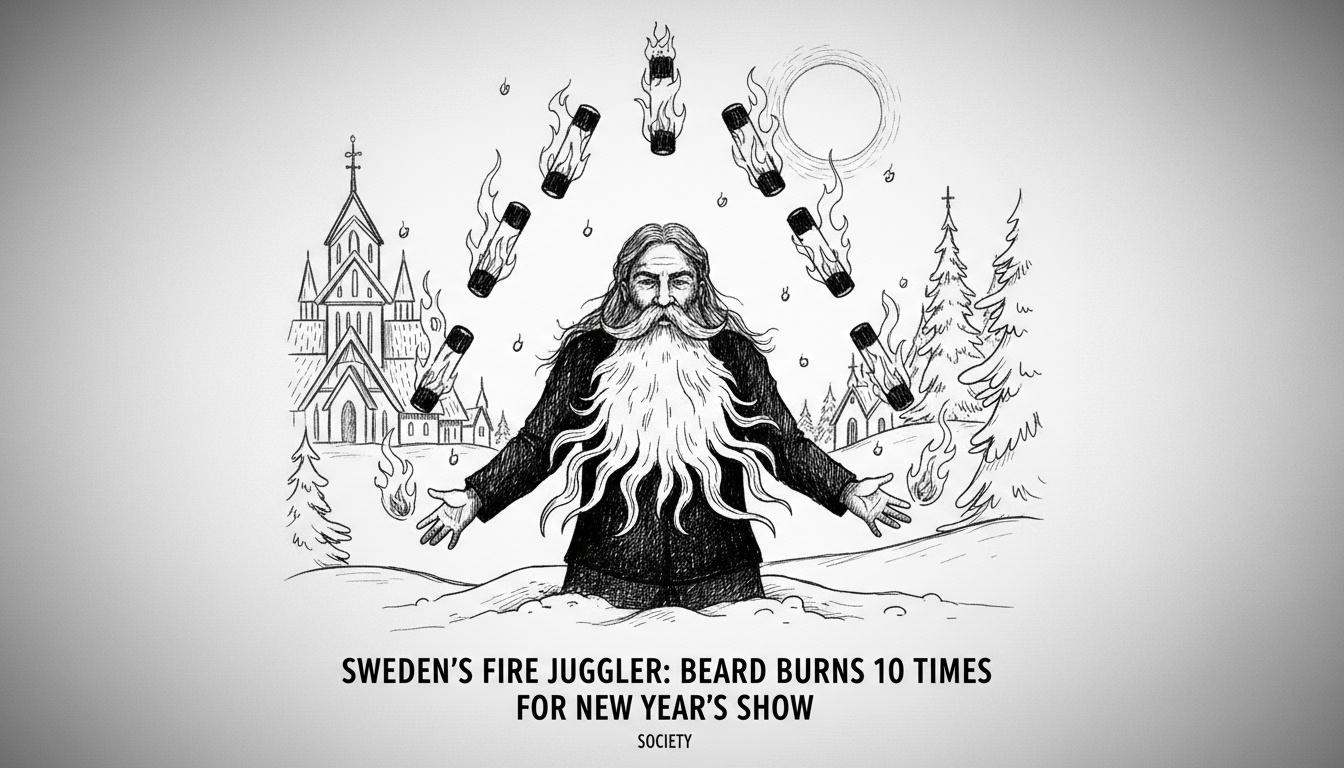
Sweden's New Year's Eve traditions are facing a quiet evolution in the far north. In the Arctic darkness of Luleå, a university student juggles flaming torches, his beard singed from a decade of practice. This is the reality for members of Phire, a 20-person performance group preparing for their annual New Year's show in Boden. While national debates question the environmental impact of fireworks, these students offer a different kind of fire—one controlled, artistic, and surprisingly personal.
"You naturally burn off your beard as soon as it gets too long," the juggler says with a laugh, reflecting on his ten beard fires. His pragmatic view captures the spirit of Phire. The group blends serious artistry with playful acceptance of the inherent risks. On a typical evening, members cycle unicycles, practice dance routines with LED lights, and then head to a vacant university parking lot. There, under the vast Norrbotten sky, they ignite their tools and rehearse the precise, swirling patterns that define their fire shows.
The Arctic Stage: Where Tradition Meets Innovation
Phire's home is Luleå University of Technology, a hub of innovation in Sweden's northernmost county. The contrast is striking. Students who spend their days in engineering and tech labs spend their nights mastering an ancient performance art. The group's chairman, Louise Bjersbo, explains their appeal. "Boden invites us quite often," she says, referring to the nearby municipality. Their New Year's Eve performance there is scheduled for a child-friendly time, a conscious choice to make the spectacle accessible to families.
Despite growing scrutiny of traditional fireworks, Bjersbo hasn't seen a surge in demand for fire shows as a direct alternative. "No, it's probably the same amount as most years," she notes. This suggests that in regions like Norrbotten, fire performance is valued as its own cultural expression, not merely a substitute. The group tours locally across the county when invited, bringing their unique blend of light and movement to community events. Their repertoire includes dazzling LED light shows, a cooler, indoor-friendly option that lacks the primal heat of fire but offers its own mesmerizing beauty.
More Than a Spectacle: The Culture of Fire Play
To understand Phire is to look beyond the show. It's about the community formed in that cold parking lot. It's about the trust required to swing fire near your friends. The group is open to all, though most members are students. It represents a microcosm of Swedish föreningsliv—the nation's deep-rooted culture of association life—applied to a niche, artistic pursuit. Members learn safety, choreography, and mutual responsibility alongside their juggling skills.
This cultural context is key. Sweden has a long history of balancing innovation with tradition, and Phire sits at that crossroads. They use modern materials for their LED shows and likely employ online forums to learn techniques. Yet they practice a performance art with ancient roots, creating live, communal experiences in an increasingly digital age. Their location adds another layer. Norrbotten's extreme winters, with limited daylight, make the deliberate creation of light and warmth a particularly resonant act. Their fire dispels the deep winter darkness, a symbolic gesture as much as a performance.
The National Conversation: Are Fireworks Fading?
Phire's steady demand exists alongside a national conversation. Across Sweden, municipalities and environmental groups have raised concerns about fireworks. The issues are pollution from heavy metals and gunpowder residue, the risk of injury, and the distress caused to pets and wildlife. Some cities have experimented with large, centralized drone or laser light shows as public alternatives. This shift is part of a broader Nordic trend toward more sustainable and controlled public celebrations.
However, the situation is not black and white. Fireworks are deeply woven into Swedish New Year's tradition, seen by many as a joyful, if noisy, way to ring in the new year. The debate often centers on private use of consumer fireworks versus organized public displays. In this landscape, groups like Phire occupy a interesting middle ground. Their show is public and professional, eliminating the safety risks of amateur handling. While burning fuel has its own environmental footprint, it lacks the chemical fallout of explosives. Their art offers the raw, elemental appeal of fire but channels it into a disciplined, artistic format.
The Human Spark: Why They Do It
Returning to the individual, the story always comes back to the human element. The juggler with the oft-singed beard chooses to see the positive. For him, the fire is a tool for creation and a built-in grooming assistant. This blend of humor and dedication is telling. It points to a deeper motivation than just putting on a show. It's about mastering a difficult skill, being part of a creative team, and offering a moment of awe to an audience.
For communities in towns like Boden, inviting Phire is a choice to support local talent and provide a unique family experience. It’s a different kind of New Year's memory—not just loud bangs and colorful sky bursts, but the smell of smoke, the feel of radiant heat in the cold air, and the sight of human figures moving in sync with the flames. It’s intimate where fireworks are grandiose, tactile where they are distant.
Looking Ahead: The Future of Flame
As Phire prepares for their New Year's performance in Boden, they represent more than just an evening's entertainment. They are a living example of how cultural traditions adapt. They are not protesting fireworks; they are simply offering another way to celebrate light in the darkness. Their continued presence suggests a public appetite for diverse forms of celebration.
The path forward for Swedish festivities may well be pluralistic. Large municipal drone shows, traditional fireworks in controlled settings, and the raw artistry of groups like Phire can all coexist. Each offers a different experience and caters to different values. In the Arctic north, where winter is profound, the need for collective, luminous celebration feels especially strong. Phire meets that need not with impersonal explosions in the sky, but with skilled, human-held fire on the ground. Their light is fleeting, warm, and unmistakably alive—a fitting metaphor for the hope embodied in a new year. As the final embers of their show fade on December 31st, they leave behind not just smoke, but the enduring glow of shared experience.