
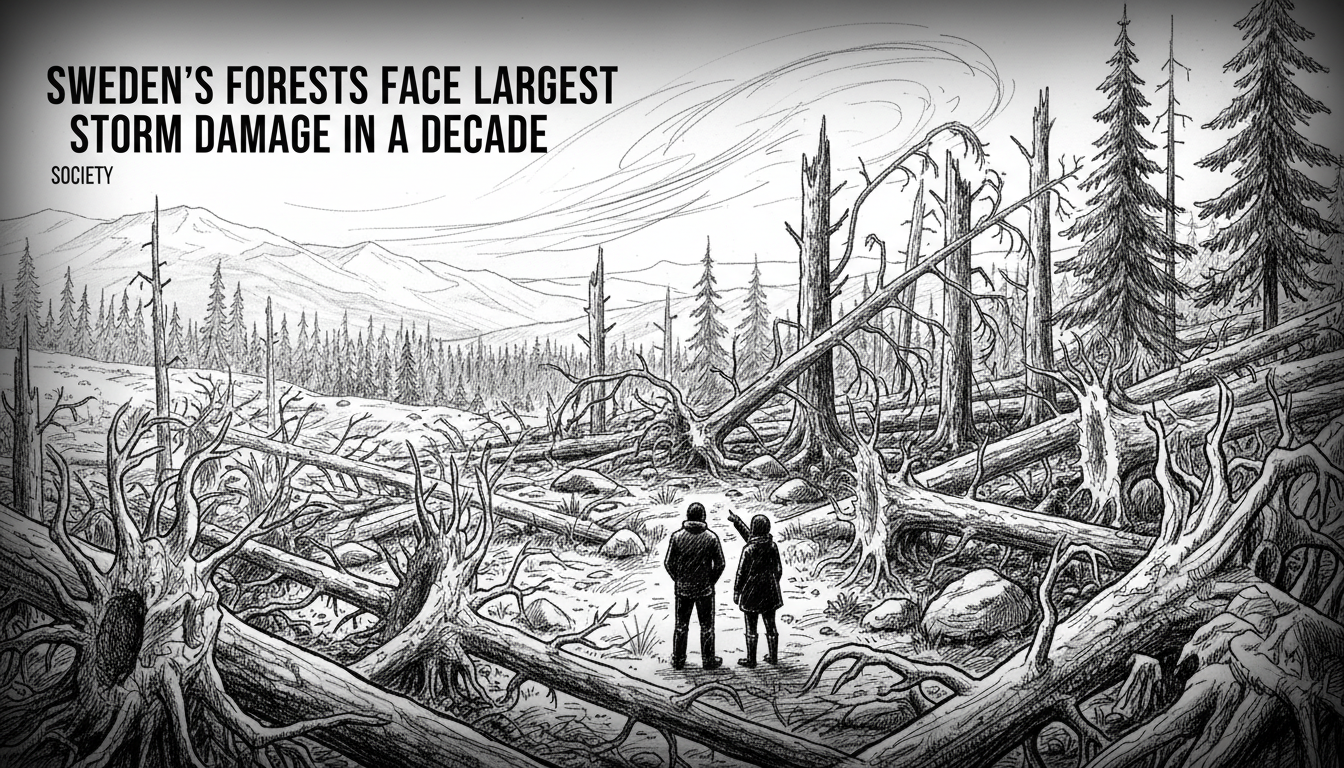
Sweden's forestry sector is assessing the most extensive storm damage in ten years after Storm Johannes swept across the country. Preliminary estimates from the Swedish Forest Agency indicate approximately 10 million cubic meters of timber were felled. The heartland counties of Dalarna and Gävleborg were hit hardest, with significant damage along the coastal belt from Uppland to Norrbotten.
"The numbers are still preliminary and may be adjusted up or down," said Magnus Martinsson, a forest coordinator at the Swedish Forest Agency. His caution underscores the scale of the ongoing assessment. For a nation where forests blanket over 60% of the land, this is a profound economic and environmental blow.
A Landscape Transformed Overnight
The true impact is written across the landscape of central and northern Sweden. In small communities like Söderhamn in Gävleborg or rural parts of Dalarna, familiar vistas are gone. Stands of spruce and pine that have stood for decades now lie in tangled, chaotic mats. The sound of chainsaws has replaced the wind in the trees, as forest owners begin the monumental clean-up task.
This scale of damage harkens back to storms like Gudrun in 2005, which felled 75 million cubic meters. While Johannes is less severe, its impact on a concentrated region is devastating. The affected volume represents a significant chunk of Sweden's annual harvest, which averages around 90 million cubic meters. The disruption will be felt for years.
The Human Cost for Rural Sweden
Behind the staggering cubic meters are personal stories. Sweden's forest ownership is diverse, with many families managing woodlands passed down through generations. For them, the forest is both a living savings account and a cherished heritage. Storm Johannes has wiped out a lifetime of careful management in a single night.
"It's soul-crushing," said Erik Lundström, a forest owner from Ludvika in Dalarna, who asked not to use his real name. He estimates 70% of his mature forest is on the ground. "My grandfather planted some of these trees. We were planning a thinning harvest next year. Now, it's all salvage logging, and the market will be flooded. The value is gone."
This emotional and financial devastation ripples through rural communities. Forestry supports thousands of jobs, from machine operators to mill workers. A sudden glut of storm-felled timber can depress prices, hurting everyone. Yet, the urgent need to clear the wood before insects and decay set in will create a short-term boom for logging contractors.
Economic Ripples and Global Markets
The economic implications extend far beyond county borders. Sweden's forestry sector is an export powerhouse, contributing around 10% of the country's total export value. Products like pulp, paper, and sawn timber feed global supply chains. Major Swedish companies like SCA and Stora Enso have large landholdings in the affected areas.
A sudden, unplanned influx of 10 million cubic meters will distort the market. In the short term, sawmills and pulp mills will have ample raw material. But this windfall is problematic. Storm-damaged wood must be processed quickly, often leading to lower-quality output. Furthermore, it disrupts carefully planned long-term supply agreements and harvesting schedules.
"The market will see a temporary surge in supply, likely pushing down timber prices for private forest owners," explained Karin Perhans, a forest economist at the Swedish University of Agricultural Sciences. "The real challenge is the long-term gap it will create. These fallen trees represent future harvests that are now gone. In five to ten years, we may see a supply shortage from these regions, potentially driving prices up."
A Climate Resilience Wake-Up Call
Experts see Storm Johannes as a stark warning. A changing climate is expected to bring more frequent and intense weather events to Northern Europe. Sweden's forests, often dominated by monoculture plantations of Norway spruce, are particularly vulnerable to high winds. Their shallow root systems are no match for sodden ground and hurricane-force gusts.
This disaster is fueling a critical debate about the future of Swedish forestry. The focus is shifting urgently toward storm resilience. "This event underscores the need to diversify our forests," said Professor Lars Drössler, a silviculture expert. "Mixing in deciduous trees like birch and oak, or using pine in windier areas, can create more stable stands. We also need to reconsider thinning practices and the rotation ages of our forests."
Modern forestry practices may have inadvertently increased risk. Intensive thinning can leave remaining trees more exposed. Planting spruce on soils better suited for pine or hardwood can create weak spots. The push for sustainability now must braid together economic, ecological, and climate resilience goals.
The Environmental Double-Edged Sword
The ecological impact is complex. On one hand, vast areas of downed trees are a tragedy for timber production. On the other, they create incredible biodiversity opportunities. Dead and dying wood is a crucial resource for thousands of insect, fungi, moss, and bird species. In a meticulously managed forest landscape, such natural disturbances are rare.
"From a biodiversity perspective, this storm creates habitats that are otherwise vanishingly scarce," said Anna Bengtsson, an ecologist with the Swedish Society for Nature Conservation. "The key will be to not 'clean up' everything. Leaving significant areas of storm-felled wood where it lies is vital for forest health and species survival. We need to balance economic salvage with ecological necessity."
This presents a practical and philosophical dilemma for forest owners and authorities. Can Sweden afford to leave valuable timber to rot for nature's sake? The answer may lie in targeted set-asides and new forms of compensation for promoting biodiversity.
Navigating the Clean-Up Challenge
The immediate priority is a massive logistical operation. Accessing damaged sites is difficult. Safe working conditions are paramount amidst unstable piles of giant trees. The Forest Agency is coordinating efforts, prioritizing the clearing of roads and power lines, and providing advice to overwhelmed private owners.
The clock is ticking. Beetles like the spruce bark beetle will quickly colonize the downed timber. If not processed within months, the wood loses most of its economic value for sawlogs or pulp. This creates a frantic race against time and nature, testing the capacity of harvesters, transporters, and processing plants to their limits.
Community solidarity is emerging. Forestry cooperatives are pooling resources. Neighbors are helping each other with initial assessments. The Swedish concept of 'duktighet' – a blend of resilience and pragmatic competence – is on full display in the affected villages.
Looking to a More Resilient Future
Storm Johannes is more than a natural disaster. It is a stress test for a cornerstone of Swedish society. The recovery will take years. The conversations it has started about forest management, climate adaptation, and rural livelihoods will define the future of Sweden's iconic landscapes.
As the initial shock gives way to the long grind of recovery, fundamental questions remain. How can Sweden honor its deep cultural connection to the forest while adapting to a stormier future? Can the industry pivot toward practices that value stability as much as yield? The answers will shape the next generation of Swedish woodlands. For now, across the storm-ravaged north, the work of rebuilding a forest – and the communities that depend on it – has just begun.