
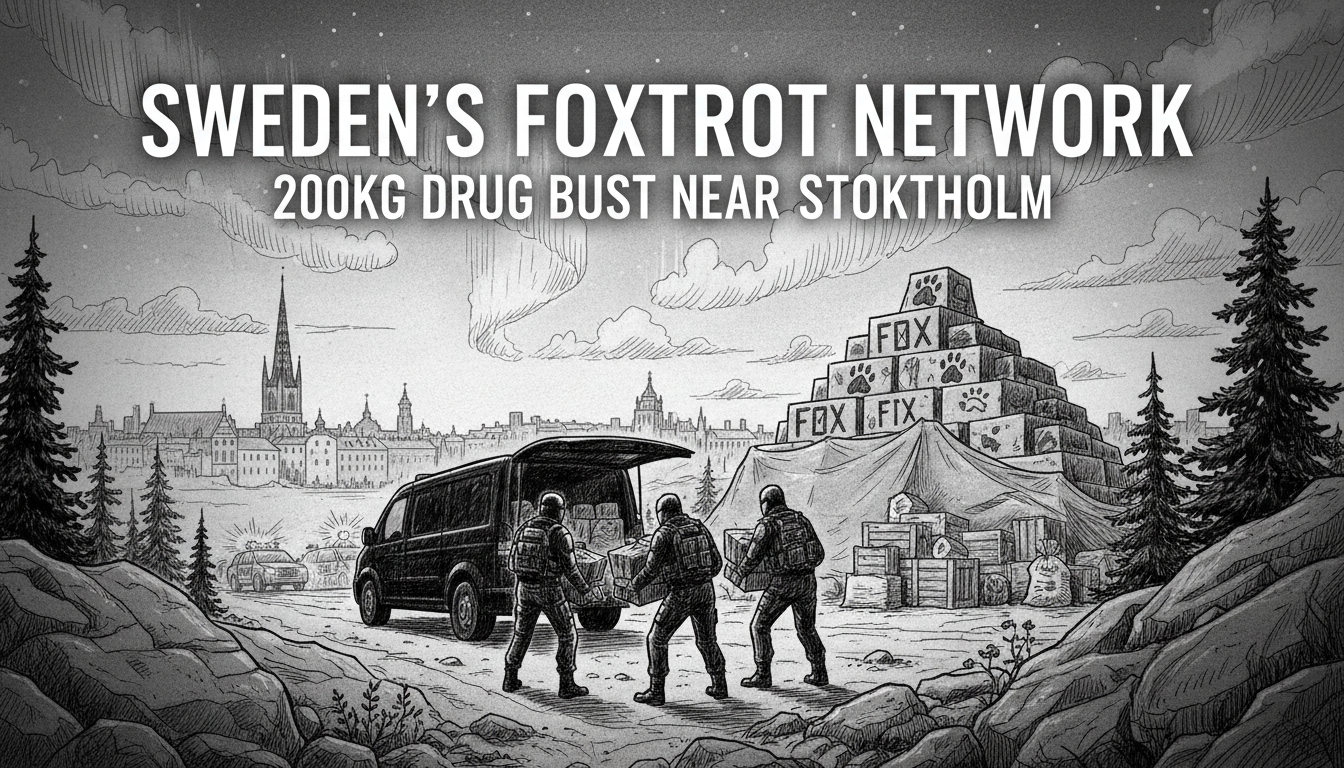
Sweden's police have dealt a major blow to one of the country's most notorious criminal networks. Authorities confirmed the seizure of at least 200 kilograms of narcotics in Nykvarn, southwest of Stockholm, directly linking the massive haul to the Foxtrot organization. This seizure represents one of the largest single drug busts connected to the gang in recent memory, highlighting both the scale of their operation and the intensity of the police crackdown.
"We are linking this seizure to the Foxtrot network, where the main leader is located abroad," said Erik Guteson, head of the section against international and serious organized crime for the West region police. The drugs, estimated to be a mix of amphetamines and cocaine, are currently undergoing forensic analysis. The bust occurred on Friday, but details are only now emerging as the investigation progresses.
A Network Under Pressure
The Foxtrot network is no ordinary street gang. It is a sophisticated, international criminal enterprise deeply embedded in Sweden's underworld. Primarily involved in drug trafficking, its tentacles also reach into weapons smuggling, extortion, and money laundering. For residents of Stockholm suburbs like Rinkeby, Tensta, and Husby, the name Foxtrot is synonymous with the gang violence that has periodically erupted in their neighborhoods. This seizure, however, suggests police are hitting them where it hurts most: their supply chain and profits.
"A seizure of this magnitude, 200 kilos, is a significant operational and financial setback," says a Stockholm-based criminologist who studies organized crime, speaking on background due to the sensitivity of ongoing investigations. "It disrupts cash flow, creates internal distrust, and forces them to take risks to replace the lost inventory. It's a tangible win for police, but it's also a move in a much longer chess game."
The International Dimension
Erik Guteson's reference to a leader "located abroad" underscores a critical challenge in Sweden's fight against gang crime. Networks like Foxtrot are inherently transnational. They source drugs from producers in the Netherlands or Belgium, smuggle them via routes through Germany or Denmark, and distribute them across the Nordic region. The profits are then laundered through complex schemes often involving overseas assets. This makes policing a matter of international cooperation, requiring coordination with Europol and police forces across Europe.
This bust in Nykvarn, a relatively quiet municipality, likely points to a storage and logistics hub. Gangs often use such locations to break down large shipments for distribution into major cities. Intercepting the drugs at this stage prevents them from reaching street-level dealers in Stockholm's city center or satellite towns.
Society's Frontline
The battle against gangs like Foxtrot is not fought only in police briefings. It plays out daily in communities. School teachers report seeing the recruitment of vulnerable teenagers. Social workers try to provide alternatives to the quick money and sense of belonging gangs offer. In cities like Malmö and Gothenburg, similar struggles against other networks are ongoing. The violence, often stemming from territorial disputes over drug sales, has led to a tragic toll of shootings and explosions, shaking the public's sense of safety.
Swedish society has been engaged in a difficult conversation about the roots of this crime. Factors frequently discussed include integration challenges, segregation in housing, youth unemployment, and the sheer profitability of the drug trade. The government has responded with tougher laws, increased police resources, and broader surveillance powers. This record seizure is a direct result of that intensified focus.
What Happens Next?
While celebrating the seizure, experts urge caution. "The void left by a disrupted network can be quickly filled," the criminologist notes. "Other groups may see an opportunity, which can spark new conflicts. Or, the network itself may adapt, finding new routes and suppliers. The key is sustained pressure and parallel efforts to reduce demand and support at-risk youth."
The immediate next steps are forensic and investigative. Police will analyze the drugs' purity and chemical signature, which can provide clues about their origin and trafficking route. They will also pursue any leads from the seizure site—surveillance footage, communications, or financial records—to identify more members of the chain. Each arrest or identified accomplice builds a larger case, potentially leading to more high-profile prosecutions.
For the average Swede, news of a 200kg drug bust is met with mixed feelings. There is relief at a clear police success and hope that it might mean quieter streets. But there is also a weary recognition that this is a single battle in a long war. The cultural impact is seen in everything from popular music that sometimes glamorizes the gangster lifestyle to political debates that dominate election cycles.
A Long-Standing Challenge
Sweden's relationship with organized crime has evolved dramatically over the past two decades. From a country perceived as relatively safe, it now grapples with a level of gang violence that commands national attention. Operations against networks like Foxtrot, whose activities are frequently splashed across Swedish culture news, have become more militarized and intelligence-driven. The police's regional task forces, like the one Erik Guteson leads, symbolize this new approach.
The seizure also raises questions about consumption. Such vast quantities of drugs are destined for a large market. This points to ongoing, significant demand within Sweden and potentially neighboring countries, fueling the cycle of violence and crime. Addressing this demand through public health and education initiatives remains a critical, though less headline-grabbing, part of the strategy.
As the drugs sit in an evidence locker and detectives work their phones, the Foxtrot network is likely recalculating. The seizure near Stockholm is a definitive victory for law enforcement. But in the shadowy world of Swedish drug trafficking, today's setback for one group can become tomorrow's opportunity for another. The real test will be whether this momentum can be turned into lasting change, making events like this the norm rather than the exception in Swedish society trends.