
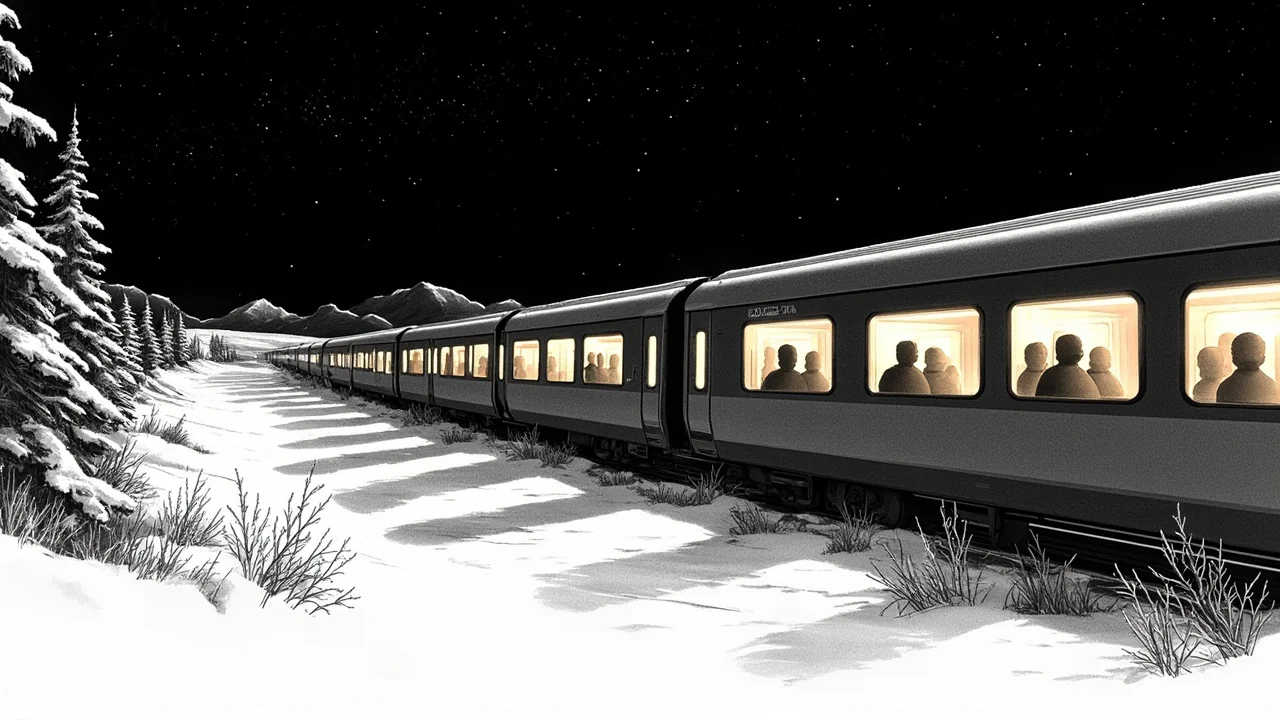
Sweden's night train services have been cancelled for the second time this month due to extreme cold, halting travel between Luleå and Stockholm and stranding passengers. The Arctic freeze, returning with temperatures plunging far below -20°C, has made railway operations impossible. For travelers and residents across Norrland, this repeat disruption is more than an inconvenience—it's a stark reminder of the vulnerabilities in Sweden's winter infrastructure.
Johannes Cleris, a press spokesperson for state operator SJ, outlined the stark reality. "If it's too cold to run trains, we don't want to run replacement buses either," he explained. "There are places where it's quite a distance from everything if something were to happen." This admission highlights the severe safety calculations at play. When metal becomes brittle and systems fail, the priority shifts from mobility to sheer survival in the isolated stretches between towns.
A Recurring Winter Struggle
This is not an isolated incident. Services were also cancelled last weekend and during the first week of January. The current halt affects the popular Stockholm-Luleå night route, a vital link between the capital and the north. Travel between Luleå and Narvik, across the border in Norway, remains suspended with no forecast for resumption. Regional operator Norrtåg has also cancelled its routes between Luleå and Kiruna. The pattern is clear: when deep winter grips the far north, the region's connectivity seizes up.
The impact is profoundly human. Imagine the student heading back to Umeå University after the holidays, now stuck in Centralstation. Consider the family trying to return to Kiruna after a visit south, their plans frozen along with the tracks. These night trains are more than transport; they are moving capsules of Swedish life, carrying tourists seeking northern lights, workers on commute, and families maintaining bonds across a vast country. Their sudden stop creates a cascade of personal and logistical crises.
The Limits of 'Folkhemmet' in the Arctic
There's a cultural irony here. Sweden prides itself on the 'folkhemmet' (the people's home) ideal—a society that functions smoothly for all its citizens, regardless of where they live. A robust, reliable public transport system is a cornerstone of that vision. Yet, the repeated failure of this key service in the north tests that social contract. It exposes a geographic divide, where the infrastructural resilience enjoyed in Stockholm or Gothenburg meets its match in the Norrland winter.
"We are prepared for cold, but this is extreme," is a common refrain from authorities. But for northerners, this is winter. The question becomes: at what point does 'extreme' become a regular occurrence that systems must reliably withstand? With climate change predicted to increase weather volatility, including more intense cold snaps, this problem may worsen. The conversation is shifting from simple maintenance to urgent adaptation.
Life at -30°C: Beyond the Timetable
To understand the cancellations, one must understand the physics of deep cold. Steel rails contract and can snap. Point mechanisms, which guide trains from one track to another, freeze solid. Lubricants in vital components thicken into glue. Onboard systems, from water pipes to braking electronics, are at high risk of failure. Operating a train in such conditions isn't just difficult; it becomes dangerously unpredictable. The safety margin evaporates.
This reality forces a tough prioritization. Resources and functional transport are funneled to the most critical services. Ambulances, emergency vehicles, and local road maintenance take precedence. The national train network, a symbol of connectedness, must yield to the immediate, localized needs of survival in a harsh climate. The silence on the tracks is a sound of caution, not neglect.
Looking for Solutions in a Cold Climate
So, what is the path forward? Experts point to several areas. Investment in cold-proofing technology is paramount—heated points, different materials for critical components, and train designs specifically hardened for Arctic operation. Some look to Finland, which maintains rail services in similar temperatures, for technical lessons. However, solutions are expensive and the passenger numbers in the vast north are low, creating a challenging economic equation.
There is also a growing call for better contingency planning. While replacement buses are not safe in all conditions, could there be designated emergency shelter stops along the route? Could communication and support for stranded passengers be more robust? The debate touches on Sweden's core values of equality and welfare. Ensuring the north is not isolated is as much a social policy issue as a transport one.
The Human Element Endures
Despite the disruptions, there is a resilient pragmatism in the north. This is captured not in official statements, but in the lived experience. It's in the way communities like Gällivare or Boden rally when people get stuck. It's in the shared understanding that nature, here, is still the dominant force. The cancelled train is a temporary setback in an enduring relationship with a formidable landscape.
As the mercury slowly rises and services hopefully resume, the episode leaves a chilling afterthought. Sweden's vision of a green transport future heavily relies on efficient, attractive rail travel. Making that vision a year-round reality across the entire nation, from the cobblestones of Gamla Stan to the iron ore fields of Kiruna, remains one of the country's most pressing and complex challenges. The frozen tracks are a clear signal: the work is not yet complete. For the thousands who depend on these services, the wait for a truly all-weather railway continues.