
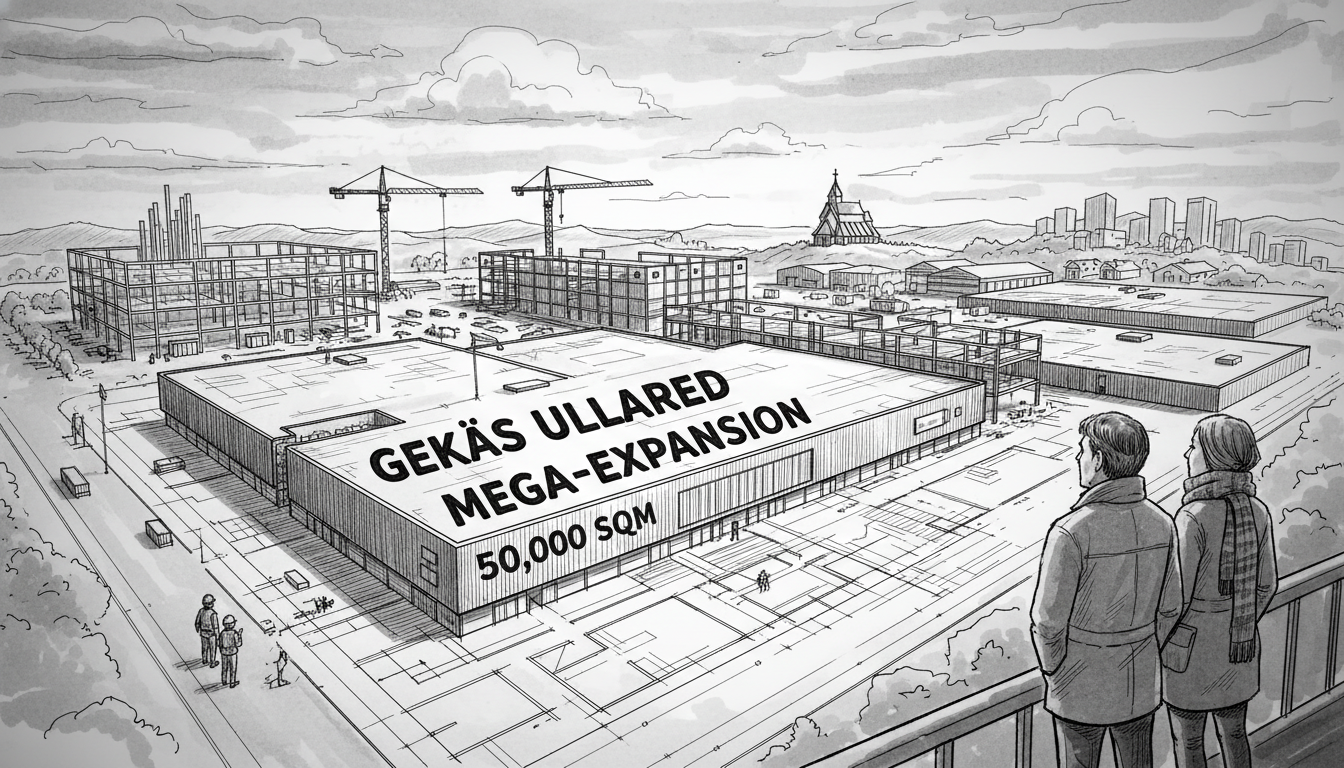
Sweden's legendary discount shopping destination Gekås Ullared is planning a colossal expansion. The hypermarket in rural Halland county aims to add 50,000 square meters of retail space and build several new floors on its hotel. This move would nearly double the store's current size and solidify its status as a cultural and economic phenomenon far beyond typical retail.
For millions of Swedes, a trip to Gekås is a rite of passage. It’s a weekend expedition, a family tradition, and a treasure hunt for bargains all rolled into one. The store’s sheer scale and low prices draw around 5 million visitors each year to the small village of Ullared. This traffic makes it one of Sweden’s top tourist attractions, rivaling historic sites and major cities. The planned growth signals a bold bet on the enduring power of physical, experience-driven discount shopping in an increasingly digital age.
More Than a Store: A Swedish Institution
To understand Gekås, you must look past the shopping carts and parking lots. It represents a specific strand of Swedish culture—practical, value-conscious, and community-oriented. The store’s origins are humble, starting as a small mail-order business in 1963. Its evolution into a retail giant speaks to a national appreciation for 'a good deal' and smart consumption. During economic uncertainty, its promise of low prices resonates even more strongly with families across the country.
“It’s not just about buying a new drill or a set of sheets,” says Lars Bengtsson, a retail analyst based in Gothenburg. “It’s about the day out. The shared experience. You drive for hours, you meet people from all over, you have lunch in the massive restaurant, and you come home with a car full of goods for a fraction of the expected cost. That ritual has proven incredibly resilient.” The expansion plans, he notes, are a direct response to this sustained demand, where the current 35,000 square meters can no longer comfortably contain the crowds.
The Engine of a Region
The impact of Gekås on its local environment is profound. Ullared, with a permanent population of just a few hundred, transforms daily into a bustling hub. The store is the region's largest employer. Hotels, campgrounds, and gas stations in the surrounding area thrive on the constant influx of visitors. This new expansion promises significant construction jobs followed by hundreds of new permanent retail and hospitality positions.
“This place is our livelihood,” says Anna Karlsson, who runs a bed and breakfast 10 kilometers from the store. “When Gekås has a busy season, we are fully booked. Their growth means our growth. It means more people staying longer, exploring more of Halland, not just the store.” The planned hotel expansion directly supports this ecosystem, offering more visitors a place to stay and extending their visits.
Navigating Growth and Identity
Such dramatic growth does not come without challenges. Infrastructure, primarily roads, is a constant concern. The influx of 5 million annual visitors creates traffic pressures that local authorities must manage. Environmental considerations for a building project of this scale are also significant, requiring careful planning and sustainable construction practices.
There is also a cultural question. Part of Gekås’s charm lies in its slightly chaotic, overwhelming, and unique atmosphere. Can it add 50,000 square meters—an area larger than many city-center department stores—and retain the character that made it special? The management’s track record suggests they are aware of this balance. Past expansions have been absorbed into the Gekås experience, adding variety while keeping the core focus on value and selection.
The Future of Discount Shopping
This expansion arrives at a fascinating time for retail. While e-commerce dominates many sectors, Gekås represents the potent appeal of a physical destination. It is a testament to the fact that for certain types of shopping, the experience itself is a major part of the product. The social aspect, the immediacy, and the sensory overload of seeing endless aisles of goods cannot be replicated online.
“Gekås is an outlier that proves a rule,” explains retail analyst Bengtsson. “The rule is that generic, boring physical stores are dying. But highly differentiated, experiential, and value-focused destinations can not only survive but thrive. They are building a day-trip ecosystem, not just a store. The hotel expansion is key—it turns a day trip into a mini-vacation.”
For Swedish consumers, the news of a bigger Gekås likely means more variety, more deals, and an even more epic shopping adventure. It reinforces the store’s position as a pillar of Swedish consumer culture. The planned 50,000-square-meter addition is more than a construction project. It is a statement of confidence in a uniquely Swedish success story, one built on the simple, powerful promise of giving people more for less.
As the blue and yellow buildings in Ullared prepare to grow again, they underscore a timeless truth. In Sweden, the pursuit of a good bargain is not just an economic activity. It is, for better or worse, a beloved national pastime. Gekås is its cathedral, and they are building a bigger nave.