
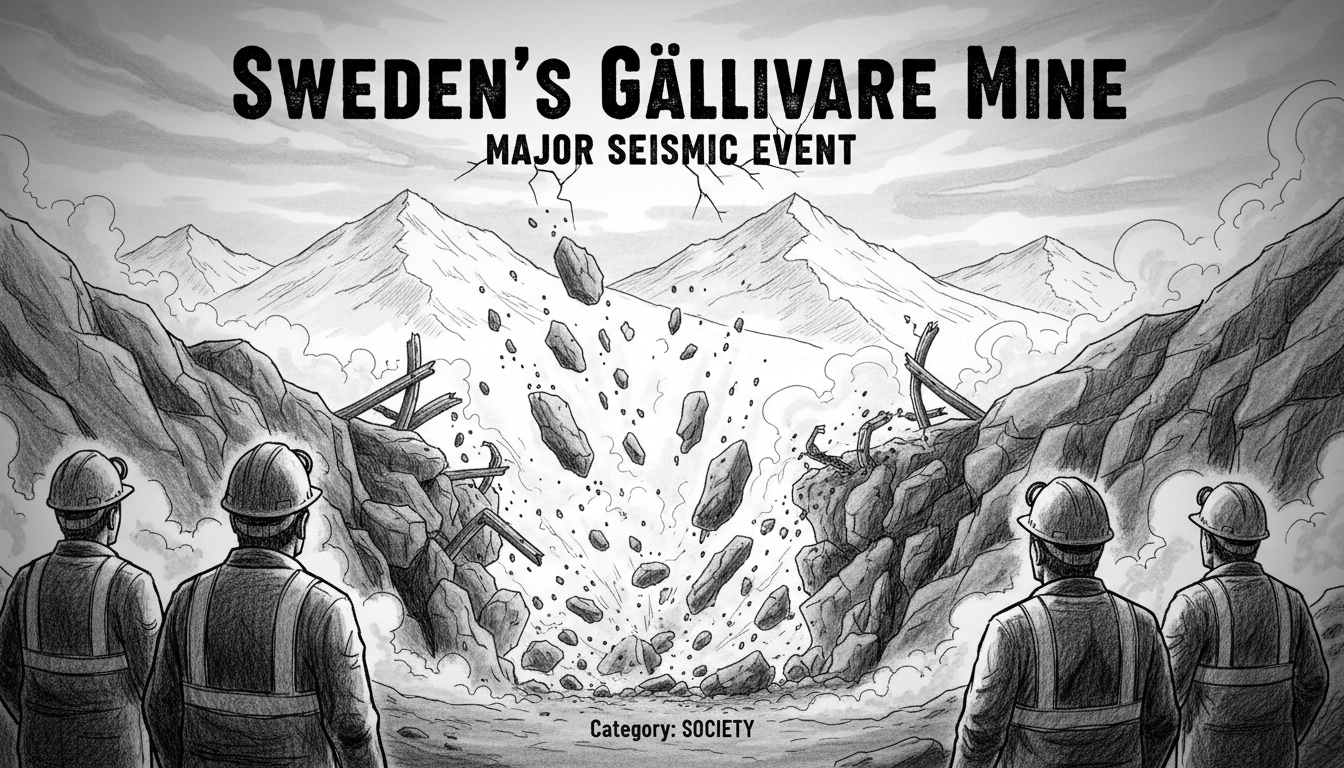
Sweden's state-owned mining giant LKAB reported one of its largest-ever seismic events at its Gällivare iron ore mine early today. The powerful tremor, described by the company as a major 'vibration or settlement,' was strong enough to be felt in the surrounding community, prompting an immediate halt to work in the affected area.
"It is one of the largest vibrations or settlements that has been measured," said Ulrika Huhtaniska, LKAB's press officer. She was quick to add that the event occurred in a 'hanging wall' area of the mine, meaning it did not directly impact active mining zones, roads, infrastructure, or areas where personnel were located. Work near the site has been temporarily suspended to allow the rock mass to stabilize. A smaller seismic event was also recorded in the same part of the mine earlier in the night, and LKAB has launched an investigation into the cause.
For residents of Gällivare, a town of about 10,000 located 60 miles north of the Arctic Circle, the shaking was a tangible reminder of the immense industrial activity happening beneath their feet. The town's identity and economy are inextricably linked to LKAB, one of the world's leading iron ore producers. This event brings the complex relationship between community, environment, and industry into sharp focus.
The Tremor Felt in Town
While LKAB assures no infrastructure was damaged and no one was endangered, the physical sensation of the ground moving resonates deeply in a mining community. It transforms an abstract industrial process into a shared physical experience. "You hear about the mining, you see the trains leaving, but feeling it is different," said Erik Lundström, a lifelong Gällivare resident I spoke to. "It’s a low rumble, a vibration in your house. It reminds you where you live."
This is not an uncommon phenomenon in regions with extensive subsurface mining. What seismologists term 'induced seismicity' refers to earthquakes caused by human activity, such as mining, which alters the stresses within the surrounding rock. As ore is extracted, the empty spaces left behind can cause the overlying rock layers to shift and settle, sometimes releasing energy as seismic waves. LKAB, like all major mining operators, has extensive monitoring systems in place to track these micro-seismic events, which are typically too small to be felt.
Today's event, however, crossed that threshold. The company's decision to pause operations is a standard precautionary measure, allowing geotechnical engineers to assess the stability of the rock formation. "The priority is always safety," Huhtaniska emphasized. "Stopping loading operations adjacent to the site is a responsible step while we analyze the data."
Life Above the Mine
Gällivare exists because of the mine. Founded in the late 19th century during the iron ore rush, the town's rhythm is set by the shift changes at LKAB. The company is not just an employer; it's a community partner, funding local sports teams, cultural events, and infrastructure. This creates a unique social contract where the benefits of mining are visible daily, but so are its physical impacts—from the constant rumble of ore trains to the occasional tremor.
This seismic event occurs at a time of intense transition for both LKAB and the Norrbotten region. The company is embarking on a historic shift from traditional iron ore extraction to producing fossil-free sponge iron, a key material for green steel. This 'green transition' is Sweden's largest-ever industrial investment, promising to secure jobs and maintain the region's industrial relevance in a decarbonizing world. Yet, it also means mining will continue, and with it, the geological realities of operating deep underground.
"We are a mining town, that's our reality," said Anna-Karin Nygårds, who runs a local café. "People here are pragmatic. They know what the mine provides—jobs, security, a future for our children. But every time something like this happens, you pause. You remember the power of what's underneath us."
The Science of Settling Rock
Expert analysis of such events focuses on magnitude, location, and the specific mining geometry involved. A 'hanging wall' refers to the rock mass above an ore body. When ore below it is removed, this wall can experience stress changes leading to movement. While alarming when felt, these events are often a controlled part of deep mining geomechanics.
"Induced seismicity in mining is a well-studied phenomenon," explains Dr. Lena Forsgren, a geomechanics researcher at Luleå University of Technology, who has studied seismic activity in Swedish mines. "The key is continuous monitoring and having clear action plans. An event being felt on the surface does not automatically indicate a problem; it indicates energy release. The critical analysis is whether the location and magnitude align with predictive models and if it necessitates a change in mining sequence or support methods."
LKAB's investigation will likely involve reviewing seismic data, inspecting the affected area with scanning equipment, and modeling the rock mechanics to understand what triggered this larger-than-usual settlement. The goal is to ensure that future mining in the area can proceed safely. In 2022, LKAB produced around 27 million tonnes of iron ore products, a volume that underscores the scale of its underground operations and the constant management of geological forces it requires.
Balancing Progress and Perception
The tremor in Gällivare is more than a local news item. It's a microcosm of the global challenge of resource extraction in the 21st century. Sweden, and particularly the Nordic region, positions itself as a leader in sustainable industry. This involves not only clean energy but also responsible mining practices with minimal environmental and social impact. Events that shake homes, literally, test that narrative.
For the international audience, it highlights the often-overlooked human and environmental dimensions of the supply chain. The iron ore from Gällivare feeds steel mills that build everything from electric vehicles to wind turbines. The green transition depends on these raw materials, and extracting them is a complex, sometimes disruptive, engineering feat.
LKAB's transparent communication following the event—quickly reporting it, outlining safety measures, and launching an investigation—reflects the high standards expected of a state-owned company in Sweden. Trust in institutions is high, but it is maintained through accountability and clear information.
Looking Ahead in Norrbotten
As work cautiously resumes in other parts of the mine, life in Gällivare continues. Children go to school, the coffee shops are busy, and the vast, beautiful landscape of Swedish Lapland remains. But the memory of the shake lingers. It serves as a reminder of the region's dual identity: a place of stunning natural beauty and profound industrial depth, of silent forests and rumbling mines.
The investigation's findings will be crucial. They will inform not only LKAB's immediate mining plans but also the ongoing dialogue about the future of extractive industries in a society increasingly sensitive to environmental and social impact. Can deep mining ever be fully separated from its physical effects on the landscape and those who live above it? For communities like Gällivare, the answer isn't abstract. It's felt in the ground beneath their feet, a vibration connecting their daily lives to the vast, hidden processes that shape both their economy and their environment. The challenge is to ensure that this connection remains one of security and prosperity, not unsettling tremor.