
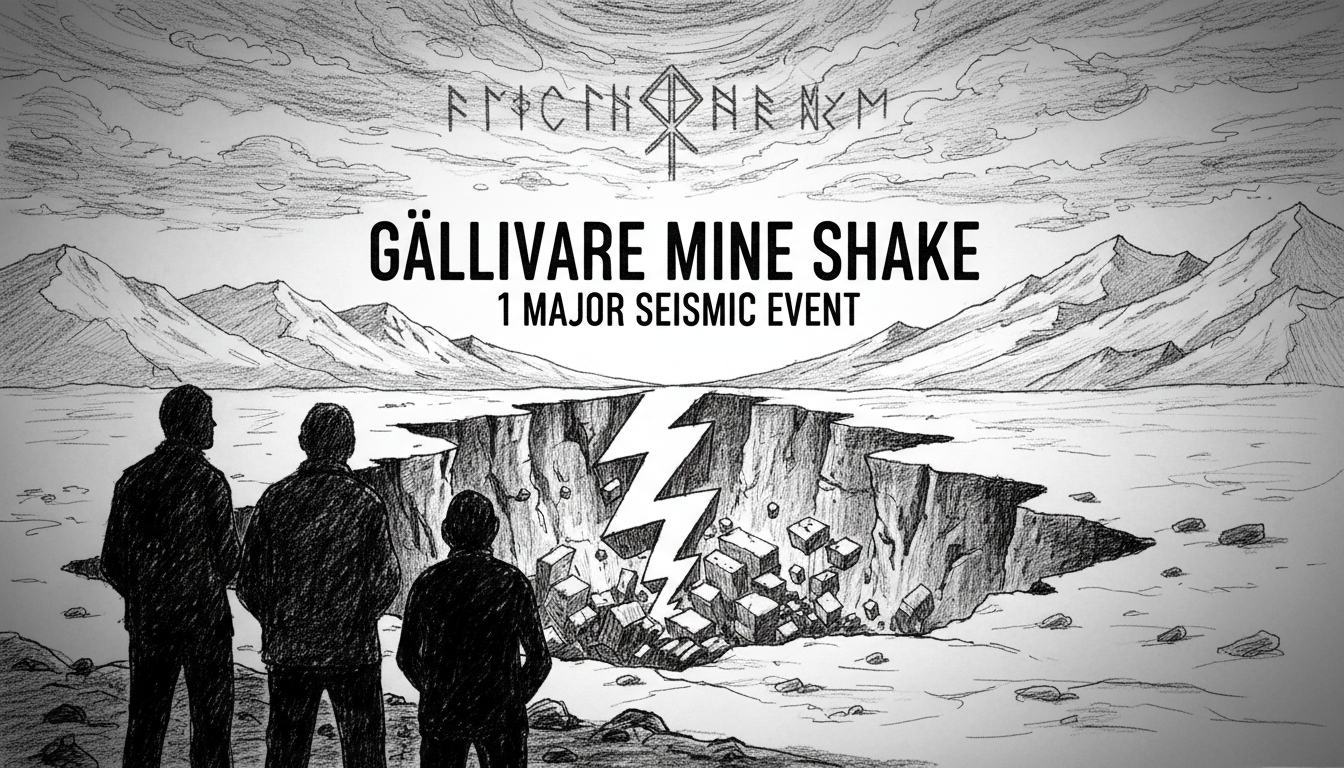
Sweden's Gällivare area experienced one of its largest mining-related seismic events early this morning. The powerful tremor, reported by state-owned mining giant LKAB, shook the ground in the northern community but caused no reported damage to infrastructure or injuries to personnel. The event has temporarily halted work in a specific section of the iron ore mine, raising questions about the stability of the deep rock formations that underpin Sweden's critical mineral industry.
“It is one of the largest vibrations or settlements that has been measured,” said Ulrika Huhtaniska, LKAB's press manager, in a statement. She emphasized that the event occurred in a hanging wall area, away from active personnel zones, roads, and key mine infrastructure. “It has not affected the mine, roads, infrastructure or areas where staff are located.” Despite this assurance, the shake was strong enough to be felt in the surrounding community of Gällivare, a town of about 10,000 people whose identity is deeply intertwined with mining.
A Community Built on Rock and Iron
Gällivare, located about 100 kilometers north of the Arctic Circle, is part of the Norrbotten region's mining heartland. Life here has long been synchronized with the rhythm of the mines. The distant rumble of blasting and the sight of the iconic ore trains are part of the local soundscape. For residents, minor tremors are not entirely uncommon. “You feel a deep rumble sometimes, like distant thunder,” says Erik Lundström, a local teacher and lifelong resident. “But this was different. This was a proper shake. My coffee cup slid right across the kitchen table.”
The event forces a moment of reflection in a community where mining is both the economic engine and a source of constant geological change. LKAB's operations in Kiruna and Malmberget (near Gällivare) are so extensive that they have necessitated the gradual relocation of entire sections of those towns due to ground subsidence. The relationship between the community and the company is complex, built on mutual dependence and a shared history, yet occasionally strained by the physical realities of living atop a moving landscape.
The Science of Mining-Induced Tremors
Sweden is not a country known for significant natural earthquakes. Most seismic activity here is attributed to post-glacial rebound—the land slowly rising after being compressed by ice-age glaciers—or, as in this case, human activity. Large-scale mining, particularly the block-caving method used to extract massive volumes of iron ore, alters stress fields in the surrounding bedrock. When these stresses redistribute, they can cause sudden rock movements, registered as seismic events.
“What we call a mining-induced earthquake is essentially a rapid adjustment in the rock mass,” explains Dr. Lena Sjöberg, a geomechanics researcher at Luleå University of Technology. “The mine creates voids. The rock above wants to fill that void, and it does so through a combination of gradual sagging and occasional, larger fractures. Monitoring these events is crucial for safety.” LKAB operates a sophisticated network of seismometers throughout its mining districts to monitor this activity in real time.
The company confirmed that a smaller seismic event occurred in the same part of the mine earlier in the night, preceding the larger shake. This sequence is typical, says Dr. Sjöberg. “Smaller foreshocks can indicate growing instability in a rock volume, culminating in a larger release of energy. It’s a warning system written in the stone itself.” The temporary work stoppage ordered by LKAB is a standard and critical safety protocol following such an event, allowing time for the rock mass to settle and for engineers to assess the data.
Balancing Industry and Stability
LKAB has initiated an investigation into the precise cause of the event. This analysis will involve reviewing seismic data, inspecting the affected hanging wall area with cameras and sensors, and modeling the rock mechanics. The findings will inform whether mining methods in that section need adjustment. “Precisely in connection, loading has been going on, but that has been stopped now to let the rock calm down a little,” Huhtaniska noted.
The incident highlights the delicate balance Sweden manages as it pushes for a green transition. LKAB's iron ore is fundamental to the European steel industry, and the company is now also positioning itself as a key supplier of rare earth elements critical for electric vehicles and wind turbines. This strategic importance necessitates mining at greater depths and scales, which in turn presents greater engineering and geological challenges. Safety and stability are not just local concerns but matters of national economic security.
“Every event like this is a learning opportunity,” says Magnus Fredriksson, a mining engineer with over twenty years of experience in Norrbotten. “The technology for monitoring and modeling rock behavior is always improving. The goal is to predict and manage these occurrences, not just react to them. A controlled event in a planned zone is one thing. An unexpected one, even without consequences, makes everyone stop and review the models.”
Life in a Shifting Landscape
Back in Gällivare, daily life has resumed its normal pace. The shake was a topic of conversation at the local coffee shop and in supermarket aisles, but not a cause for panic. There is a hardened pragmatism here. The mine provides thousands of direct and indirect jobs; it funds local sports clubs, cultural events, and community services. The relationship with the ground beneath their feet is simply different than in other parts of Sweden.
Local authorities confirmed they received no reports of damage to homes or public buildings. The municipal crisis management team was in contact with LKAB but did not need to activate any emergency response. “We have well-established channels with the company,” says Gällivare municipal commissioner, Anna-Karin Nyström. “We are informed immediately of any event that could affect the community. Our role is to ensure public information is clear and that residents feel secure.”
For the miners themselves, the event is a professional reality. Safety protocols are drilled into every worker. The temporary pause in work is seen not as an inconvenience, but as a necessary and rational step. “The mountain always has the last word,” says one miner, who asked not to be named as he is not an official spokesperson. “Our job is to listen to it. When it speaks this loudly, we stop and listen very carefully.”
The Road Ahead for Sweden's Mining North
The Gällivare mine shake will likely fade from national headlines quickly, given the lack of immediate dramatic impact. But its ripples will be felt in engineering offices and research labs for some time. It serves as a potent reminder that Sweden's path to a fossil-free future is literally carved from ancient, unpredictable rock.
The investigation's results will be scrutinized by the Swedish Mining Inspectorate. Any changes to the mining plan in the affected area will be implemented with caution. For the people of Gällivare, it is another chapter in their long story with the mine. They live with the understanding that their town sits on a foundation that is both immensely valuable and dynamically alive. The event ends not with a crisis, but with a watchful pause—a community and a company waiting for the deep earth to settle, before they carefully resume their work.