
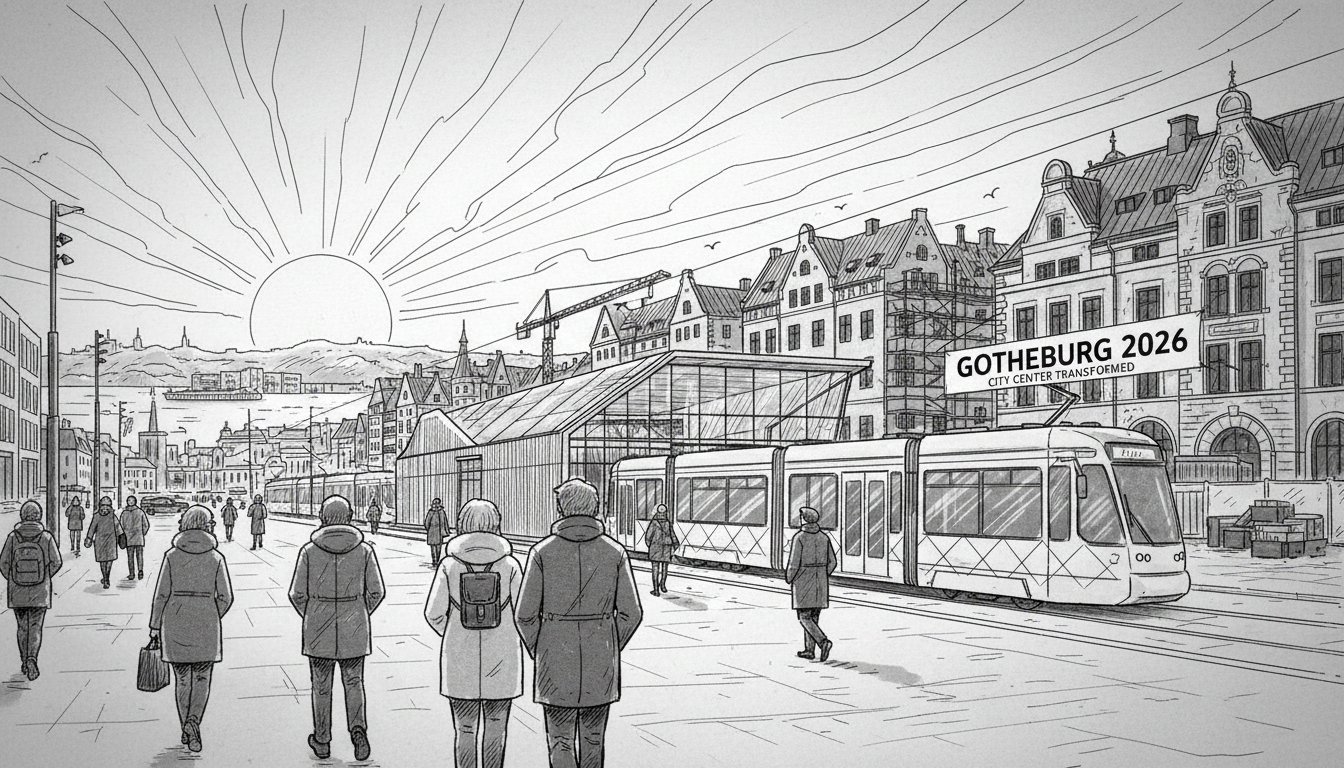
Gothenburg construction projects are set to dramatically reshape the city's core by 2026. As cranes dot the skyline from Frihamnen to Centralstationen, residents are watching their familiar streets evolve. This isn't just about new buildings. It's about answering a fundamental question: how does a historic port city grow while keeping its soul? I spent a week walking the construction fences, talking to planners, architects, and people who call these neighborhoods home. The story I found is one of ambition, tension, and a city carefully stitching its future into its past.
The View from the Scaffolding
On a crisp morning, I meet Erik Lundström, a project manager, near the rising skeleton of what will be a mixed-use complex on Drottningtorget. He gestures towards the old Central Station. 'We are building for the next hundred years here,' he says, his breath visible in the cold air. 'The challenge is respect. Respect for the brick and granite around us, and respect for the people who will live with these buildings long after we're gone.' This sentiment echoes across multiple sites. The developments slated for 2026 completion aren't isolated towers. They are pieces of a larger urban puzzle—adding housing, offices, and cultural venues to a downtown facing growing demand.
This growth is driven by numbers. Gothenburg's population continues to climb, increasing pressure on housing and public services. The construction sector itself is a major economic engine for western Sweden. But the real story isn't in the statistics. It's in the details of daily life that are changing. The shortcut to the tram that's now a detour. The beloved, shabby cafe making way for a sleek lobby. The promise of a new square where a parking lot once stood.
Balancing Brick with Glass
'Gothenburg has always been a practical city,' says Dr. Lena Forsberg, an urban historian I consult for perspective. 'It was built on trade, shipbuilding, and industry. That legacy is in its DNA—solid, unpretentious, functional.' She points out that the current wave of development tests this identity. 'The risk is becoming a generic, modern city. The opportunity is to enhance accessibility and sustainability while strengthening local character.' The 2026 projects actively grapple with this. Many incorporate the city's signature red brick or industrial-inspired elements. They are also designed with strict sustainability targets, focusing on energy efficiency and green spaces.
Take the ongoing development in the Frihamnen port area, part of the larger RiverCity vision. Once a closed-off industrial zone, it's being transformed into a new district. By 2026, new residential blocks and parks should be taking shape here, literally turning the city's face back towards the water. It's a profound shift. For centuries, the docks were purely for work. Now, they are becoming places to live and play. This requires new infrastructure, too. Bus routes are being adjusted, and cycling networks expanded to connect these new areas to the old city center.
The Neighborhoods in Transition
To understand the human impact, I visit Masthugget, a hillside neighborhood with postcard views of the harbor. At a corner bakery, regulars discuss the changes over coffee. 'My worry is that it becomes too polished,' says Katarina, a lifelong resident. 'We need homes, yes. But we also need places that aren't expensive. Where young artists can have a studio, or someone can open a small, weird bookshop.' Her friend Anders is more optimistic. 'The city was getting stale in some parts. This brings energy, new people. But they have to get the mix right.'
This 'mix' is the central planning philosophy. The goal is to avoid creating sterile business districts that empty at night or residential areas without life. The projects aiming for 2026 completion typically blend ground-floor retail, restaurants, or public services with apartments and offices above. The idea is constant activity. It's a lesson learned from older, organic neighborhoods and now applied with modern design. Yet, the proof will be in the living. Will these spaces feel genuinely integrated, or will they feel managed and corporate?
The Expert Perspective: More Than Concrete
I put this question to Mikael Svensson, an independent urban planner. 'The hardware—the buildings—is only half the equation,' he explains. 'The software is what happens between them. The benches, the lighting, the public art, the events. A building finished in 2026 might not feel truly part of the city until 2030, when the trees have grown, and the community has claimed the space.' He emphasizes that the most successful projects are those that leave some elements unfinished—flexibility for future generations to adapt and imprint their own needs.
Svensson also highlights the invisible upgrades. 'Everyone sees the new facades, but the real success depends on what they don't see as easily. The district heating networks, the fiber-optic cables, the stormwater management systems being built now.' These investments in 'urban tech' are crucial for long-term sustainability and resilience, especially as climate change brings more intense weather to Sweden's west coast. A beautiful building that overheats in summer or floods during heavy rains is a failure, no matter how photogenic it is.
Looking Ahead to 2027 and Beyond
Walking back along the Göta älv river as the sun sets, the scale of change becomes clear. The skyline I remember from a decade ago is already gone, replaced by a new one under construction. By the end of 2026, another layer will be complete. The cranes will move to new sites. The focus will shift from construction to habitation. Will the new residents feel connected to Gothenburg's maritime history? Will the public spaces be lively and inclusive?
The projects finishing in 2026 are not an endpoint. They are a major milestone in a transformation that will continue for decades. The true measure of their success won't be in architectural awards or property prices alone. It will be in the sound of children playing in a new waterfront park. It will be in the vitality of a street that once was quiet after dark. Gothenburg is building its future, one brick, one pane of glass, one square meter at a time. The city has always been a work in progress. That, perhaps, is the most Swedish tradition of all.