
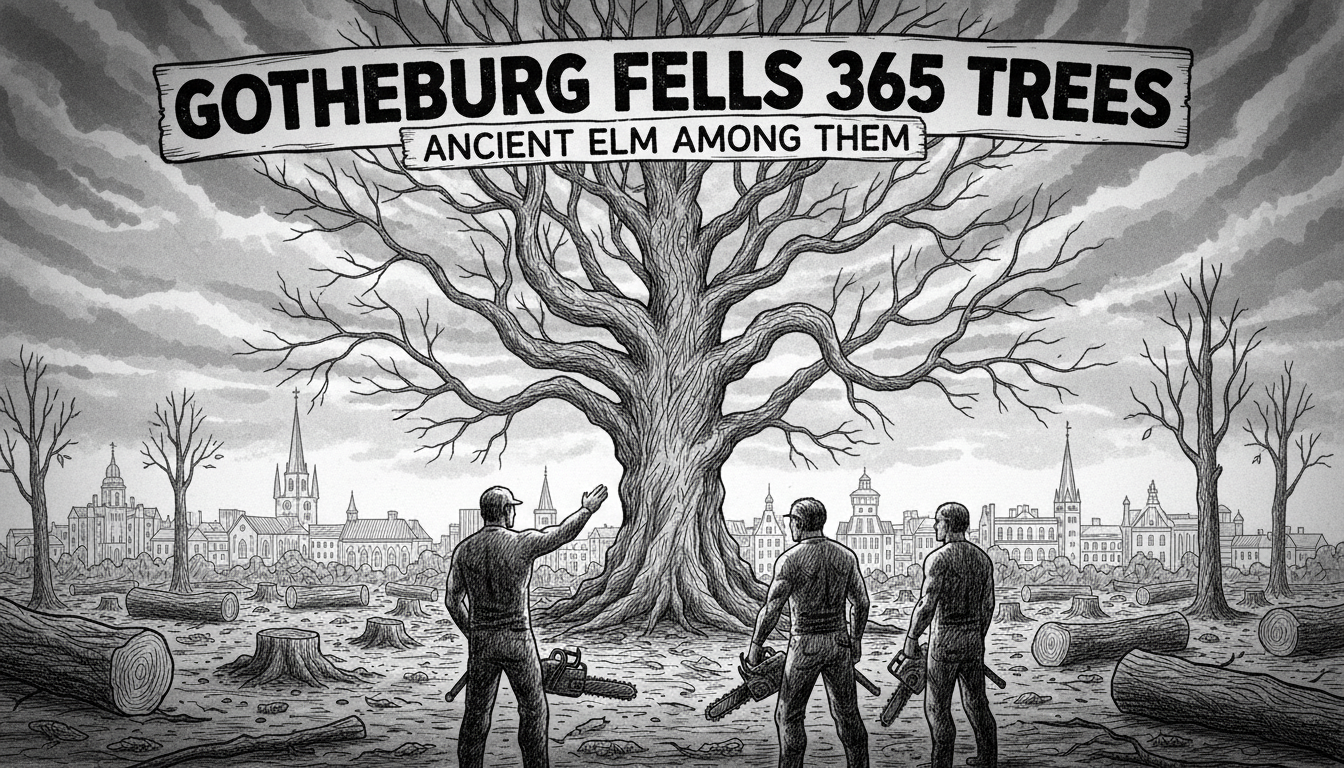
Sweden's second city, Gothenburg, will cut down 365 trees this year following its annual urban forest inventory. The felling list includes a centuries-old elm near the iconic Näckrosdammen, a decision city officials describe as necessary but deeply regrettable. This large-scale removal highlights the persistent challenges facing Sweden's urban green spaces.
Jesper Krantz, an official with the City of Gothenburg's Environmental Management Department, confirmed the decision. "It is, of course, very sad," Krantz said regarding the ancient tree's fate. The inventory, a systematic survey of municipal trees, identified these specimens as posing a safety risk or being terminally ill. Dutch elm disease, a fungal pathogen spread by bark beetles, is a primary culprit for the elm population.
The Invisible Threat to Urban Canopies
Dutch elm disease has ravaged European and North American elms for over a century. The fungus blocks the tree's vascular system, causing it to wilt and die, often within a single season. Gothenburg, with its many historic elms, has fought a protracted battle against the disease for decades. Regular inventories are the frontline defense, allowing arborists to identify infected trees before they become hazardous or spread the pathogen further.
"The removal of a centuries-old tree is never taken lightly," explained a senior arborist familiar with Gothenburg's forestry strategy. "These trees are living history. But when they are infected with Dutch elm disease, they become a source of infection for every other elm in the vicinity. The responsible action is removal and safe disposal of the wood." The city follows strict protocols to prevent the disease's spread during felling operations.
Ecological and Social Cost of Urban Forestry
The loss of 365 trees, particularly large, mature specimens, has tangible consequences. Mature trees are superior at carbon sequestration, cooling urban heat islands, managing stormwater runoff, and providing habitat for birds and insects. Their aesthetic and psychological value to city residents is also significant, contributing to well-being and community identity.
"An ancient tree near a beloved pond like Näckrosdammen isn't just a biological entity; it's a landmark," said a landscape architect specializing in urban planning. "It holds collective memory. Its removal creates a visceral sense of loss that goes beyond ecology." The city acknowledges this, with Krantz's statement reflecting an administrative melancholy. Compensatory planting is a standard policy, but saplings require decades to match the environmental services of a centuries-old elm.
A National Challenge Beyond Gothenburg
Gothenburg's situation is not unique in Sweden. Municipalities across the country grapple with balancing preservation, public safety, and ecological health. Urban trees face pressures from climate change, new pests, soil compaction from construction, and aging infrastructure. The Swedish government's environmental objectives emphasize biodiversity and green urban spaces, but the management burden falls heavily on local authorities.
National policies provide a framework for sustainable urban development, yet day-to-day decisions like tree felling are local mandates. This creates a patchwork of management intensities. Cities like Stockholm, Malmö, and Gothenburg often have more robust forestry departments than smaller towns. The expertise required to diagnose tree health and plan urban forests is a specialized, and costly, field.
The Protocol of Preservation and Removal
The process leading to a felling decision is methodical. Gothenburg's annual inventory involves visual inspections and, when needed, more advanced diagnostic tools. Trees are assessed for structural integrity, signs of disease, and their location relative to pedestrians, traffic, and buildings. A tree deemed dangerous or fatally diseased is marked for removal.
Public notification typically follows, though emergency removals can happen swiftly. The city's environmental management department then plans the logistics, often timing work for periods of low public activity. Wood from felled trees is frequently repurposed as mulch, biofuel, or, in some cases, lumber for municipal projects, adhering to circular economy principles.
Looking Ahead: The Future of Sweden's City Trees
The felling of 365 trees in Gothenburg prompts a critical question about the future composition of Sweden's urban forests. Experts increasingly advocate for diversification. "Reliance on a single species, like elms were in the past, is a recipe for disaster," noted a botanist from the Swedish University of Agricultural Sciences. "Modern urban forestry prioritizes a mix of native species with proven resilience to climate stressors and pests."
This means the iconic avenues of the future may not be uniform. They might instead feature a mosaic of oak, lime, hornbeam, and disease-resistant hybrid elms. The goal is to create a resilient canopy that can withstand specific threats without wholesale collapse. This strategic shift is slowly taking root in municipal planning documents across Sweden.
A Necessary Loss in a Long-Term Strategy
The removal of the ancient elm at Näckrosdammen is a poignant symbol of this transition. It represents the loss of an old, vulnerable monoculture to safeguard the broader urban forest. While new trees will be planted, the cityscape will change. The shadow cast by the old elm will be absent, and the character of the pond's edge will alter.
This story, therefore, is more than a local environmental update. It is a microcosm of a global urban challenge: how to steward natural heritage in an artificial environment under increasing stress. Gothenburg's decision, while sad, follows a scientific and safety-led protocol. The true test will be how effectively the city learns from this loss and builds a more diverse and resilient green legacy for the next century. Can Sweden's cities cultivate urban forests that are not only beautiful but also biologically robust enough to survive the coming challenges? The answer will shape the very feel of Swedish urban life for generations.