
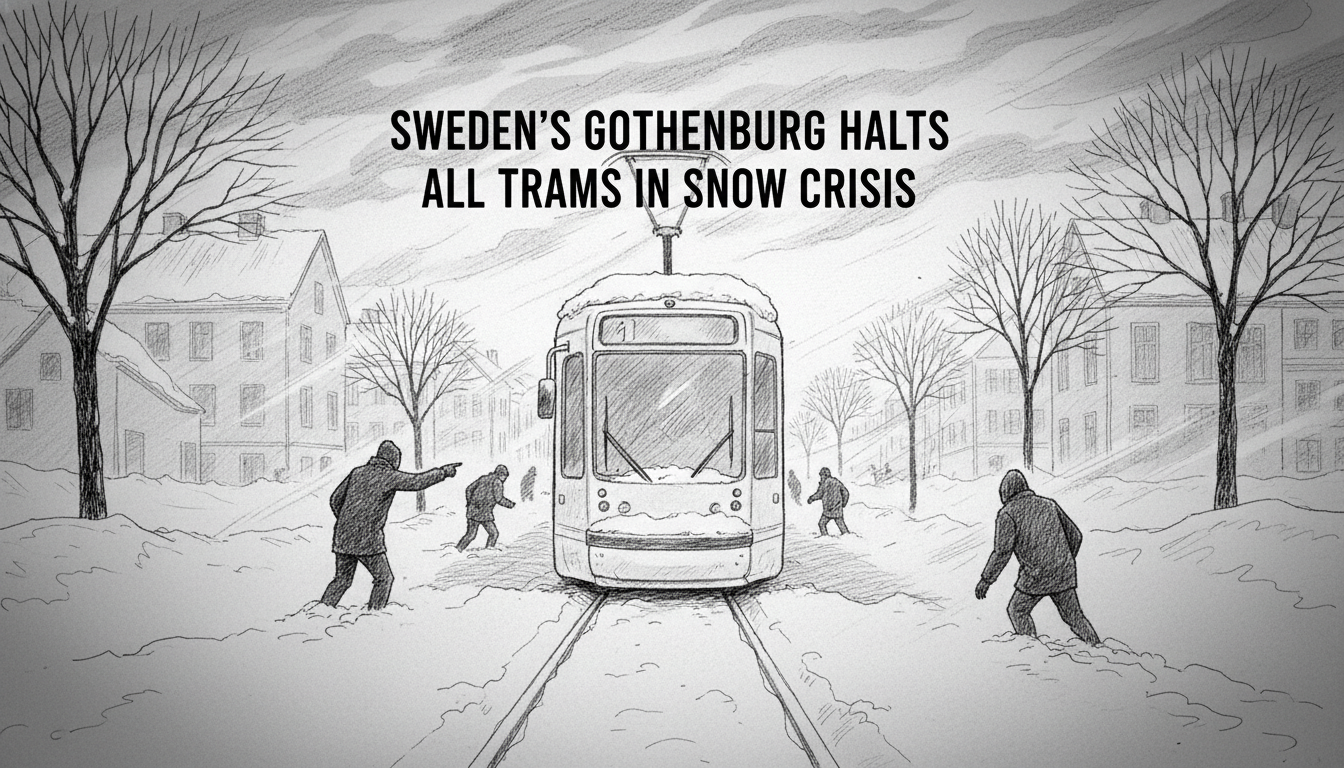
Sweden's second-largest city, Gothenburg, faces a complete standstill of its critical tram network after heavy snowfall. Public transport authority Västtrafik suspended all tram and most bus services at 9:00 AM Wednesday, citing extreme danger to road users. The decision followed an orange weather warning from the Swedish Meteorological and Hydrological Institute (SMHI). “It is simply too dangerous to drive. This is a difficult situation right now,” said Västtrafik press spokesperson Frida Antonsson.
The unprecedented shutdown of Scandinavia's largest tram network leaves hundreds of thousands of residents stranded. Gothenburg's public transport system, a backbone of the city's mobility, has effectively ground to a halt. Authorities identified a specific hazard: trams were plowing snow into dangerous drifts that threatened other vehicles and pedestrians. “We hope the municipality can remove the snow soon so we can restart traffic, but currently we have no forecast for when operations can resume,” Antonsson added. This crisis highlights the vulnerability of modern urban infrastructure to severe winter weather, even in a nation renowned for its winter preparedness.
A City Paralyzed by Snow
The suspension of all tram services represents a severe disruption for Gothenburg's 600,000 residents. The city's tram network, with its 12 lines and over 160 stops, is not just a transport option but the central circulatory system for commuters, students, and shoppers. Without it, the city's economic and social functions face immediate strain. Major employers, including the Volvo Group headquarters and the University of Gothenburg, must contend with widespread absenteeism. The decision to also cancel most bus services compounds the paralysis, leaving private cars on treacherous roads as the only alternative for many.
This incident is not merely a weather-related delay but a full-scale failure of a key public service. The orange warning from SMHI indicated a high probability of substantial snowfall, yet the system proved unable to cope. The situation raises urgent questions about winter maintenance planning and investment in resilient infrastructure. For a city that experiences winter annually, the complete collapse of its primary transport mode points to a significant planning deficit. The economic cost of a day-long citywide shutdown runs into hundreds of millions of Swedish kronor, affecting retail, hospitality, and industrial productivity.
The Technical and Logistical Breakdown
The core problem, as explained by Västtrafik, is a vicious cycle created by the trams themselves. As they attempt to run, their design and weight push snow along the tracks, compacting it into high, hard ridges or ‘snow walls’ on adjacent roadways. These drifts become impassable for cars, emergency vehicles, and cyclists. They also create a major safety risk for pedestrians stepping off curbs. Continuing service would therefore externalize danger onto the entire road network, an unacceptable trade-off for the transport authority.
This specific failure mode suggests a coordination gap between Västtrafik, which operates the trams, and the Gothenburg Municipality, which is responsible for clearing snow from streets and tram tracks. Effective winter operation requires synchronized plowing crews working ahead of and alongside tram schedules. The statement from Västtrafik—“We hope the municipality can remove the snow soon”—publicly underscores this interdependency. It indicates that the pre-planned protocols for heavy snow have been overwhelmed, forcing a full retreat until manual clearance can catch up. The lack of any restart prognosis reveals deep uncertainty about how long this recovery will take.
Historical Context and Systemic Vulnerability
Gothenburg has faced similar, though less comprehensive, disruptions in past winters. Events in 2010, 2013, and 2018 saw major tram delays and partial suspensions. However, a complete, pre-emptive shutdown of the entire network is a rare and drastic measure. It indicates that lessons from previous crises may not have been fully integrated into operational planning. Experts often note that while Swedish cities are well-equipped for cold weather, intense snowfall in a short period presents a unique challenge, especially for rail-bound transport.
The city's heavy reliance on trams, while a model of sustainable urban planning in normal times, becomes a liability during extreme events. Unlike buses, which can sometimes be rerouted, trams are confined to their fixed tracks. If those tracks are blocked, the entire line fails. This incident will likely fuel debates about the need for more diversified and resilient transport options, including the robustness of bus services and the infrastructure for winter tire use. The crisis also tests the limits of remote work policies adopted post-pandemic, as many essential workers cannot perform their duties from home.
Political and Policy Repercussions
The transport collapse places immediate pressure on local and regional politicians. Västtrafik is owned by the Västra Götaland Regional Council, while street maintenance falls under the Gothenburg City Council. The public will demand answers regarding preparedness and coordination. Opposition politicians are likely to question whether budget constraints or prioritization errors in maintenance contracts contributed to the severity of the shutdown. There will be scrutiny of whether investments in specialized snow-clearing equipment for the tram network have been sufficient.
This event serves as a real-time stress test for Sweden's broader climate adaptation strategy. While much focus is on long-term warming, intense winter storms remain a key threat. The Swedish government's national infrastructure planning emphasizes reliability and climate resilience. A failure of this magnitude in a major urban center will resonate in policy discussions in Stockholm, potentially influencing future state funding allocations for municipal climate adaptation. It demonstrates that resilience requires not just heavy machinery, but flawless coordination between different agencies and private contractors.
The Human and Economic Toll
Beyond the statistics, the shutdown creates countless individual struggles. Hospital staff cannot reach workplaces, students miss critical exams, and elderly residents are confined to their homes. Small businesses lose a day's revenue as customers stay away. The disruption exposes socioeconomic divides: those with flexible jobs and cars manage better, while shift workers and those reliant on public transport bear the brunt. The silence on the normally bustling avenues like Kungsportsavenyn and Avenyn is a stark indicator of a city in forced pause.
The incident also damages confidence in public transport. Regular users may reconsider their dependence on a system that can fail entirely, potentially leading to increased car purchases and usage, contrary to long-term sustainability goals. Restoring that confidence will require transparent communication from Västtrafik and clear demonstrations of improved winter readiness. The authority must explain not just why the shutdown was necessary, but what concrete steps will prevent a total shutdown under similar conditions in the future.
Looking Ahead: Recovery and Resilience
As municipal snowplows work to clear hundreds of kilometers of tracks and roads, the focus shifts to recovery. The restart of the tram network will be gradual, likely beginning with priority lines serving hospitals and major residential areas. Bus services will return as roads become passable. However, the aftermath of the storm will linger for days in the form of schedule adjustments and crowded vehicles.
The true test for Gothenburg's authorities is not managing this single storm, but implementing changes before the next one. This requires honest evaluation, potential investment in more robust clearing technology, and revised inter-agency agreements. Will this event be a catalyst for building a truly winter-proof transport system, or merely remembered as another harsh Swedish winter day? The answer will determine how Gothenburg moves forward, literally and figuratively, in the years to come. For now, the city waits, its familiar green and white trams silent, as the snow continues to fall.