
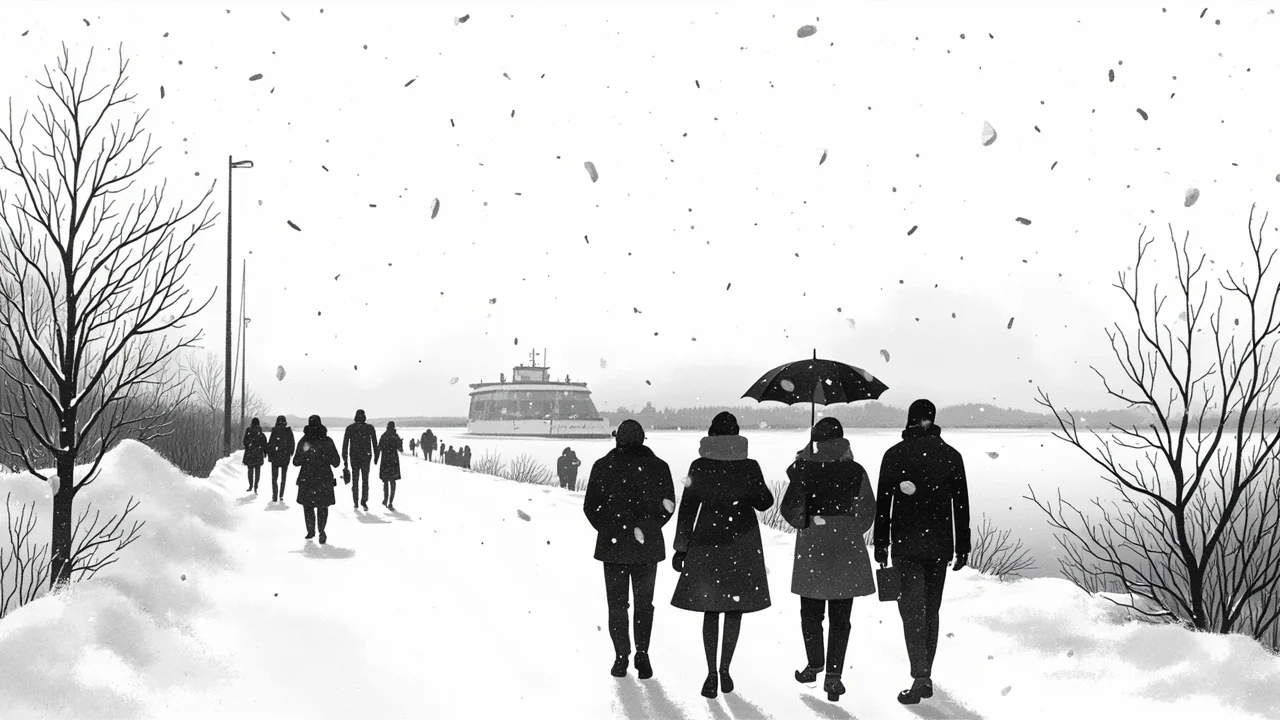
Sweden's Meteorological and Hydrological Institute (SMHI) has issued a yellow warning for Gotland, forecasting heavy snow and strong winds that have already disrupted travel to the mainland. The warning covers the entire island and is valid until Sunday at 8 PM, with predictions of 5 to 15 centimeters of snow driven by fresh northerly winds. Early ferry departures between Visby and Nynäshamn have been canceled in both directions due to the harsh weather, with afternoon departures postponed.
Residents are preparing for a classic Gotland winter lockdown. The island, often bathed in summer sun, transforms into a windswept outpost when storms roll in from the Baltic. This weather event tests the resilience of island life, where a canceled ferry means more than just a delayed trip. It means postponed deliveries, missed appointments, and a tangible sense of isolation. The Swedish Transport Administration has issued a stark advisory, urging people to avoid road travel unless absolutely necessary.
A Sudden Shift for Sweden's Holiday Isle
For many, Gotland symbolizes Swedish summer. Its medieval capital, Visby, buzzes with tourists, and its rocky beaches are packed in July. But winter tells a different story. The population of 60,000 tightens its circle. Local shops in Visby's cobblestone lanes see a run on essentials before a storm. "You learn to read the sky here," says Erik Lundström, a lifelong resident of Burgsviken on the west coast. "When the wind turns north and the gulls settle, you know it's time to check the pantry and the firewood." This storm, arriving with little buildup, catches some off guard, interrupting the slow, dark calm of February.
SMHI's warning highlights "very large local variations" in snowfall. This is typical for Gotland's flat, exposed landscape. One village might see a dusting, while another, just kilometers away, gets buried. The driving force is the wind, which can whip fallen snow into near-zero visibility drifts across country roads. This makes the Transport Administration's warning particularly critical for the island's rural communities, where a stranded car can become a serious danger.
Transport Grinds to a Halt
The immediate impact is on connectivity. The canceled ferries operated by Destination Gotland are the island's primary lifeline to mainland Sweden. For freight, tourists, and residents needing to travel, this severing of the link is a major disruption. Postponed afternoon departings offer a sliver of hope, but are dependent on the storm easing. This uncertainty is part of winter life here. The decision to cancel is never taken lightly, balancing economic loss against passenger safety in the treacherous Baltic Sea crossing.
On the roads, conditions deteriorate rapidly. Main routes like Road 140 from Visby to the northern tip of the island can become treacherous corridors. The local police and rescue services typically go on heightened alert during such warnings. Their advice echoes the national agency: stay home if you can. For families, this sudden weather-induced pause becomes an unexpected 'mys' (cozy) day—a core Swedish concept of finding comfort indoors while weather rages outside. Schools may close, and remote work becomes the only option for many.
The Cultural Rhythm of Island Winters
This event is more than a weather report. It's a window into the unique societal fabric of island Sweden. Gotland's culture is shaped by its geography and climate. There's a self-reliance and community spirit that strengthens during the winter months. Neighbors check on each other. Local Facebook groups light up with offers of help and updates on which roads are passable. The storm reinforces a slower, more intentional pace of life that contrasts sharply with the mainland's constant motion.
"We have two hearts," says Karin Mårtensson, a cultural historian based in Visby. "One for summer, when we open our doors to the world, and one for winter, when we turn inward. A storm like this activates the winter heart. It's a reminder of our dependence on nature and on each other." Traditional practices, like ensuring a well-stocked 'vinterförråd' (winter pantry), still hold practical value. The local 'konditori' (bakery) does a brisk trade as people stock up on comfort food.
Analysis: Climate and Preparedness in the Baltic
While a winter storm is not unusual, its intensity and the frequency of such events are part of a broader conversation about climate change in the Baltic region. SMHI's own climate profiles indicate that while winters are warming, precipitation extremes, including heavy snowfall events, may become more pronounced. For an island like Gotland, this has long-term implications for infrastructure, agriculture, and the very tourism economy it relies on.
From a crisis management perspective, Sweden's system of color-coded weather warnings (yellow, orange, red) functions well. The yellow warning triggers specific protocols for transport agencies and municipalities. The clear, direct public messaging—"Do not go out into traffic unless you absolutely have to"—is a hallmark of Sweden's risk communication strategy. It avoids ambiguity and places responsibility on the individual, a common theme in Swedish societal norms.
However, challenges remain. An aging population in rural Gotland is more vulnerable during power outages or extended isolation. The reliability of alternative transport, like small aircraft, is also compromised by such weather. This storm tests the redundancy built into the island's systems.
Looking Ahead: Sunday and Beyond
The warning is in effect until Sunday evening. All eyes are on the sky and the forecast updates. Will the promised 15 centimeters materialize in Visby's picturesque city center? Will farmers in the north spend Monday digging out sheep? The island waits, as it has for centuries. Life adapts. Meetings become video calls. A walk to the local shop becomes the day's expedition. The storm, for all its inconvenience, also brings a dramatic beauty—the sight of snow racing horizontally across ancient limestone walls, the profound quiet of a landscape hushed by snow.
This is the duality of Swedish nature, revered and respected. It provides the stunning landscapes and the concept of 'allemansrätten' (the right of public access), but it also demands humility. On Gotland this weekend, that humility is front and center. The storm will pass. The ferries will run again. The roads will be cleared. But for now, the island hunkers down, a self-contained world in the swirling Baltic white, demonstrating the quiet resilience that defines so much of Swedish society beyond the major cities. It's a reminder that in an increasingly connected world, weather still has the final say on one of Sweden's most cherished islands.