
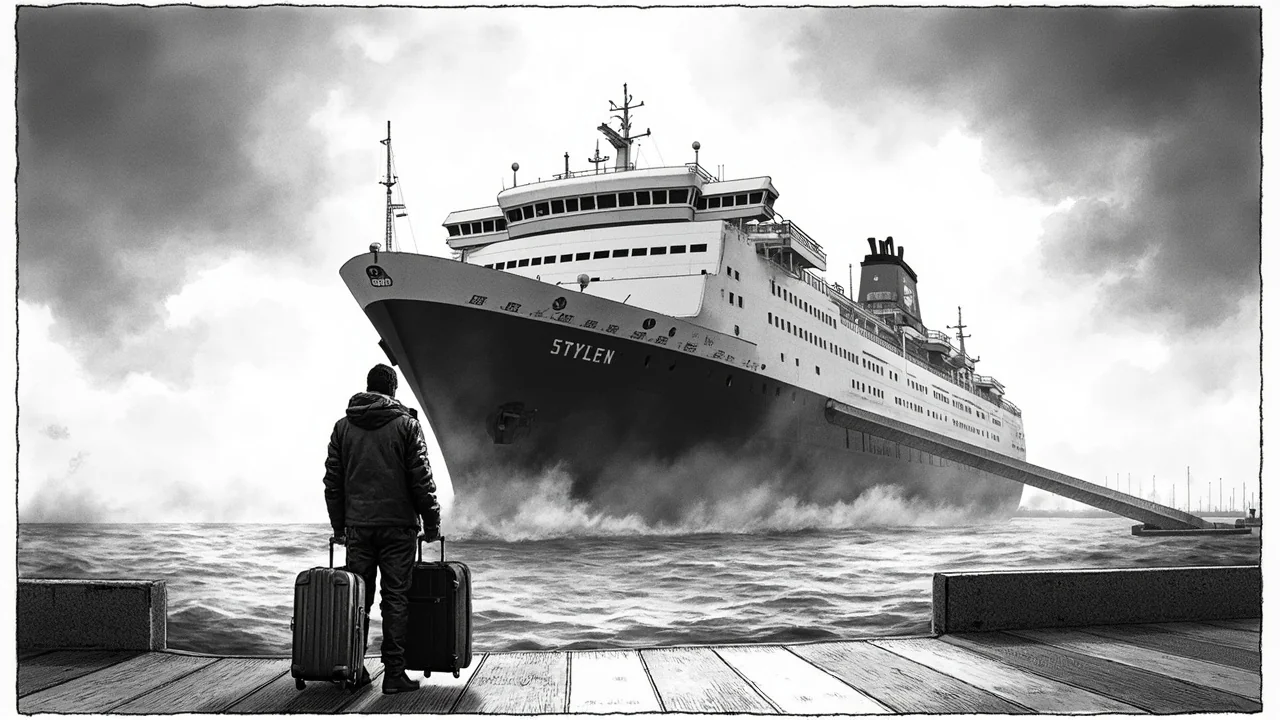
Swedish ferry services to Gotland were halted Sunday, stranding thousands as a severe weather system slammed the Baltic coast. The Swedish Transport Administration canceled all sailings between the mainland port of Nynäshamn and Visby due to gale-force winds and heavy snow, issuing a yellow warning valid until 8 PM. For an island where the ferry is a literal lifeline, the disruption cuts deep into daily life, isolating residents and halting the flow of goods and people. This isn't just a travel delay; it's a stark reminder of Gotland's vulnerability and the fierce power of a Nordic winter.
I reached Eva Karlsson, a teacher from Visby, as she checked departure boards for the tenth time. She was trying to return home after a conference in Stockholm. 'You plan your life around these ferries,' she told me, her voice tinged with familiar resignation. 'The grocery store shelves get a bit emptier, hospital appointments on the mainland are missed, and you just have to wait. It’s part of living here. We call it 'ö-leda'—island weariness.' Her experience reflects a shared reality for Gotland's 60,000 permanent residents. The island's economy and social fabric are intrinsically tied to this maritime connection.
The Anatomy of a Baltic Storm
The culprit is a potent low-pressure system churning over the Baltic Sea. The Swedish Meteorological and Hydrological Institute (SMHI) issued a dual yellow warning for the county: one for gale-force winds, or 'kuling,' along the entire coast, and another for combined heavy snowfall and wind. This combination is particularly dangerous for maritime traffic and creates treacherous road conditions. Yellow is the middle level in Sweden's three-tier warning system (yellow, orange, red), signaling conditions that could pose a risk to the public and cause significant disruption. While not the most extreme alert, it commands respect and triggers operational shutdowns for operators like Destination Gotland, the main ferry company.
These cancellations are a well-rehearsed protocol. Captain Lars Mikkelsen, a retired ferry master with over thirty years of experience on the route, explained the decision-making process. 'The threshold for canceling sailings on the Baltic is lower than many think,' he said. 'The waves might not look enormous from land, but the shallow sea here can create short, sharp waves that are incredibly stressful on a ship's hull and horrible for passengers. Safety is absolute. No one wants a repeat of the Marco Polo incident from years past.' His reference is to a 2011 event where a ferry lost power in a storm, a scenario the industry works relentlessly to avoid.
Life on Pause: The Ripple Effects
The immediate impact is visible at Nynäshamn harbor—a quiet terminal where crowds would normally bustle. But the effects ripple far beyond the empty waiting area. Gotland imports the majority of its consumer goods. While the island has contingency plans, prolonged disruptions can strain supplies. Fresh produce, pharmaceuticals, and even mail travel on those ferries. For the tourism and hospitality sector, which is vital to Gotland's summer economy but still operates in winter with conference and spa visitors, last-minute cancellations mean lost revenue and logistical headaches.
Furthermore, the island faces a healthcare dilemma. While Visby has a hospital for acute care, many specialized treatments and surgeries require transfer to mainland hospitals in Stockholm or Linköping. Scheduled patient transfers are automatically postponed during such stoppages, causing anxiety and clinical delays. 'It highlights a structural challenge,' notes sociologist Dr. Henrik Fjellström, who studies remote communities. 'Regional development policies talk about equal living conditions across Sweden. But an event like this lays bare the fundamental geographic inequality. A Stockholmer might face a delayed train. A Gotlander faces being cut off entirely.'
A Culture Forged by Weather
This vulnerability, however, has shaped a distinct cultural resilience. Swedes have a specific term for coziness in the face of harsh weather: 'mys.' On Gotland, 'mys' becomes a collective strategy. Cafés in Visby's medieval ring wall fill up with stranded travelers and locals making the best of it. Community networks activate quickly, with people offering spare rooms via social media groups like 'Gest på Gotland' (Guest on Gotland). There's a shared, unspoken understanding that weather is a force you accommodate, not fight.
This stands in contrast to the bustling, efficiency-driven mainland. The storm enforces a different rhythm. Anna Bengtsson, who runs a small hotel in Burgsvik on the southern coast, told me she spent the day calling guests due to arrive from the ferry. 'We just adjust. We offer them to rearrange or give a full refund. Then we check on our older neighbors to see if they need anything from the shop before the weather gets worse. It’s practical, and it’s just how it is.' This pragmatic solidarity is the social glue that holds island communities together during recurring disruptions.
Climate Change and an Uncertain Future
Experts are now asking a critical question: Are these disruptive weather events becoming more frequent or intense due to a changing climate? While a single storm cannot be directly attributed to climate change, the patterns are shifting. SMHI's own climate models project that for the Baltic Sea region, winter precipitation is expected to increase, and while winter storms may not become more numerous, their intensity could grow. This poses a long-term strategic challenge for island infrastructure.
'We need to look at redundancy and resilience,' says infrastructure analyst Mikael Johansson. 'The ferry model has served Gotland well for decades, but discussions about a fixed link—a tunnel or bridge—always resurface after major disruptions. The economics are daunting, but the conversation is evolving alongside climate projections.' For now, the dependency on this maritime highway is total. The conversation also turns to energy resilience, as such storms can threaten power supplies, and food security planning at a municipal level.
Navigating the Aftermath
As the yellow warning expired at 8 PM Sunday, the process of recovery began. Crews assessed the vessels, and freight queued on the docks was prioritized. Passenger service typically resumes cautiously, often starting with the larger, more stable vessels. The backlog can take a full day to clear. For travelers, the advice remains anchored in the Swedish principle of 'förebyggande'—prevention. Always check SMHI warnings and Transport Administration alerts before traveling to island regions in winter. Have flexible bookings and travel insurance. For residents, it’s a reminder to keep the pantry reasonably stocked.
The storm will pass. The ferries will run again. But each 'gul varning' (yellow warning) is a stress test on the system that connects Sweden's largest island to the mainland. It reveals the delicate balance between modern mobility and ancient geography. In the cozy warmth of a Visby café, waiting for the all-clear, the community endures. They embody a Swedish acceptance of nature's power, a trait as integral to the national character as the famous right of public access, 'Allemansrätten.' The weather, in the end, is the one schedule even the most efficient society cannot control.