
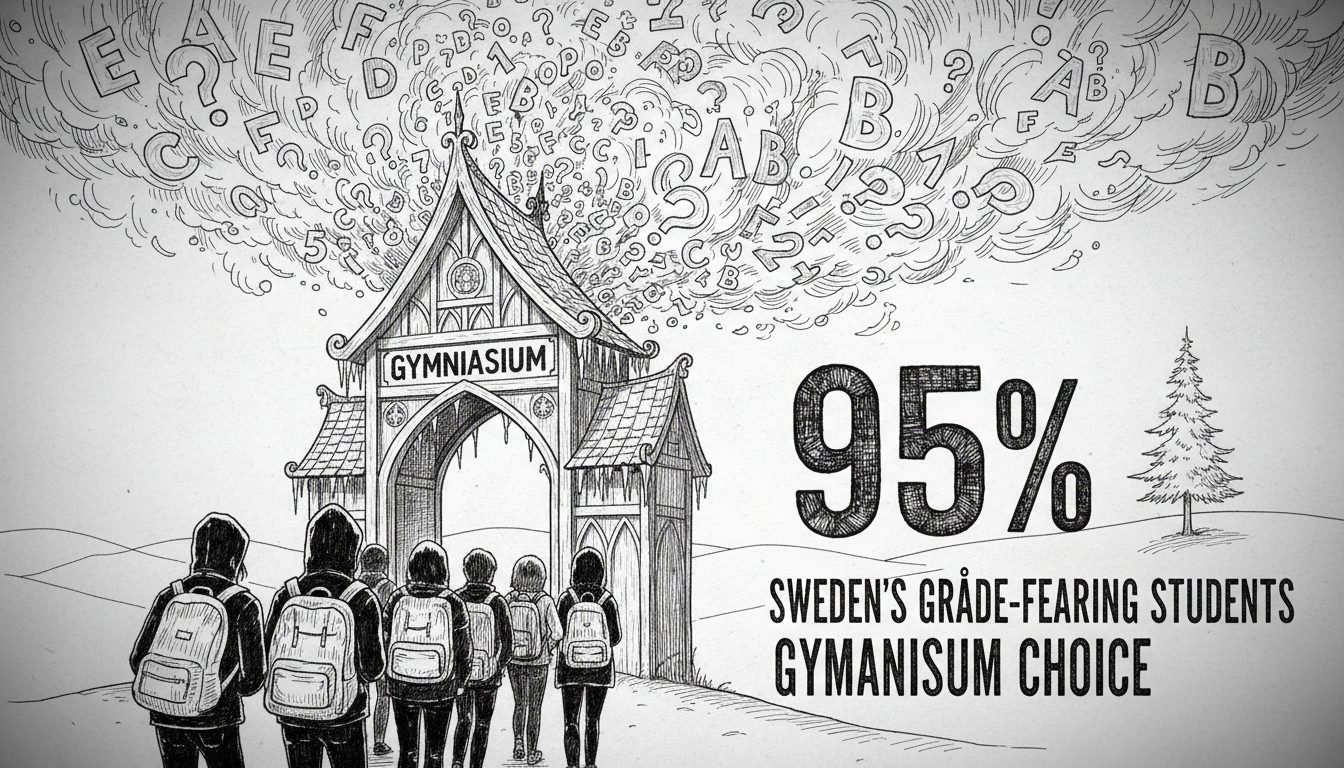
Sweden's upper secondary school application process is creating a strategic dilemma for thousands of 15-year-olds. As the January application deadline approaches, a growing trend sees students avoiding demanding academic programs like Natural Science, fearing lower grades will hurt future university chances. This phenomenon, termed 'tactic-choosing' or 'taktikval', is reshaping educational pathways across the nation. At Hökarängsskolan in southern Stockholm, however, guidance counselors are pushing back against this strategic pessimism. "You're only fooling yourself then," says 15-year-old student Ivar Alfredsson, capturing a counter-current to the national anxiety.
The Counselor's Frontline Battle
Marta Stachowska Rowicka, a study and career guidance counselor at Hökarängsskolan, is in the midst of her annual marathon. She has spent recent weeks conducting individual meetings with all 90 of the school's ninth-grade students. Her office becomes a confessional for teenage anxieties about the future. The centralized application system, where students rank their preferred gymnasium programs, turns abstract fears into concrete choices. Stachowska Rowicka's role is to navigate students away from choices based solely on perceived grading leniency. "The core of our work is to connect a student's genuine interest with a sustainable educational path," she explains, emphasizing the long-term risks of a mismatch. Her conversations focus on aptitude and passion, not just the GPA algorithm.
A System Under Pressure
Sweden's gymnasium system, attended by approximately 95% of compulsory school graduates, sits at a critical junction. It offers both university-preparatory programs (högskoleförberedande program) and vocational tracks (yrkesprogram). Reforms to grading scales and university admission criteria, which heavily prioritize final grades, have intensified competition. The Natural Science (Naturvetenskapsprogrammet) and Technology programs, once premier routes for aspiring engineers and scientists, are now seen by some as grade liabilities. Meanwhile, the Social Science program (Samhällsvetenskapsprogrammet) remains perennially popular, partly due to perceptions of a more forgiving grade distribution. This creates a distortion in the educational pipeline, potentially steering students away from STEM fields not due to lack of ability, but due to strategic calculation.
The Stockholm Perspective: Beyond the Tactic
In the halls of Hökarängsskolan, the national anxiety meets localized resilience. The school's ethos, as articulated by students like Ivar Alfredsson, challenges the 'taktikval' narrative. "It destroys the whole point if you choose something just because you think you'll get an A," Alfredsson states, arguing for integrity in one's educational journey. This perspective highlights a crucial divide: between viewing upper secondary school as a mere stepping stone with optimized metrics, and seeing it as a formative period of intellectual exploration. Stockholm's competitive school landscape, with its specialized gymnasiums and high aspirations, often amplifies grade pressure. Yet, within individual schools, counselors work to recalibrate student focus from short-term grade maximization to long-term personal and professional fulfillment.
Expert Analysis: The Long-Term Cost of Short-Term Strategy
Educational researchers are sounding the alarm about the downstream effects of tactic-choosing. "When students select a program based on anticipated grades rather than interest, we see higher rates of disengagement, poorer performance, and ultimately, program dropout," notes one Stockholm-based education policy analyst. The analyst points out that the Swedish higher education system, which relies almost exclusively on gymnasium grades for admission, inadvertently incentivizes this behavior. The fear is not just individual student dissatisfaction, but a broader societal impact: a shortage of qualified applicants for university programs in science, technology, and engineering because talented students were advised away from the rigorous preparatory paths in gymnasium. This creates a strategic deficit for Sweden's knowledge-based economy.
Navigating the Centralized Application Maze
The process itself adds a layer of stress. Students submit their ranked choices through a national digital platform, with admission determined by their compulsory school grades and, for oversubscribed programs, a lottery number. This high-stakes, single-point decision makes the counsel of professionals like Stachowska Rowicka invaluable. She helps students interpret data on program entry requirements and historical grade statistics, not to facilitate tactical avoidance, but to inform a balanced decision. The goal is a first-choice placement that aligns with a student's authentic academic profile, reducing the likelihood of demotivating placement in a lower-choice, ill-suited program.
The Road Ahead for Swedish Education
The tension between grade optimization and authentic choice presents a policy challenge for Swedish authorities. While the gymnasium system successfully ensures near-universal upper secondary attendance, its linkage to university admissions may be undermining its educational purpose. Potential solutions discussed in policy circles include supplementing grade-based admissions with other criteria, such as standardized tests or personal statements, to dilute the overwhelming power of the GPA. Another focus is strengthening vocational programs to make them equally prestigious and viable long-term career paths, reducing the funnel effect into university-prep tracks. The work of frontline counselors remains the most immediate intervention, guiding each cohort through a system that is often perceived as a game to be played rather than an opportunity to be seized.
As the mid-January application deadline looms, the choices made by 15-year-olds across Sweden will shape their immediate futures and hint at the nation's longer-term competencies. The debate between 'taktikval' and genuine interest, between playing the system and engaging with it, is more than a teenage dilemma. It is a reflection of how an entire society designs and values the bridge from childhood education to adult contribution. The final question, echoing in guidance offices from Stockholm to Malmö, is whether the system will adapt to foster talent, or continue to reward strategy.