
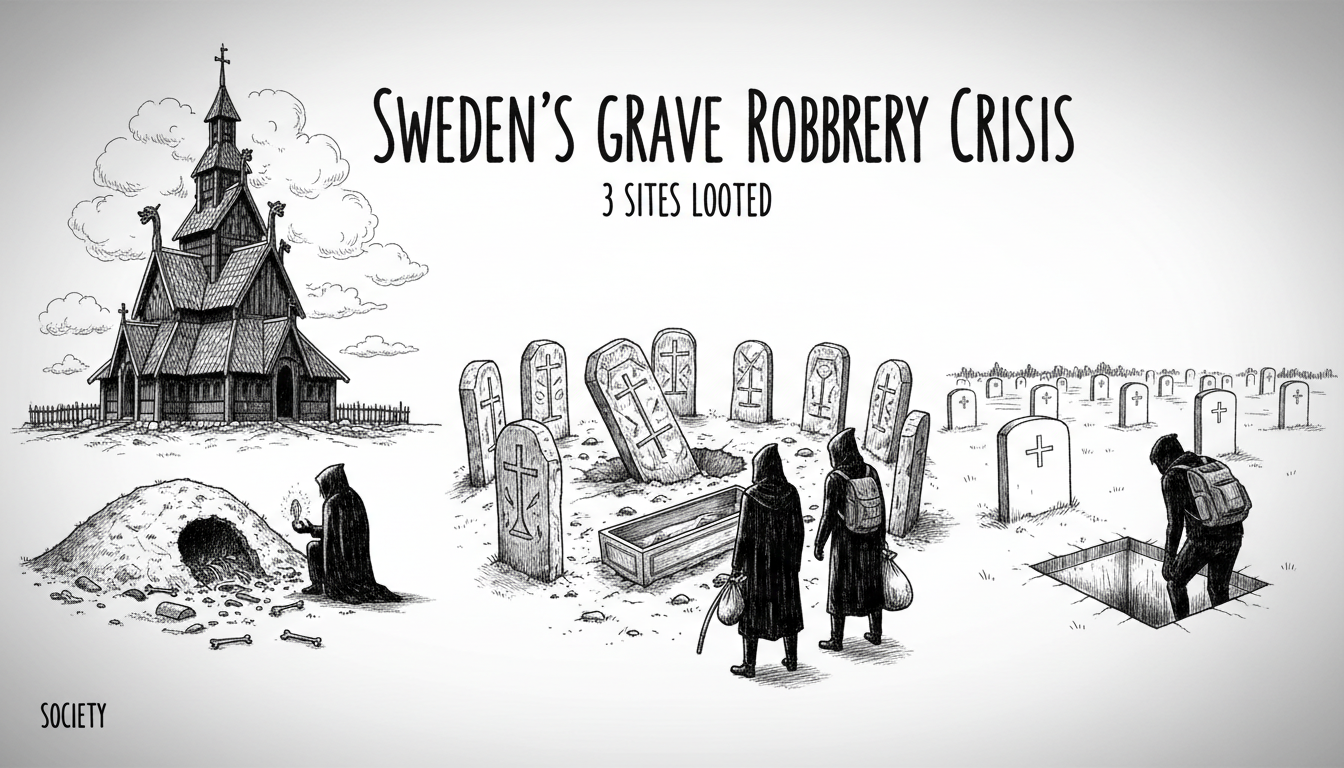
Sweden's ancient burial grounds are being silently plundered. A new suspected heritage crime has been discovered in the historic town of Sigtuna. About thirty small, precise holes have been dug into the ground at a protected archaeological site. The method is discreet and destructive. Someone digs a hole no wider than a spade's blade, removes what they find, and carefully replaces the turf. To the casual observer, the damage is almost invisible. But to archaeologists, it is a devastating attack on the nation's collective memory. "It is a threat to our cultural heritage," says Nina Eklöf, head of Västerås Museum, who reported the first looting. Her team has now identified three similar cases in the Mälardalen region in a short period. These are not random acts. They are calculated thefts, where individuals use metal detectors to scan for valuables before digging. The targeted sites are ancient monuments and grave fields, silent witnesses to Sweden's Viking Age and early medieval past. Their violation erases irreplaceable chapters of history.
A Silent Crime in Sacred Ground
The pattern is chillingly consistent. The looters operate with a stealth that suggests experience. They target known archaeological sites, often in rural or wooded areas around Lake Mälaren. Using metal detectors, they locate metallic objects buried for centuries. Then, with surgical precision, they extract them. The replaced turf is a deliberate attempt to hide the crime, potentially for weeks or months. This makes it incredibly difficult for authorities to catch perpetrators in the act. For archaeologists like Nina Eklöf, the discovery is a gut punch. "We have three identical cases in a short time where we suspect someone is scanning heritage sites with metal detectors and then digging up what they find," she explains. The Mälardalen valley is the cradle of Swedish state formation. Every looted artifact is a stolen piece of that story. The objects themselves—a brooch, a coin, a weapon—have monetary value to collectors. But their true worth lies in their context: their position in the soil, their relation to other finds, and what they reveal about the people buried there. Once removed, that knowledge is lost forever.
The Heart of Swedish History Under Siege
The choice of Sigtuna is particularly symbolic. Founded around 980 AD, Sigtuna is one of Sweden's oldest towns. It was a key political and commercial center during the Viking Age's twilight and the dawn of Christianity. Its surroundings are littered with grave fields and settlement sites from these transformative centuries. Looting here is like tearing pages from a foundational history book. Swedish law strongly protects these ancient monuments. The Heritage Conservation Act makes it illegal to excavate, alter, or remove artifacts from protected sites without permission. Metal detecting is heavily regulated. You need consent from the landowner and, crucially, a permit from the county administrative board if your search could affect an ancient monument. The penalties for breaking these laws can include hefty fines and even imprisonment. Yet, the crimes continue. This suggests the black market for Nordic antiquities is active. It also points to a potential lack of surveillance and resources for protecting Sweden's vast, open-air cultural heritage. There are thousands of registered ancient sites around Mälaren alone, making them impossible to guard constantly.
More Than Just Stolen Objects
To understand the impact, you must talk to the experts. Johan Runer, an archaeologist with the Stockholm County Museum, explains the true cost. "An object in a museum case tells one story," he says. "That same object, found in situ with scientific documentation, tells a hundred. We can learn about trade routes, craftsmanship, social status, burial rituals, and even dating. When a looter takes it, they take all those potential stories too." He describes a recent case where a plundered site revealed disturbed human remains. This adds a profound ethical dimension to the crime. These are not just digging holes. They are desecrating final resting places. The motivation is almost always financial. Online marketplaces and shady collector networks can turn a Viking-age ring or a medieval coin into quick cash. The anonymity of the internet has made this illicit trade easier. For heritage professionals, combating this requires a multi-pronged approach: public education, sharper law enforcement, and international cooperation to track trafficked items.
Protecting a Fragile Legacy
So, what is being done? Museums and county administrative boards are the first line of defense. They rely on vigilant citizens—hikers, landowners, and local history enthusiasts—to report suspicious activity. "If you see someone with a metal detector in an area you know is an ancient site, don't confront them," advises Eklöf. "Note the details and call the police or the local museum." There are also calls for stricter regulations on metal detector sales and use, though many legitimate hobbyists responsibly collaborate with archaeologists. The key is raising awareness that these sites are a non-renewable resource. Once destroyed, they are gone for good. Some suggest employing modern technology, like remote sensors or periodic drone surveillance of known vulnerable sites. However, with limited budgets, heritage institutions often prioritize reactive measures over proactive patrols. The recent cluster of cases in Mälardalen has sounded an alarm. It shows that heritage crime is not a relic of the past but a present and persistent threat.
A Theft From Everyone
The quiet robbery of Sweden's graves is a theft from every Swede and anyone interested in human history. These sites belong to the public, held in trust for future generations. The looters are stealing from both the past and the future. They operate in the shadows, leaving behind neat holes and a void in our understanding. As the police investigate the Sigtuna case and its parallels, the cultural sector is left to assess the damage. The physical holes will eventually heal, grass growing over the scars. The historical loss, however, is permanent. Each looted artifact becomes a ghost in the archaeological record—a known unknown. The crisis in Mälardalen asks a difficult question: in a country rightfully proud of its open access to nature and history, how do we protect our most vulnerable treasures from those who see them not as heritage, but as loot? The answer will determine what stories we can still tell our grandchildren about the land beneath their feet.