
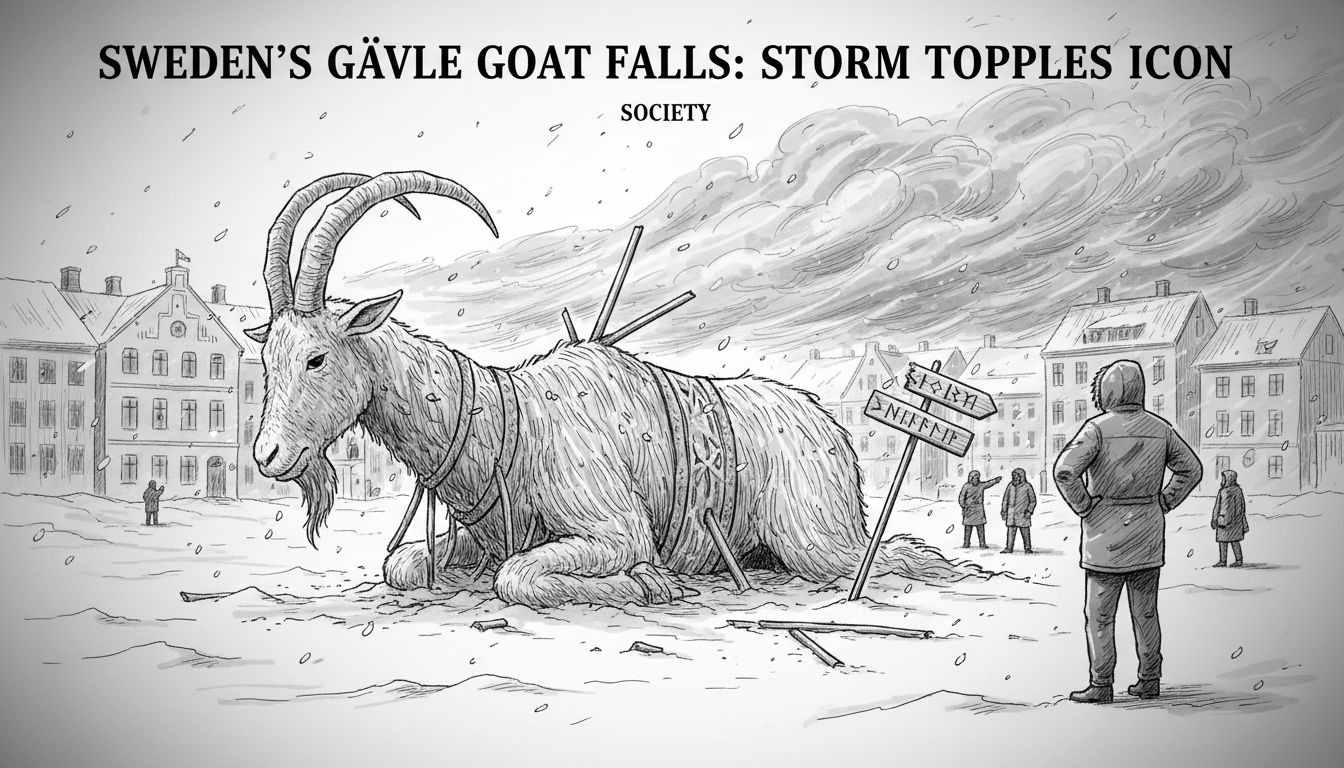
Sweden's famous Gävle Goat lies toppled on its side, a victim of Storm Johannes. The 13-meter-tall straw landmark collapsed in strong winds on Saturday afternoon, leaving its future uncertain before the Christmas season ends. 'We need to see what can be done and what we should do in that case,' municipal councilor Åsa Wiklund Lång said. Curious onlookers gathered at the fenced-off site on Slottstorget, the Castle Square, to see the fallen giant.
This is not the first dramatic chapter in the goat's long history. Since 1966, the Gävle Goat has faced fire, vandalism, and now, the weather. Its repeated destruction has become a bizarre part of Swedish Christmas culture. The goat's struggle for survival each winter captures international attention, blending tradition with unexpected spectacle.
A Goat's Frail History
The Gävle Goat tradition started as a marketing idea. In 1966, advertising consultant Stig Gävlen conceived the giant straw goat to promote local business. It was an instant hit, but its vulnerability was clear from the start. The first goat met its end on New Year's Eve 1966, burned down by vandals. This set a pattern that has defined the goat's existence for nearly six decades.
There are actually two goats erected in Gävle each year. The municipal goat, which fell this weekend, is built on Slottstorget. A second, slightly smaller goat is built by a local association of merchants. Both are constructed from roughly 3 tonnes of straw, wood, and steel, standing over 13 meters tall. The construction cost for the municipal goat is typically between 100,000 and 120,000 Swedish kronor.
'It's a symbol that contains so many contradictions,' says Lars Trulsson, a cultural historian based in Stockholm. 'It represents Christmas comfort and tradition, yet its story is one of chaos and destruction. People feel a strange ownership over it, whether to protect it or to see it fall.'
The Unlikely Celebrity
Survival is rare for the Gävle Goat. Of the municipal goats erected since 1966, only about 15 have made it intact to Christmas Day. Arson is the most common cause of death. The goat has been burned so many times that its destruction is now a global news event. People place bets on its survival online. Webcams monitor it 24/7.
Security measures have escalated over the years. The goat has been fireproofed, surrounded by fences, and placed under guard. In 2005, it was even treated with a flame-retardant solution. It survived that year, only to be burned by vandals who climbed the fence with a ladder in 2006. The goat's battle against its attackers is a yearly drama that many Swedes follow with dark humor.
'It's our own peculiar version of a Christmas cliffhanger,' says Anna Berg, a teacher from Gävle. 'Every morning in December, you check the news. Is the goat still there? It's become part of our advent routine, alongside saffron buns and Lucia processions.'
When Nature Strikes
The goat's toppling by Storm Johannes introduces a new villain: the weather. While wind has damaged the structure before, a complete collapse is less common than fire. The storm, which swept across central Sweden, provided a force that security fences could not stop. This presents a different problem for the city council. Vandalism is a crime. A storm is an act of nature.
The question now is whether to rebuild. Councilor Wiklund Lång's statement reflects the dilemma. The financial and practical effort to re-erect the 3-tonne structure is significant. With Christmas soon over, the payoff is limited. Yet, the goat is a major tourist attraction and a point of local pride. Letting it remain fallen feels like an admission of defeat.
'There's a cultural obligation,' argues Trulsson. 'The goat is no longer just a Christmas decoration. It's a protagonist in a story we all participate in. Leaving it on its side changes the narrative. The community has to decide if the story ends with a whimper from the wind, or if they fight back.'
More Than Just Straw
The Gävle Goat taps into deep Swedish traditions. The Yule Goat (Julbocken) is an ancient Scandinavian symbol. Historically, it was connected to the Norse god Thor and his goats, or to folk tales of a gift-giving creature. Modern versions are often small straw ornaments placed under the Christmas tree. Gävle's giant incarnation transformed a humble craft into a monumental public spectacle.
Its repeated destruction sparks debate about Swedish society. Some see the vandalism as harmless mischief, a rebellion against orderly tradition. Others view it as costly disrespect. The discussion plays out in newspapers and cafes every December. The goat holds up a mirror to Sweden's balance between rule-following and playful rebellion.
'The goat's fragility is key,' says Berg. 'If it were made of steel and concrete, no one would care. The fact that it's straw, that it can burn or fall, makes it human. We see its vulnerability, and we project our own stories onto it.'
What Happens Next?
As of now, the giant straw goat remains on its side within its enclosure. The municipal council has not announced a decision. They must weigh cost, effort, and symbolic value. Meanwhile, the merchant association's goat, located elsewhere in the city, reportedly still stands.
The fall of the goat closes another unpredictable chapter. Whether this year's tale ends with a rebuilding or a quiet dismantling is still being written. The incident proves that the goat's enemies are not just humans with matches. Sometimes, nature itself joins the fray.
This year, Swedes and the world watched as wind accomplished what many vandals have tried. The story of the Gävle Goat continues to evolve, reminding us that even the sturdiest-looking traditions can be fragile. It asks a question that resonates beyond a square in Gävle: how hard do we fight to keep our symbols standing, and when do we let them rest?