
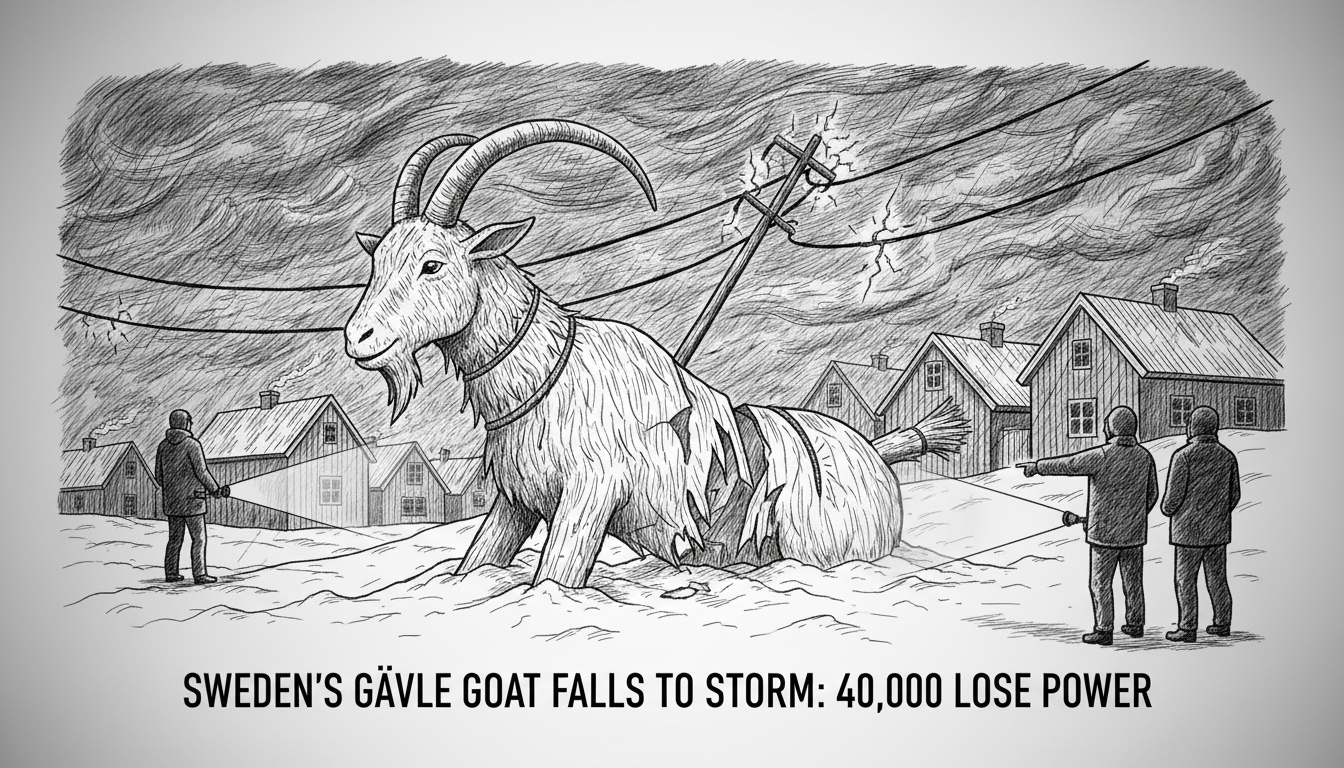
Sweden's iconic Gävle Goat has been toppled, not by festive arsonists, but by a powerful storm. The 13-metre-high straw Christmas symbol met its fate as Storm Johannes slammed into the country, cutting electricity for over 40,000 households and halting rail traffic across multiple regions. The Swedish Meteorological and Hydrological Institute (SMHI) issued its second-highest alert level for vast areas, warning of dangerous winds, snow, and ice.
A Symbolic Fall in Gävle
For residents of Gävle, a coastal city about two hours north of Stockholm, the sight was surreal. The mighty goat, a yuletide fixture since 1966, lay defeated on the slushy ground of Castle Square. Its destruction is normally a source of dark humor and local legend, often the result of a daring pre-Christmas fire. This time, nature itself was the vandal. "It’s a strange feeling," said local shopkeeper Erik Lundström, looking at the fallen figure. "We’re so used to the drama of it being burned. To see it just... knocked over by the wind feels almost disrespectful to tradition. Mother Nature won this round." The goat's demise marks an unusual, non-human-caused chapter in its long, perilous history.
A Nation Braces for Impact
The fallen goat was merely the most photogenic victim of Storm Johannes. From the northern forests of Norrland to the coastal communities along the Bothnian Sea, the storm system unleashed chaos. SMHI's orange warnings—signifying a significant danger to the public—blanketed northern Dalarna, northeastern Svealand, and southern Norrland. Authorities pleaded with people to avoid travel as winds whipped up to storm force, tearing down trees and power lines. In many areas, heavy, wet snow compounded the problems, reducing visibility and creating hazardous driving conditions. The Swedish Transport Administration reported numerous cancelled train departures, stranding passengers and disrupting freight.
The human impact was immediate and widespread. More than 40,000 households found themselves in sudden darkness as the grid faltered under the strain. In a country where winter darkness is profound, a power outage is more than an inconvenience; it's a genuine safety concern. Homeowners reliant on electric heating faced dropping temperatures, while emergency services braced for increased calls.
The Culture of the Julbock
To understand the significance of the Gävle Goat's fall, one must understand the 'Julbock' or Yule Goat in Swedish culture. The tradition predates the popular figure of Jultomten (the Christmas gnome). Historically made of straw, the goat was both a symbol of the harvest and a mischievous gift-giver. The modern Gävle Goat, erected by the local Natural Science Club in 1966, transformed this folk symbol into a massive public spectacle—and an irresistible target. Its repeated destruction, primarily by fire, has become a perverse part of Sweden's Christmas lore, attracting international betting pools and global headlines. Its survival each season is never guaranteed.
"The goat represents a playful, slightly rebellious side of the Swedish Christmas," explains cultural historian Lena Bergström. "The fact that people try to burn it down every year is almost a ritual in itself. It’s about testing boundaries, even in our very orderly society. A storm knocking it over is different. It’s a reminder that for all our engineering and planning, nature is still the ultimate authority, especially in the Nordic winter."
Expert Warnings and Public Response
Meteorologists had been tracking Johannes for days. The combination of a deep low-pressure system and unusually moist air created the conditions for a severe winter storm. "The primary threat is the wind, followed by heavy, accumulating snow and the risk of ice forming on surfaces," a meteorologist from SMHI said in a briefing. "This is a widespread weather event that requires the public to take warnings seriously."
Emergency services echoed the call for caution. In Stockholm, while not under the highest alert, residents in suburbs like Södermalm and Vasastan reported gusty winds shaking balconies. The message from rescue services was unified: stay home if possible, check on vulnerable neighbors, and avoid any unnecessary road trips. The storm’s timing, hitting on a weekend, likely prevented greater disruption to commuters but increased the risk of leisure travelers getting caught out.
Resilience in the Face of the Storm
As crews worked to restore power and clear roads, a familiar Nordic resilience took hold. Communities in affected areas, long accustomed to harsh winter conditions, began their response. The focus shifted from the symbolic loss of a straw goat to the practical needs of safety and warmth. For the 40,000 without electricity, the coming hours would be about generators, candles, and waiting. For the transport authorities, it was a long night of assessing damage to infrastructure.
The Gävle Goat’s fate for this season remains uncertain. Its builders have not yet announced if the structure, now waterlogged and damaged, will be resurrected before Christmas. The cost and effort may be prohibitive. In a typical year, its destruction sparks investigations and even arrests. This time, the culprit is clear, and no police report is needed.
Storm Johannes offers a stark lesson. It reminds Swedes that their relationship with nature is foundational, shaping everything from daily commutes in Stockholm’s T-centralen to century-old traditions in provincial towns. The fallen Gävle Goat is a potent symbol of that dynamic—a reminder that in Scandinavia, nature writes the final script, often with a strong wind and a blanket of snow. As the clean-up begins, one question lingers: in a nation famed for engineering and order, what does it mean when our most chaotic tradition is upstaged by the weather itself?