
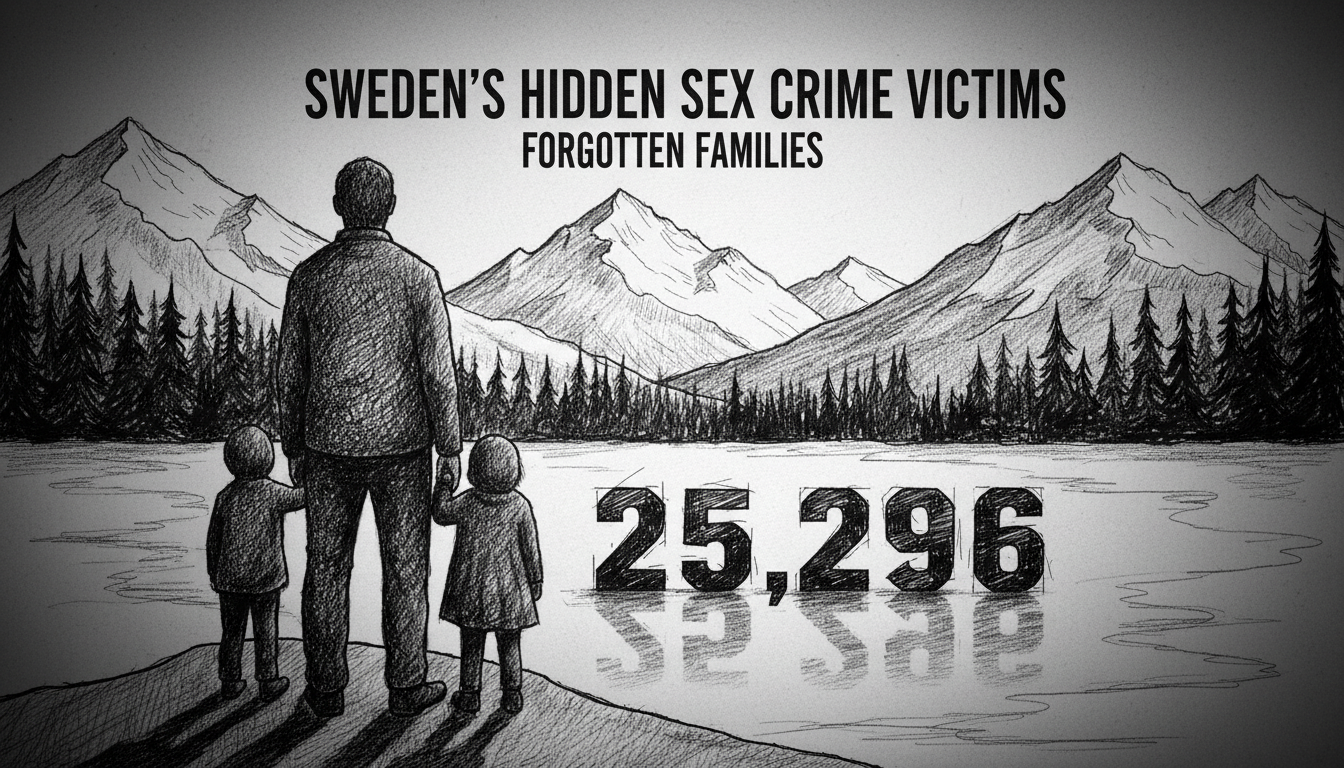
Sweden's sex crime statistics for 2024 reveal 25,296 reported offenses, but behind each number lies a hidden circle of suffering. While victims rightly receive focus, another group endures a silent crisis. They are the families of the perpetrators, left isolated by a system struggling to see their pain. 'Jenny' knows this isolation intimately. Her world shattered when her daughter, while they were abroad years ago, shared recovered memories of childhood abuse. The abuser was Jenny's ex-husband, the children's father. 'It was an incredible shock. I suspected nothing,' Jenny says, her voice heavy with remembered trauma. 'She had a good relationship with her dad. He's the kind of person you'd describe as kind and considerate.' A wave of shame and guilt washed over her. Was the father of her children a sex offender? She and her daughter rushed back to Sweden to file a police report. For Jenny, the journey for her daughter's justice began. Her own journey through shame, guilt, and isolation had just started, with little support in sight.
The Unseen Aftermath
Jenny's story is not unique, but it is largely invisible. In a recent dissertation from Umeå University, Roberth Adebahr, a medical doctor and psychologist at Anova, Karolinska University Hospital, documents the profound suffering of relatives to sex offenders. The feelings of guilt and shame are palpable. 'We have interviewed relatives of people under investigation for child pornography offenses, and we see how difficult it is for them to get support,' Adebahr explains. 'They take on a huge burden of guilt, become isolated and lonely. People don't understand how hard they are hit.' The Swedish welfare system, renowned for its comprehensive support, often fails to reach this group. Resources are stretched, and the specific, complex needs of perpetrators' families frequently fall through the cracks of primary care and general counseling services.
A System Struggling to Respond
Adebahr points to a critical gap in the support network. 'Relatives can call our helpline, Preventell, and we can meet relatives of patients with unwanted or risky sexuality who are getting treatment with us, but it's not enough to meet the need,' he states. The issue is one of both capacity and awareness. 'More knowledge needs to reach both primary care and online psychologists.' For someone like Jenny, who did eventually find some support, the path was unclear and arduous. Many never find it at all. They navigate a whirlwind of conflicting emotions—love for the family member, horror at their actions, loyalty to the victim, and a crushing societal stigma that makes them feel complicit. They grieve for the victim, for their shattered family, and for the person they thought they knew.
The Numbers Behind the Silence
The scale of the issue is underscored by the official statistics. In 2024, 9,633 of the 25,296 reported sexual offenses were rapes. A particularly harrowing figure is that 2,876 rape reports—30 percent—involved children up to 15 years old. Each confirmed case represents a victim whose life is altered forever. But criminology and psychology experts emphasize that each case also ripples outward, affecting parents, siblings, partners, and children of the perpetrator. These individuals become secondary victims, grappling with a trauma that carries its own unique brand of social shame. They are often unsure where to turn, fearing judgment or believing support services are exclusively for the primary victim.
Living in the Shadow of the Act
For Jenny, the aftermath was a private hell of doubt and self-recrimination. 'My daughter told me about the abuse, events from when she was little that she now remembered. About what her dad had done,' Jenny recounts. 'What she said was so clear, I could see she wasn't making it up. He had also told her he would kill her if she ever said anything to anyone.' The betrayal was double: her ex-husband's actions against her child, and her own perceived failure to protect her. This corrosive guilt is a common thread among families of offenders. They replay memories, searching for missed signs, blaming themselves for not seeing the unseen. The isolation is self-imposed and societal; how do you tell a friend your brother, your son, your ex-partner, is accused of such a crime?
A Call for Broader Compassion
The growing call from experts like Adebahr is for a more nuanced understanding of victimhood. Supporting the families of perpetrators is not about diminishing the suffering of primary victims. It is about recognizing that crime creates concentric circles of damage. Providing these families with psychological support can be a critical component of prevention and healing. A supported, less isolated family might be better equipped to encourage a perpetrator to seek help, or to protect potential future victims. It also addresses a significant mental health need in its own right. Stockholm, with its network of clinics and community centers, could pioneer such targeted support, integrating it into existing social services and healthcare.
The Long Road Ahead
Jenny's story highlights the personal cost of this systemic gap. 'It needs to be easier to get help,' she says simply. Her statement is a quiet manifesto for hundreds of others in her situation. As Sweden continues its serious and necessary work to support victims and prevent sexual offenses, a crucial piece of the puzzle remains in the shadows. The challenge is to extend the nation's culture of care to include these hidden casualties. It requires training for healthcare providers, public awareness to reduce stigma, and dedicated resources. Until then, people like Jenny will continue to bear their guilt and shame in silence, a forgotten echo of the 25,296 crimes reported each year. The question for Swedish society is whether its famed safety net can be woven tightly enough to catch them, too.